Mosasaur tails reveal which ancient ocean predators were built for surprise attacks
A Rutgers-led study links mosasaur tail anatomy to sudden lunges, suggesting distinct ambush and pursuit strategies.
 Rutgers University Writer: Kitta MacPherson

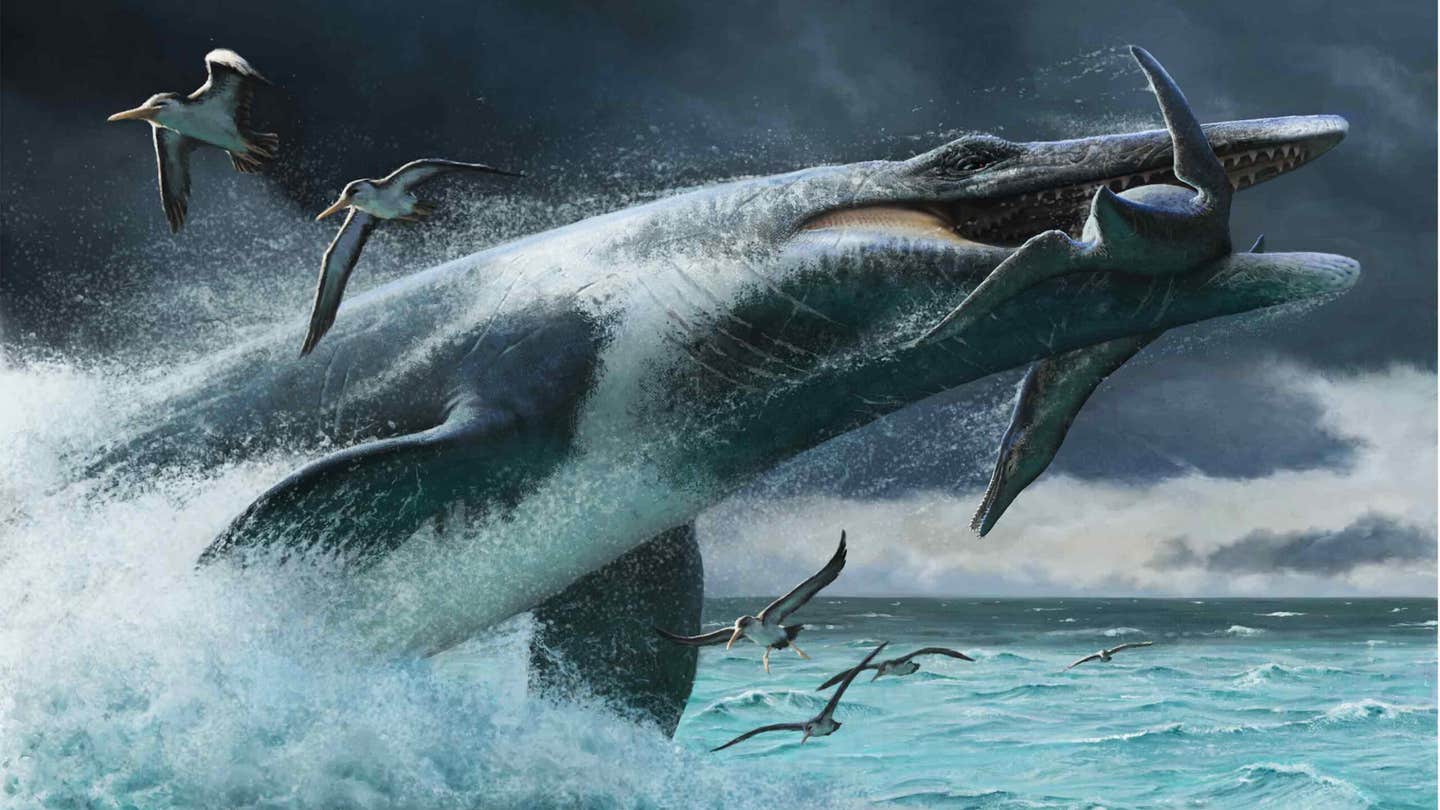
An artist’s depiction of a mosasaur lunging from the water to catch prey. Rutgers-led research suggests tail differences influenced how these ancient marine predators hunted. (CREDIT: Henry Sharpe)
- Fossil-based models suggest Platecarpus and Tylosaurus could launch faster lunges for their body size than Mosasaurus and Plotosaurus.
- A scaled model of a particularly large Tylosaurus reached an estimated 15 mph after one tail stroke under selected conditions.
- The findings support different hunting strategies, but reconstructed muscles and simplified swimming mechanics leave exact speeds uncertain.
A single sweep of its tail could have sent a giant Tylosaurus lunging forward at roughly 15 miles per hour. That modeled burst offers a glimpse of how an enormous marine reptile might have closed the gap on prey.
The estimate comes from a Rutgers University-led biomechanical study published in Current Biology. Kiersten Formoso, an assistant professor in the Department of Ecology, Evolution, and Natural Resources, led the research. Her team used reconstructed skeletons and physics to compare sudden acceleration in four kinds of mosasaurs.
The analysis suggests that different tail proportions favored different hunting strategies. Platecarpus and Tylosaurus consistently outperformed Mosasaurus and Plotosaurus in lunges relative to body size. Those differences were more reliable than the calculated speeds themselves, which depend on assumptions about muscles and movement.
A tail stroke built for a sudden launch
Mosasaurs were ocean-adapted lizards that became major predators in Late Cretaceous seas. Although they lived alongside dinosaurs, their evolutionary history belonged to a different reptile group. Their swimming bodies carried flippers and tails adapted to propulsion through water.
Earlier research mainly examined cruising, in which repeated tail movements maintain forward motion. Formoso focused instead on the first powerful stroke from near standstill. Such acceleration could matter when seizing prey, escaping predators or avoiding an approaching threat.
The team called its modeled maneuver a “slam-start.” An animal bends its tail to one side, then sweeps it back against the surrounding water. That push accelerates the body before sustained swimming takes over.
Formoso compared the initial surge to a swimmer pushing away from a pool wall. “It’s the tail itself pushing off the water,” she said. The analogy captures the launching action, although the model calculates forces acting on an animal moving through water.
The resulting velocities describe a brief lunge following one tail stroke. They are neither measurements of living animals nor estimates of sustained cruising speed. They also do not establish the fastest speed a mosasaur could ever reach.
Rebuilding motion from preserved bones
The four principal reconstructions represented Platecarpus tympaniticus, Tylosaurus proriger, Plotosaurus bennisoni and an unidentified species of Mosasaurus. Their fossils provided information about body proportions and tail anatomy. Reconstructing the missing muscles required comparisons with living lizards, including Komodo dragons.
The researchers concentrated on the section of the tail responsible for most of its sideways sweep. This region is proportionally longer in Platecarpus and Tylosaurus than in the other two animals. Its dimensions help determine how far the tail can bend and push against water.
Rather than assigning one supposedly definitive swimming speed, the team tested multiple combinations of conditions. Tail curl ranged from 60 to 120 degrees. Assumed muscle power ranged from 200 to 800 watts per kilogram, alongside three estimates of resistance from the water.
Those combinations produced 27 modeled conditions for each main reconstruction, or 108 across the four animals. Applying the same assumptions to every reconstruction made the comparisons more consistent. Results were expressed in body lengths per second to account for differences in size.
Increased muscle power and greater tail curl raised predicted lunge speed. Higher drag reduced it, but did not reverse the relative performance pattern. Across the tested conditions, Platecarpus ranked first, followed by Tylosaurus, Mosasaurus and Plotosaurus.
Flexibility mattered more than water resistance
Tail curl was the strongest driver of modeled performance. Increasing it from 60 to 120 degrees raised average lunge velocity by 139% to 165% across the animals. That effect was much larger than the reductions associated with increasing drag.
Even a more than sixfold rise in the modeled drag coefficient reduced mean speed by only about 4% to 17%. The size of that reduction differed among the reconstructions. The results suggest that the ability to sweep the tail through a larger arc strongly influenced launching performance.
The researchers also scaled two reconstructions to represent exceptionally large individuals. One used the skull length of a Tylosaurus specimen nicknamed “Bunker.” The other used a Mosasaurus fossil held by the New Jersey State Museum in Trenton.
These were enlarged versions of baseline body shapes, rather than independent reconstructions of the large fossils. Under the team’s selected upper-end conditions, the Bunker-sized model reached 6.66 meters per second. That is approximately 15 mph, or 24 kilometers per hour.
The calculation assumed 120 degrees of tail curl, muscle power of 500 watts per kilogram and the highest tested drag coefficient. At that velocity, the animal would cover nearly half its body length in one second. Larger models achieved higher speeds in meters per second, but lower speeds relative to their length.
Ambush hunters and open-water pursuers
Faster initial acceleration would favor predators launching surprise attacks in shallow marine environments. The team interprets the stronger modeled lunges of Platecarpus and Tylosaurus as support for ambush hunting. Their longer tail-sweeping regions offered a mechanical advantage in that particular maneuver.
The lower burst ranking of Plotosaurus does not mean it was an ineffective swimmer. Its more specialized tail appears better suited to repeated movements during sustained pursuit. The researchers compare that style with modern open-water swimmers such as tuna, billfish and certain sharks.
Mosasaurus also showed lower body-size-normalized lunge performance than the two faster-launching forms. The findings support broader differences between the two major mosasaur branches represented in the study. However, four reconstructions cannot capture every species or every behavior within those groups.
Other investigations provide separate clues to feeding strategies through bite mechanics, microscopic tooth wear and fossil chemistry. The modeled swimming differences broadly agree with that evidence. Agreement among different methods strengthens the ecological interpretation without turning inferred hunting behavior into direct observation.
Useful comparisons despite uncertain speeds
The calculations simplify several features of real swimming. They use constant drag coefficients, estimated muscle power and a stiff, flat, plate-like representation of the tail. More complex body bending was also excluded from the modeled movement.
Those choices leave absolute velocities uncertain, even when the predicted values appear biologically plausible. Relative comparisons remain the study’s main contribution because every animal faced the same modeled conditions. The consistent ranking shows how preserved differences in anatomy can inform questions about ancient performance.
The authors describe the work as the first quantitative estimate of burst locomotion in a Mesozoic marine reptile. They have made their modeling tools available for researchers studying additional extinct swimmers. Extending the method to more fossils could test how widely these contrasting hunting strategies applied across ancient seas.
Dig deeper into mosasaur movement and feeding
These studies explore tail reconstruction, aquatic adaptation and the fossil evidence for ancient marine food webs.
Convergence in aquatic locomotion: reconstructing mosasaurian (Squamata: Mosasauria) tail fins from osteological correlates and covariation with extant sharks: Develops a method for predicting mosasaur tail-fin shapes using preserved anatomy and comparisons with living sharks. (Paleobiology, 2026)
Mosasaur Feeding Ecology from the Campanian Bearpaw Formation, Alberta, Canada: A Preliminary Multi-Proxy Approach: Combines tooth wear and geochemical evidence to investigate feeding roles in a Late Cretaceous marine ecosystem. (Diversity, 2025)
Three-dimensional dental microwear in type-Maastrichtian mosasaur teeth (Reptilia, Squamata): Uses microscopic tooth-surface textures to evaluate diets and overlap among mosasaur feeding niches. (Scientific Reports, 2023)
Soft tissue preservation in a fossil marine lizard with a bilobed tail fin: Documents preserved tail-fin and flipper outlines that clarify how derived mosasaurs propelled themselves. (Nature Communications, 2013)
Convergent Evolution in Aquatic Tetrapods: Insights from an Exceptional Fossil Mosasaur: Examines an unusually complete Platecarpus fossil, revealing evidence for a streamlined body and specialized tail. (PLOS ONE, 2010)
Research findings are available online in the journal Current Biology.
The original story "Mosasaur tails reveal which ancient ocean predators were built for surprise attacks" is published in The Brighter Side of News.
Related Stories
- Ancient crocodile-like predators rewrite current knowledge of how animals adapted to the land
- This giant predator is literally the T. rex of the sea
- Giant octopuses were the ocean's apex predators 100 million years ago
Like these kind of feel good stories? Get The Brighter Side of News' newsletter.
Joseph Shavit
Writer, Editor-At-Large and Publisher
Joseph Shavit, based in Los Angeles, is a seasoned science journalist, editor and co-founder of The Brighter Side of News, where he transforms complex discoveries into clear, engaging stories for general readers. With vast experience at major media companies like The Los Angeles Times, Times Mirror and Tribune Publishing, he writes with both authority and curiosity. His writing focuses on space science, planetary science, quantum mechanics, geology. Known for linking breakthroughs to real-world markets, he highlights how research transitions into products and industries that shape daily life.