
Astronomers discover a giant volcano on Mars that may hide the remnants of an ice glacier
Noctis volcano offers clues to Mars’ volcanic and glacial history, but surviving ice and present activity remain unconfirmed.

 Editor: Joshua Shavit

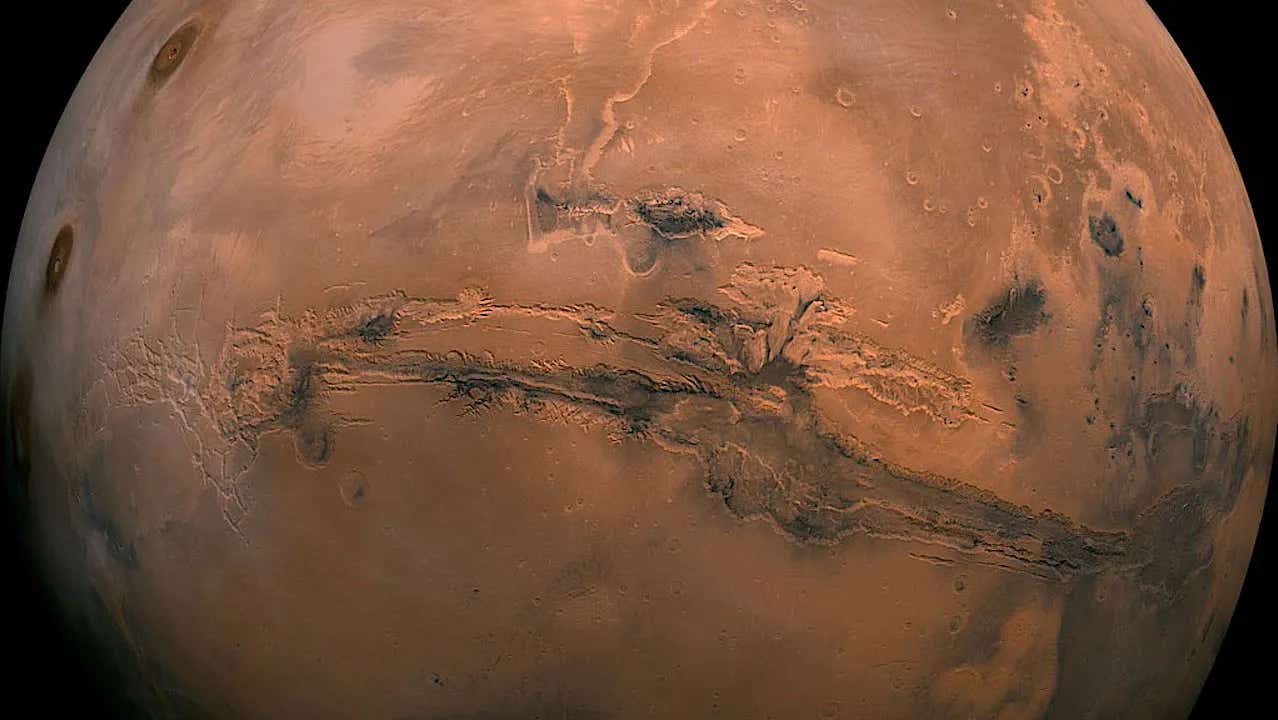
Orbital evidence points to an eroded volcano near Mars’ equator, where buried glacier ice may survive beneath volcanic deposits. (CREDIT: NASA)
- Orbital observations suggest that a deeply eroded region near Mars’ equator contains the remains of a giant volcanic complex.
- Landforms and sulfate deposits point to past interactions between volcanic material and ice, but surviving buried glacier ice remains unconfirmed.
- Follow-up research and a proposed helicopter mission highlight the region’s scientific appeal without establishing present volcanic activity or a usable water reserve.
A maze of fractured plateaus and canyons near Mars’ equator may preserve the remains of an enormous volcano. Within that landscape, scientists have also identified clues that glacier ice could survive beneath volcanic debris. Together, the observations make eastern Noctis Labyrinthus a compelling target for investigating the planet’s changing environment.
Pascal Lee of the SETI Institute and Mars Institute, along with Sourabh Shubham of the University of Maryland, proposed the interpretation in a Lunar and Planetary Science Conference abstract. They identified an eroded volcanic complex tentatively named Noctis Mons, also called “Noctis volcano” in the public announcement.
The proposal concerns terrain already photographed by generations of spacecraft. Its significance lies in recognizing a possible geological structure within that familiar landscape, rather than discovering an unseen mountain. The volcano’s history and the present condition of any buried ice remain open questions.
Recognizing a volcano inside a broken landscape
The proposed complex lies between Noctis Labyrinthus and the immense Valles Marineris canyon system. This region sits along the eastern side of Tharsis, the broad volcanic rise containing several of Mars’ largest volcanoes. Deep fracturing and erosion obscure the shape of the suspected edifice.
“We were examining the geology of an area where we had found the remains of a glacier last year when we realized we were inside a huge and deeply eroded volcano,” Lee said. The glacier interpretation had been presented in 2023.
The team identified elevated mesas arranged in an arc, with slopes extending outward from a central high. Terraced depressions near the summit were interpreted as remnants of calderas, formed through volcanic collapse. Dark flow features and deposits associated with volcanic activity added to the case.
The analysis combined detailed orbital images, elevation measurements and mineral spectra. Important datasets came from Mars Reconnaissance Orbiter’s HiRISE camera and CRISM spectrometer, alongside the Mars Global Surveyor laser altimeter. Together, these observations connect the region’s large-scale shape with clues preserved in individual rock deposits.
Understanding the different measurements
Descriptions of the complex give two widths that refer to different mapped zones. The 2024 conference abstract describes an approximately 250-kilometer-wide shield volcano complex. The accompanying release distinguishes that inner region of high-standing remains from a broader, roughly 450-kilometer-wide outer zone.
Those figures describe interpreted boundaries within a heavily modified landscape. They should not be treated as interchangeable measurements of an intact volcanic cone. Deciding which remnants belong to the original structure is part of reconstructing its history.
The highest surviving terrain reaches approximately 9,000 meters above Mars’ reference elevation. The original abstract gives 9,028 meters, while the release gives 9,022 meters. Neither figure means that the volcano rises nine kilometers above its immediate surroundings.
A shield-volcano interpretation also does not imply a steep, pointed mountain. Such edifices can have broad, gently sloping profiles. Here, the researchers propose that faulting, collapse and erosion have dismantled much of the original structure, leaving its architecture to be inferred from scattered remnants.
Why the glacier evidence requires careful wording
The possible ice reserve is inferred from surface geology. In 2023, Lee, Shubham and John Schutt described a light-toned deposit with features resembling glacial crevasses, flow structures and moraine bands. They interpreted it as the preserved form of a former glacier.
Crucially, the spectrometer detected hydrated and hydroxylated sulfates, rather than exposed water ice at that deposit. The original report allowed two possibilities: the ice had disappeared, leaving a mineral veneer preserving its shape, or some remained beneath protective material. A relict glacier therefore does not automatically mean an intact glacier survives today.
The 2024 investigation added fields of low, blister-like mounds. The team interprets them as rootless cones, features that can develop when hot volcanic material encounters wet or icy ground. Steam generated at that contact can swell or rupture the overlying deposit.
Light-toned sulfate material exposed within some breached mounds strengthens the proposed connection between volcanic deposits and water. Jarosite, a sulfate associated with acidic conditions, is particularly relevant to the interpretation. These observations support investigating past volcano-water interactions, while falling short of directly detecting a continuous present-day ice sheet.
A long history of heat, water and collapse
The proposed reconstruction involves repeated volcanic deposition and glaciation. Lava, fragmented volcanic material and ice may have accumulated in layers over time. Later fractures could have allowed heat to reach buried ice, contributing to erosion and collapse.
This remains a geological scenario assembled from surviving landforms and minerals. It does not establish a complete eruption chronology. Relatively fresh-looking deposits can indicate younger activity compared with surrounding terrain without demonstrating eruptions in human history or an active volcano today.
Follow-up mineralogical work presented at the Tenth International Conference on Mars in 2024 examined that complexity further. Shubham and Lee reported several volcanic minerals alongside sulfates, clays and hydrated silica. They interpreted the variety as evidence for prolonged activity and changing environmental conditions.
Their report also noted ambiguities in linking particular minerals to particular periods. Different compositions might reflect changing magma sources, local chemical differences or older material redistributed across the landscape. That uncertainty makes careful mapping and eventual sampling valuable for testing the proposed sequence.
An exploration target, with ice still to verify
The combination of exposed geological layers and possible water makes the region attractive for future missions. If shallow ice survives, it could matter for scientific sampling and resource planning. Its amount, depth, accessibility and purity would still need to be established before treating it as a dependable supply.
In a 2025 conference abstract, Lee and colleagues outlined Nighthawk, a robotic helicopter mission concept for eastern Noctis Labyrinthus. The proposed payload includes cameras, a near-infrared spectrometer and a neutron detector. These instruments would investigate terrain, composition and near-surface hydrogen, helping test interpretations made from orbit.
Nighthawk is presented as a concept, rather than an approved mission with a launch date. Its objectives include examining the suspected glacier remains, volcanic deposits and environments relevant to the search for life. Neither mineral diversity nor past interaction between heat and water establishes that organisms lived there.
For now, Noctis offers several testable questions within one complex landscape. Establishing the volcanic structure, dating its deposits and determining whether ice remains could reveal how this equatorial region evolved. The scientific opportunity comes from that combination of accessible geological history and important uncertainties still awaiting direct investigation.
Dig deeper into Noctis volcano and possible equatorial ice
These resources trace the glacier interpretation, follow-up geology and proposed ways to investigate the region.
A Relict Glacier Near Mars’ Equator: Evidence for Recent Glaciation and Volcanism in Eastern Noctis Labyrinthus: Introduces the glacier-like landforms and explicitly considers both surviving buried ice and complete ice loss. (Lunar and Planetary Science Conference abstract, 2023)
Noctis Volcano: Mineralogic Evidence for Protracted Volcanism and Volcano-H₂O Interactions: Examines volcanic and alteration minerals, including uncertainties in interpreting the region’s history. (Tenth International Conference on Mars abstract, 2024)
Mapping of Western Valles Marineris Light-Toned Layered Deposits and Newly Classified Rim Deposits: Investigates nearby layered deposits and discusses the proposed volcano as a possible source of volcanic material. (Journal of Geophysical Research: Planets, 2024)
Nighthawk: A Mars Chopper Mission to Explore Noctis Labyrinthus’ Giant Volcano, Canyons, Relict Glacier, H₂O Evolution, and Potential for Life & Human Exploration: Outlines a helicopter mission concept and instruments that could test geological and resource-related questions. (Lunar and Planetary Science Conference abstract, 2025)
Geophysical Investigation of Noctis Volcano on (equatorial) Mars using MOLA, MARSIS, and Numerical Plume Modelling: Explores the proposed structure using orbital observations and geophysical modeling in a master’s thesis. (University of Nantes thesis, 2025)
Research findings are available online in the Lunar and Planetary Science Conference abstract.
The original story "Astronomers discover a giant volcano on Mars that may hide the remnants of an ice glacier" is published in The Brighter Side of News.
Related Stories
- Mars’s longest morning cloud may form ice without dust
- Why Mars became a desert while Earth stayed alive
- Martian dust storms crackle with 'mini lightning,' revealing a hidden electric Mars
Like these kind of feel good stories? Get The Brighter Side of News' newsletter.
Joseph Shavit
Writer, Editor-At-Large and Publisher
Joseph Shavit, based in Los Angeles, is a seasoned science journalist, editor and co-founder of The Brighter Side of News, where he transforms complex discoveries into clear, engaging stories for general readers. With vast experience at major media companies like The Los Angeles Times, Times Mirror and Tribune Publishing, he writes with both authority and curiosity. His writing focuses on space science, planetary science, quantum mechanics, geology. Known for linking breakthroughs to real-world markets, he highlights how research transitions into products and industries that shape daily life.