Laser light reveals the hidden quantum properties of crystals
An ultrafast optical experiment measures a hidden electronic property that helps shape how crystals respond to light.
 University of Jena Writer: Ute Schönfelder

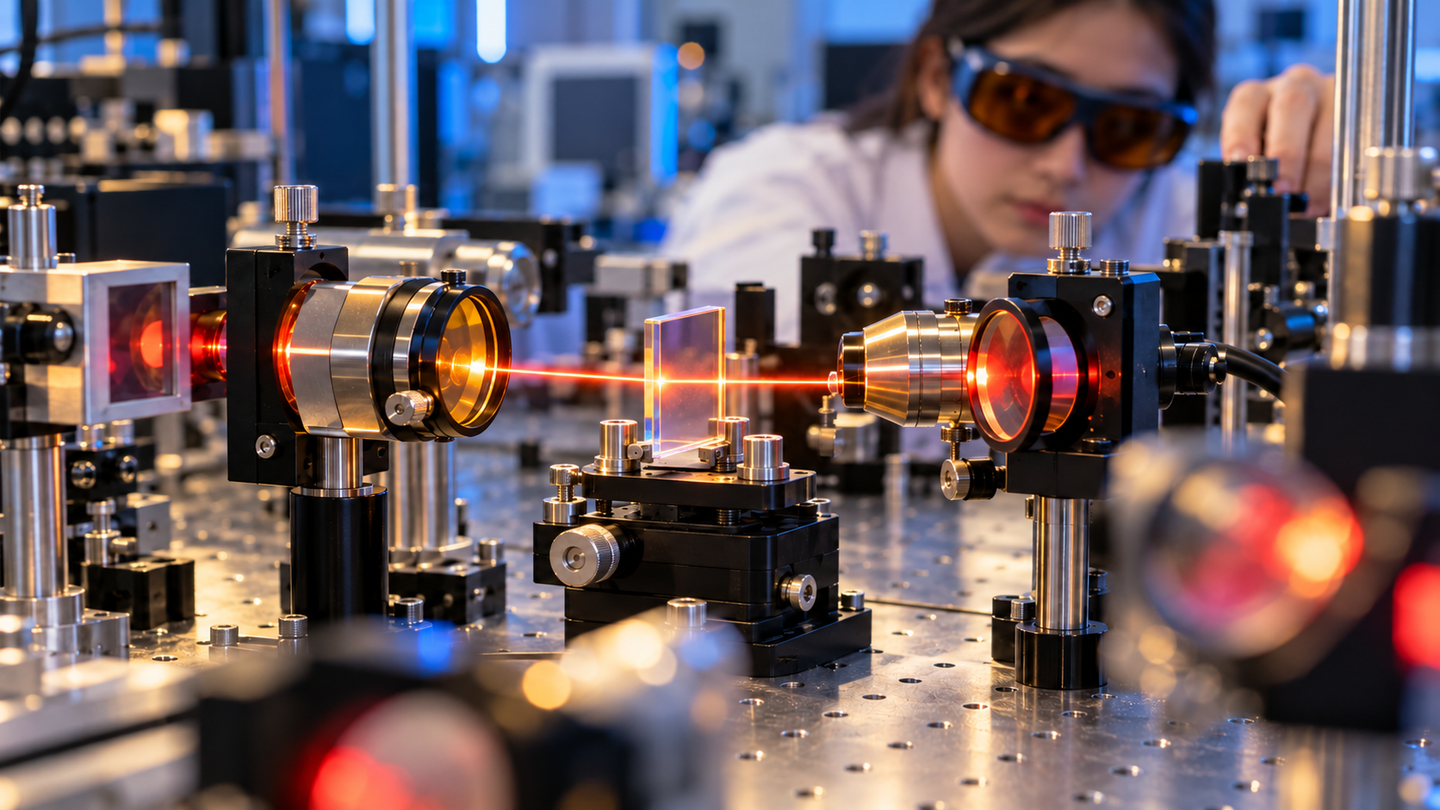
Two laser pulses and an analytical model reveal local Berry curvature in an atomically thin semiconductor. (CREDIT: The Brighter Side of News)
- Two ultrashort laser pulses revealed a difficult-to-measure quantum property in an atomically thin semiconductor.
- Combining optical measurements with an analytical model yielded a local Berry curvature consistent with theoretical calculations.
- The approach could help track rapid changes in electronic quantum states, although broader applications require further testing.
A crystal can send electrons sideways even without an external magnetic field. Behind that unexpected motion lies Berry curvature, a geometric property of electronic quantum states. Measuring it experimentally, however, has remained considerably harder than calculating it.
A collaboration between the universities of Jena and Regensburg has demonstrated an optical approach to that problem. In Nature Photonics, the team describes how ultrashort laser pulses and an analytical model revealed local Berry curvature in tungsten diselenide.
The experiment examined a semiconductor layer less than one nanometer thick. Its response to light provided a quantitative estimate that agreed with theoretical predictions. The method also operated on a timescale of a few hundred femtoseconds, offering a route toward following exceptionally fast electronic changes.
Geometry inside an electron’s quantum state
Electrons inside crystals do not behave like miniature balls following predetermined tracks. Their behavior depends on quantum states shaped by the material’s electronic structure. Quantum geometry describes relationships between those states and how they change.
Berry curvature is one part of that geometry. It can influence the direction electrons move under an electric field and how a material interacts with light. These effects connect an abstract mathematical quantity to measurable electrical and optical behavior.
Earlier work connected Berry curvature with optical behavior and explored techniques based on emitted electrons. The challenge here was more specific: finding an analytical relationship that could turn an accessible optical response into a numerical estimate. That relationship makes the experiment useful beyond simply detecting that a material responds differently to different polarizations of light.
The curvature does not describe a physical bend in the crystal. Instead, it concerns electronic states in momentum space, the framework physicists use to describe electron motion. Measuring it helps explain responses that ordinary pictures of particle movement cannot capture.
“We wanted to make a quantum property accessible that has so far been difficult to determine experimentally,” said lead author Nele Tornow. She works at Jena’s Institute of Solid State Physics. The team’s solution combined an optical experiment with a model connecting the observed light to the underlying electronic property.
Two pulses with different jobs
Tungsten diselenide belongs to a family of materials that interact strongly with light when reduced to a single layer. That makes it useful for nonlinear optics, where the emitted light does not simply reproduce the incoming signal. Here, the important response was second-harmonic generation.
In that process, the material produces light at twice the incoming light’s frequency. Its wavelength is therefore half as long. The researchers examined the polarization of this generated light, meaning the pattern in which its electric field oscillates.
The first pulse, called the pump, temporarily modified the material’s electronic energy levels. It was circularly polarized, with an electric field that rotates as the light travels. The second pulse, a linearly polarized probe, generated the second-harmonic signal used for measurement.
Both pulses were in the near-infrared range. For representative measurements, the pump wavelength was 1,800 nanometers and the probe wavelength was 1,460 nanometers. Changing their timing allowed the researchers to separate the brief, light-induced response from the material’s behavior outside that interval.
Making opposite electronic valleys distinguishable
The experiment relied on two electronic regions called valleys, located at opposite momenta and labeled +K and −K. These are features of the electronic energy landscape, rather than hollows in the material. Their Berry curvatures have opposite signs under the relevant equilibrium symmetry.
Without the pump, their optical contributions balance so the measured difference between opposite circular polarizations vanishes. The circularly polarized pump temporarily shifts the valley energy levels differently. Those shifts arise through coherent interactions known as the optical Stark and Bloch–Siegert effects.
That imbalance changes the polarization of the generated second-harmonic light. The team measured the difference between its left- and right-circularly polarized components. This difference, called second-harmonic circular dichroism, supplied the experimental signal for the model.
Reversing the pump’s rotation reversed the signal’s sign, as the model predicted. Increasing pump intensity also changed the response in the expected way. These checks helped connect the optical measurement to the valley-dependent energy shifts, rather than treating any polarization change as sufficient evidence.
Turning the optical response into a number
The analytical model connected the measured signal to Berry curvature near the optical resonances being probed. Fitting the wavelength-dependent measurements gave a curvature magnitude of 6.2 ± 1.4 square ångströms. That estimate agreed with previously reported tight-binding and density functional theory calculations.
The units do not mean the team photographed a patch of an electron’s orbit. They arise from how Berry curvature is defined in momentum space. The result concerns the local electronic states accessible through the optical experiment.
The fit had two adjustable parameters: Berry curvature and the optical resonance’s dephasing time. Other inputs were measured experimentally and held fixed. This makes the result a quantitative extraction supported by a model, rather than a direct image independent of theoretical assumptions.
The time-dependent signal had a measured width of 313 ± 40 femtoseconds, limited by the laser pulses. A femtosecond is one millionth of a billionth of a second. This demonstrates an ultrafast optical response, although the experiment did not reconstruct every aspect of the material’s changing quantum geometry.
A possible tool for watching rapid changes
“Using this optical method, we can investigate such properties on extremely short time scales,” said Giancarlo Soavi. He works at Jena’s Institute of Solid State Physics and Abbe Centre of Photonics. The longer-term goal is to track how quantum geometry changes during rapid processes.
The approach could extend beyond tungsten diselenide, but applying it elsewhere will require suitable optical transitions and material-specific analysis. Crystal symmetry also determines which harmonic signals can occur. The demonstration therefore establishes a measurement strategy, rather than a universal test for every solid.
Its scope is also narrower than a complete map of quantum geometry. The experiment estimates Berry curvature near selected resonant states, not across every electronic momentum. It does not measure the entire quantum geometric tensor, which contains additional information.
Future work could use this optical access to investigate valley-based electronics and other fast light-driven phenomena. Practical devices remain a prospect, not an outcome demonstrated here. For now, the advance is a measurable connection between emitted light and an elusive property governing electrons inside a crystal.
Dig deeper into Berry curvature and quantum geometry
These resources explain the foundations of geometric quantum effects and approaches to investigating them in materials.
Quantal phase factors accompanying adiabatic changes: Michael Berry’s foundational paper introduces the geometric phase underlying the field. (Proceedings of the Royal Society of London A, 1984)
Berry phase effects on electronic properties: Reviews how geometric quantum effects influence electron motion, polarization and magnetism in solids. (Reviews of Modern Physics, 2010)
Coupled spin and valley physics in monolayers of MoS₂ and other group-VI dichalcogenides: Explains the relationship between spin, electronic valleys and optical control in atomically thin semiconductors. (Physical Review Letters, 2012)
Local Berry curvature signatures in dichroic angle-resolved photoelectron spectroscopy from two-dimensional materials: Investigates how photoemission measurements could reveal signatures of local Berry curvature. (Science Advances, 2020)
Essay: Where Can Quantum Geometry Lead Us?: Discusses quantum geometry’s wider significance and the need for experimental tests of its effects. (Physical Review Letters, 2023)
Research findings are available online in the journal Nature Photonics.
The original story "Laser light reveals the hidden quantum properties of crystals" is published in The Brighter Side of News.
Related Stories
- Light-powered neural network could transform future quantum communications
- Physicists use 3D light pulses to unlock new electron quantum states
- Scientists propose a light-matter quantum state inside living cells
Like these kind of feel good stories? Get The Brighter Side of News' newsletter.
Shy Cohen
Writer