
Your cat may be doing more for your emotional well-being than you realize
Cats and owners showed linked hormone patterns, while closer everyday proximity was associated with greater vigor and activity.
 Kyoto University Writer: Whitney Hubbell

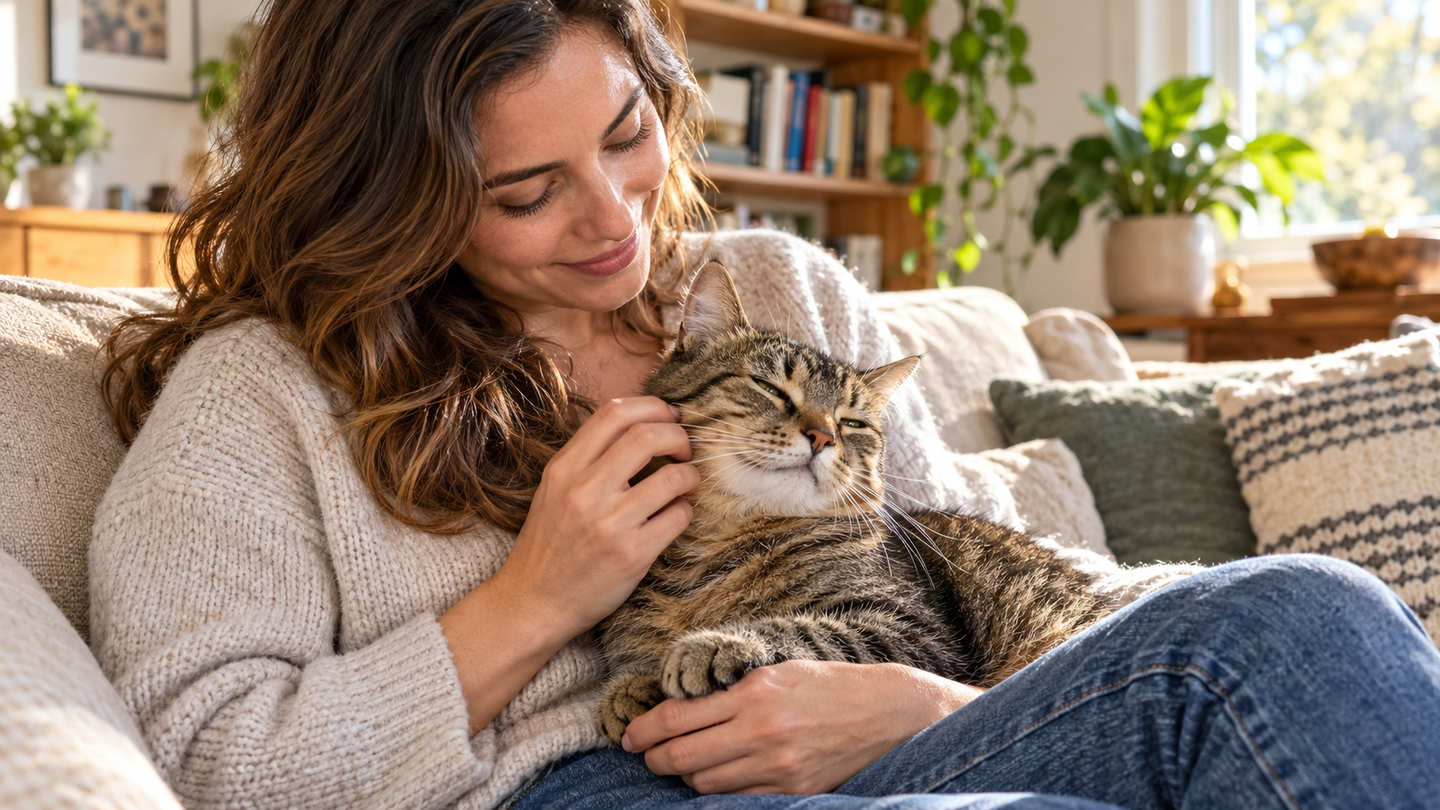
A small study links cat-owner proximity to greater vitality and finds shared oxytocin patterns, without proving cause and effect. (CREDIT: Shutterstock)
- A small Japanese study found correlated urinary oxytocin levels in cats and their owners, alongside links with owner stress and mood.
- Closer everyday proximity was associated specifically with higher vigor and activity scores, rather than better scores across every mood measure.
- The observational findings do not show that cats caused improved mental health or establish how much time owners should spend with them.
A cat settling beside its owner may be part of a relationship that reaches beyond companionship. A small study of Japanese households found links between feline and human hormone levels, while closer everyday proximity was associated with owners feeling more vigorous and active.
The research, published in iScience, examined 29 cats and 19 owners over one month. Saho Takagi of Kyoto University worked with Taisuke Tsubomura, Miho Nagasawa and Takefumi Kikusui. The team investigated whether everyday relationships could help explain why studies of cat ownership and human wellbeing have produced inconsistent findings.
The results suggest that cats and owners share measurable physiological patterns. However, the study cannot establish whether cats improve their owners’ moods, happier owners interact differently with cats, or shared household conditions influence both.
Looking beyond whether someone owns a cat
Many owners describe their cats as sources of comfort, but research has not produced a uniform account of the health effects. Some studies report benefits, while others find weak, mixed or negative associations. Ownership alone may therefore capture too little about what happens between people and their animals.
The team focused on oxytocin and cortisol. Oxytocin participates in social bonding and other biological processes, while cortisol helps regulate the body’s stress response. Neither hormone is a simple readout of affection, happiness or relationship quality.
Researchers recruited volunteers through flyers and social media, then combined urine sampling, a mood questionnaire, proximity monitoring and behavioral observations. Sixteen of the 19 owners were women, limiting how broadly the findings can be generalized. Several owners contributed more than one cat, which also complicated the analysis.
For hormone comparisons, complete data were available from 24 cats belonging to 17 owners. Each individual’s hormone concentrations were averaged across three urine samples collected during the month. These averages offered a picture of associated physiological states, rather than moment-by-moment changes during individual interactions.
The clearest hormonal connection involved oxytocin
Owners with higher urinary oxytocin tended to have cats with higher urinary oxytocin. Higher cortisol in owners, meanwhile, was associated with lower oxytocin in their cats. These relationships were supported by the study’s statistical models, although their direction remains unknown.
The researchers did not find equally clear evidence that owner and cat cortisol levels tracked one another. Cat cortisol also showed no supported association with the owners’ mood scores. That distinction matters because the results do not demonstrate that the partners mirrored each other’s stress responses.
The paper describes its findings as cross-sectional associations, even though sampling took place over a month. Researchers compared aggregated measurements across individuals, rather than measuring whether a change in one partner reliably preceded a change in the other. The design therefore cannot demonstrate a hormonal feedback loop.
“Our findings suggest that this feeling may be partly reflected in the hormonal connection between cats and their owners,” Takagi said. She was referring to the comfort owners often describe during affectionate encounters. The study offers a possible biological connection, rather than proof of the mechanism behind that experience.
A cat’s hormones were linked to owner mood
Owners completed the Profile of Mood States questionnaire, which measures dimensions including tension, fatigue, confusion and vigor. Higher owner cortisol was consistently associated with several negative mood scores. It was also associated with lower vigor and activity.
Cats’ oxytocin levels initially showed associations with a wider range of owner mood dimensions than owners’ own oxytocin did. Higher feline oxytocin was linked with lower anger, confusion, depression-dejection, tension-anxiety and overall mood disturbance. Those questionnaire labels describe reported feelings, rather than clinical diagnoses.
However, some owners shared their homes with multiple study cats. Counting each cat-owner pair can effectively repeat the same person’s mood score, making observations less independent. The researchers therefore checked the findings again using household-level summaries.
In those checks, the associations between feline oxytocin and owner confusion and tension-anxiety remained supported. Other feline-oxytocin mood associations became less certain. This narrower result strengthens the need for replication before treating a cat’s hormone level as a reliable indicator of its owner’s wellbeing.
Closeness mattered, but time together was not measured
Small Bluetooth Low Energy beacons on the cats’ collars communicated with receiving smartphones. Signal strength provided an objective indicator of relative proximity during detected contact. This approach reduced reliance on owners remembering or estimating how closely they interacted with their cats.
Closer proximity was associated with higher vigor and activity scores, including in the household-level analysis. The other mood dimensions did not show similarly supported proximity associations. The finding therefore concerns one positive aspect of mood, rather than a general improvement across all measures.
Importantly, the devices did not establish total minutes spent together. Smartphone recording operated while owners were home, but the researchers lacked verified records of when recording started and stopped. They summarized the month’s signal strength during detected contact instead of calculating the duration or proportion of close contact.
The number of years owners had lived with their cats also failed to show a robust relationship with mood. Some initial associations linked longer cohabitation with more negative scores, but those did not survive household-level checks. The study therefore does not establish that longer ownership either improves or worsens wellbeing.
Social behavior offers clues for future research
The researchers also observed cats near their owners and unfamiliar people in a secure-base test. Cats with higher oxytocin were more likely to approach the designated area around a person. That relationship did not depend clearly on whether the person was their owner or a stranger.
This pattern could reflect general social motivation rather than owner-specific attachment. It did not show that higher-oxytocin cats stayed near people longer once they approached. Evidence connecting feline cortisol with stranger avoidance was also uncertain.
Those distinctions could help future studies separate general sociability from the unique effects of interaction with a familiar caregiver. Repeated observations could reveal whether the same cats respond consistently across different people and settings.
Several shared influences remain possible, including household noise, routines, temperature and crowding. The researchers did not fully document other caregivers or household composition. Hormone sampling schedules also differed: owners supplied first-morning urine, while cat samples were collected when available.
The exploratory study was not preregistered, and mood was measured only once. Larger studies with repeated, synchronized measurements could test whether particular interactions predict subsequent changes in both partners. For now, the findings support investigating the relationship itself, while leaving its causes and health consequences open.
Dig deeper into cat-human relationships
These studies explore feline attachment, communication and the physiological effects of interactions with people.
Attachment bonds between domestic cats and humans: Reports distinct attachment patterns toward human caregivers using behavioral criteria adapted from attachment research. (Current Biology, 2019)
The role of cat eye narrowing movements in cat–human communication: Investigates slow blinking as a form of communication between cats and people. (Scientific Reports, 2020)
Effects of Interactions with Cats in Domestic Environment on the Psychological and Physiological State of Their Owners: Associations among Cortisol, Oxytocin, Heart Rate Variability, and Emotions: Examines owners’ short-term physiological and emotional responses during interactions with their cats at home. (Animals, 2023)
Exogenous oxytocin increases gaze to humans in male cats: Tests how experimentally administered oxytocin affects feline behavior toward people, with effects differing by sex. (Scientific Reports, 2024)
The hormonal effects of owner-cat interactions on pet cats of different potential attachment styles: Examines how interaction type and potential attachment style relate to feline cortisol and oxytocin responses. (Journal of Feline Medicine and Surgery, 2026)
Research findings are available online in the journal iScience.
The original story "Your cat may be doing more for your emotional well-being than you realize" is published in The Brighter Side of News.
Related Stories
- Dogs act more like toddlers than cats when someone needs help
- Cats with dementia reveal new clues about Alzheimer’s disease in humans
- Do pet owners love their dogs or cats more?
Like these kind of feel good stories? Get The Brighter Side of News' newsletter.
Hannah Shavit-Weiner
Medical & Health Writer
Hannah Shavit-Weiner is a Los Angeles–based medical and health journalist for The Brighter Side of News, an online publication focused on uplifting, transformative stories from around the globe. Having published articles on AOL.com, MSN and Yahoo News, Hannah covers a broad spectrum of topics—from medical breakthroughs and health information to animal science. With a talent for making complex science clear and compelling, she connects readers to the advancements shaping a brighter, more hopeful future.