Astronomers discover faint dwarf galaxy that seems to exist without dark matter
DF9 may be the third galaxy in a narrow cosmic trail whose mass can be explained by stars alone, not dark matter.

 Edited By: Joshua Shavit

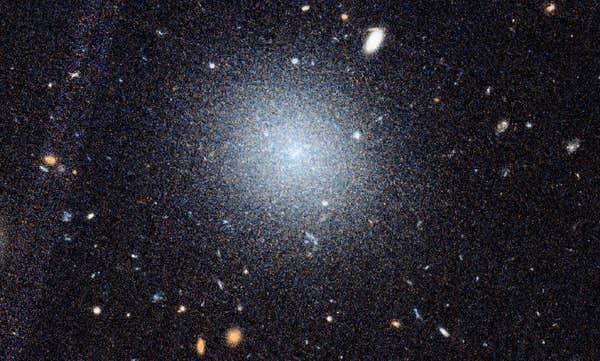
DF9 appears to lack dark matter, joining two other galaxies in a rare linear trail that may have formed in a violent collision. (CREDIT: Credit: NASA, ESA, and P. van Dokkum (Yale))
A faint dwarf galaxy drifting 45 million light-years from Earth may have joined one of astronomy’s strangest clubs. It belongs to a tiny set of galaxies that seem to exist without dark matter.
That would be odd enough on its own. However, what makes NGC 1052-DF9 more striking is where it sits, in a narrow, straight trail of small galaxies in the NGC 1052 group. It sits alongside two other unusual systems, DF2 and DF4, that were already reported to lack dark matter.
Now DF9 appears to fit the same pattern.
In measurements reported in The Astrophysical Journal, a Yale-led team found that DF9’s mass can be explained by its stars alone. In ordinary dwarf galaxies, that should not happen. Normally, these systems are dominated by dark matter, the unseen material thought to provide the gravitational framework that helps galaxies form. This framework also helps galaxies hold together.
“A line of galaxies lacking dark matter has never been seen before,” said Michael Keim, a Ph.D. student in astrophysics in Yale’s Graduate School of Arts and Sciences and first author of the study. “The discovery provides some of the strongest evidence yet that these galaxies formed through an extreme and previously unseen process and offers a rare new window into the nature of dark matter itself.”
A third outlier in the same trail
Astronomers have long worked from a basic picture of galaxy formation: gas falls into a dark matter halo, cools, and forms stars. By that logic, dwarf galaxies should be especially rich in dark matter. Since they are small and fragile, they tend to lose gas more easily. As a result, dark matter dominates their total mass.
That is why DF2 and DF4 drew so much attention in earlier work. Both looked like galaxies whose total mass closely matched the mass of their stars. So, there was little room left for the huge dark matter halos normally expected.
DF9 became a compelling target because it appears to be part of the same long, kinematically connected trail as those two galaxies. Previous work had shown that galaxies along this line are not only aligned in space, but also follow a velocity pattern that suggests a common origin.
Keim identified DF9 during his doctoral work with Yale astronomer Pieter van Dokkum. It had been misidentified as a supermassive black hole. The team then used the Keck Cosmic Web Imager in Hawaii, an instrument built to study faint, diffuse light, to take a closer look.
They observed DF9 for more than 10 hours across two nights in October 2024. Afterward, they measured how fast stars move inside the galaxy. Those stellar motions reveal how much mass is present overall.
Weighing a ghostly galaxy
The result was stark. The researchers found that DF9 has a mass of about 100 million suns. This is a figure consistent with the visible matter expected for a galaxy of its size.
If DF9 carried the sort of dark matter halo astronomers would normally expect, its mass should have been more than 10 billion suns.
The team also compared DF9 with the broader population of dwarf galaxies. In those comparisons, DF2, DF4, and DF9 all stand apart. Galaxies with similarly low stellar velocity dispersions are usually much smaller and have far less stellar mass. Galaxies with similar stellar masses usually have much larger velocity dispersions, a sign of far more total mass.
In other words, DF9 does not look like a normal dwarf galaxy that merely sits at the edge of the usual range. Instead, it looks physically unusual.
The measured velocity dispersion, after accounting for effects such as stellar atmospheric broadening and binary stars, was consistent with what the stars alone would produce. It did not match the much higher dispersion expected if DF9 were embedded in a standard dark matter halo.
That same basic mismatch had already been reported for DF2 and DF4. With DF9, the case broadens from two odd galaxies to three objects in the same system.
A violent origin comes into focus
That clustering matters. A lone outlier can invite arguments over distance, measurement error, or unusual structure. Three galaxies in a connected linear trail are harder to dismiss as isolated quirks.
The authors say the simplest explanation is that DF2, DF4, DF9, and the rest of the trail formed together in an extreme event that separated gas from dark matter. One candidate is a high-speed collision between galaxies, a dwarf-scale version of the sort of matter separation seen in the Bullet Cluster.
In that picture, gas was stripped away from its original dark matter. It then went on to form new galaxies in a straight trail. That idea had already been proposed to explain DF2 and DF4, and simulations had suggested that other galaxies in the trail should also be dark-matter-poor.
DF9 was a test of that prediction.
“Up until now it was assumed galaxies formed within pools of dark matter called ‘halos,’” Keim said. “This system shows that stars and galaxies can form outside of dark matter ‘halos’ in extreme events and indicates that dark matter is a physical substance that can act independently of normal matter or gas, challenging alternative theories that dark matter is gravity.”
That point goes beyond the fate of one faint galaxy. If gas and dark matter can be pulled apart in a collision and behave differently afterward, that supports the idea that dark matter is a separate physical component. It is not just a modification of gravity.
The authors also note that DF9 is not completely alone in this broader category. Another similar galaxy, FCC 224, has recently been identified elsewhere. Even so, the NGC 1052 trail remains unusually tight and unusually suggestive.
What astronomers still need to find
The team is careful not to claim that every detail is settled. Measuring these galaxies is difficult because they are faint and diffuse. Moreover, most of the other trail members are even dimmer than DF9. Their stellar masses are lower, and the internal motions astronomers would need to measure are smaller still.
That makes follow-up work especially important.
Researchers are now using additional facilities, including the new Mothra telescope co-founded by van Dokkum and University of Toronto astronomer Roberto Abraham, to search for gas that may have been left behind after the original event. If such gas is found and mapped in a way that matches the trail, it could provide what the authors describe as smoking-gun evidence for a violent shared origin.
It would also help pin down how much ordinary matter these galaxies still contain. This matters when trying to determine just how little room is left for dark matter.
For now, DF9 sharpens a puzzle that was already difficult to ignore. In a universe where dark matter is supposed to be the rule, one strange galaxy was provocative. Two were disruptive, and three in a line begin to look like a system telling astronomers that galaxy formation may have more than one path.
Practical implications of the research
This research matters because it pushes on one of modern astronomy’s central assumptions, that galaxies need dark matter halos to form.
If DF9, DF2, and DF4 truly formed from gas separated from dark matter in a violent collision, then astronomers may need to treat some rare galaxies as products of a very different formation channel.
The work also strengthens the case that dark matter behaves as a distinct physical substance. This could help narrow future theories about what dark matter is and how it interacts with ordinary matter.
Research findings are available online in The Astrophysical Journal.
The original story "Astronomers discover faint dwarf galaxy that seems to exist without dark matter" is published in The Brighter Side of News.
Related Stories
- New prototype quantum sensor expedites search for dark matter and gravitational waves
- A strange glow in the heart of the Milky Way may be dark matter
- Strange ripples in space may point to dark matter near merging black holes
Like these kind of feel good stories? Get The Brighter Side of News' newsletter.
Joseph Shavit
Writer, Editor-At-Large and Publisher
Joseph Shavit, based in Los Angeles, is a seasoned science journalist, editor and co-founder of The Brighter Side of News, where he transforms complex discoveries into clear, engaging stories for general readers. With vast experience at major media companies like The Los Angeles Times, Times Mirror and Tribune Publishing, he writes with both authority and curiosity. His writing focuses on space science, planetary science, quantum mechanics, geology. Known for linking breakthroughs to real-world markets, he highlights how research transitions into products and industries that shape daily life.