80-million-year-old snake fossil rewrites the story of snake evolution
A rare Brazilian snake fossil shows early snakes explored burrowing, land and marine lifestyles 80 million years ago.

 Edited By: Joseph Shavit

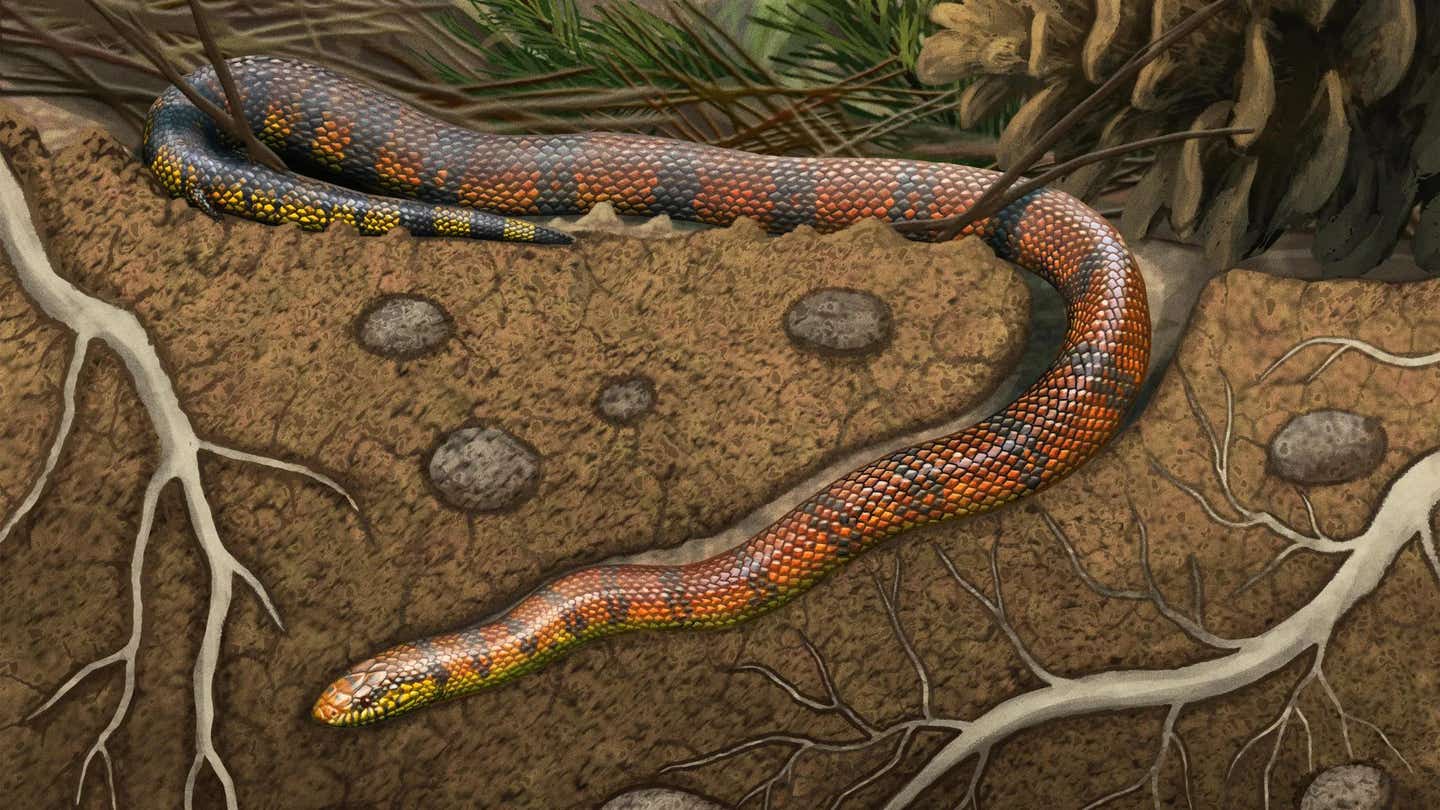
Life reconstruction of the burrowing stem snake Tametara mirim which lived alongside now-extinct stem-birds and sauropod dinosaurs. (CREDIT: Gabriel Ugueto)
- Scientists identified Tametara mirim, an 80-million-year-old fossil snake from Brazil whose unusually well-preserved skull and brain cavity provide new clues about early snake evolution.
- CT scans revealed features associated with burrowing, including a reinforced skull, reduced optic region and specialized inner ear, while comparisons with other ancient snakes suggest different species were already adapted to very different habitats.
- The findings challenge the long-running debate over whether snakes first evolved on land, underground or in water, suggesting instead that early snakes rapidly diversified across multiple environments and evolutionary pathways.
A small fossil snake from Brazil is changing how scientists understand one of evolution’s most dramatic transformations. For decades, researchers debated whether the first snakes evolved their long, limbless bodies for burrowing underground or swimming in water. A new study suggests that question may be too simple.
The research describes a newly identified fossil snake, Tametara mirim, from southeastern Brazil. It lived around 80 million years ago, during the Late Cretaceous Period. Its rare preservation allowed scientists to study not only its bones, but also the shape of the space once occupied by its brain.
“Our findings show that early snakes had already achieved remarkable ecological and morphological diversity by the Late Cretaceous, around 80 million years ago,” said Tiago Simões, Assistant Professor at Princeton University and lead author of the study.
A Rare Fossil With Big Answers
Snakes are highly modified lizards, and more than 4,000 species live today. They move through deserts, forests, oceans and underground tunnels. Yet their early history remains difficult to trace.
The fossil record for early snakes is sparse. Their delicate bones rarely survive intact. Many ancient species are known only from scattered vertebrae, leaving major questions unanswered.
Tametara mirim gives researchers something far more complete. The fossil preserves part of a three-dimensional skull, jaws and the front section of the body. It also includes 103 vertebrae in the preserved body region.
The specimen was found in 2020 at William’s Quarry 2 in São Paulo state. It came from the Adamantina Formation, a rock unit rich in Late Cretaceous fossils.
Looking Inside The Ancient Skull
Researchers used computed tomography to scan the fossil without damaging it. They then created detailed digital models of the skull, vertebrae and brain cavity.
The team also used cinematic 3D rendering to examine fine anatomical details. This allowed them to study structures hidden inside the stone.
Postdoctoral researcher Simone Macrì and Research Director Nicolas Di-Poï, both at University of Helsinki’s HiLIFE Helsinki Institute of Life Science, helped lead the brain reconstruction and comparison work.
“The brain tells a much richer story than the skeleton alone,” Macrì said. “By combining computed tomography-based brain reconstructions with data from living snakes, we could show that early snakes were not simply progressing toward one modern condition but experimenting with different sensory and ecological strategies. This means that early snakes did not follow a single evolutionary pathway.”
A Snake Built For Burrowing
The digital reconstruction showed that Tametara had traits linked to a burrowing lifestyle. Its brain shape, skull structure and inner ear all pointed in that direction.
The brain cavity was long from front to back. Its olfactory bulbs were short, and its cerebral hemispheres were only mildly enlarged. The optic region appeared reduced, a pattern often seen in animals that spend time underground.
The inner ear also supported this interpretation. Its structure resembled those of burrowing snakes, which often rely less on vision and more on touch, vibration and smell.
Bone structure added another clue. The skull showed compact, reinforced features suited for pushing through soil or narrow spaces. Taken together, these traits suggest the animal likely spent much of its life underground.
Another Fossil Tells A Different Story
The team compared Tametara with another ancient snake, Dinilysia patagonica, from Argentina. That fossil has long played an important role in debates about snake origins.
The comparison revealed striking differences. Tametara appeared adapted for burrowing, while Dinilysia showed features more consistent with life on the ground.
“The two had strikingly different brain shapes, both from each other and from most other snakes studied,” Di-Poï said. “Brain shape and bone microstructure pointed to the same conclusion: Tametara was adapted to burrowing, Dinilysia to life on the ground.”
That difference matters. It suggests early snakes were not locked into one lifestyle. Instead, different branches explored different ways of living.
More Than One Path To Becoming A Snake
For many years, the origin of snakes was framed as a choice between two ideas. Some scientists argued snakes began as burrowers. Others proposed that they evolved in aquatic environments.
The new study challenges that debate. It shows that early snake evolution involved several habitat shifts. Some ancient lineages moved underground. Others lived on land. Evidence from marine sediments suggests some entered aquatic environments too.
“Together with evidence from marine sediments, the findings reveal several shifts between burrowing, terrestrial and marine lifestyles in early snake evolution,” Di-Poï said. “Different lineages explored different habitats much earlier than previously thought.”
This means the snake body plan may not have evolved for one setting alone. Instead, it may have proved useful across many environments.
Senses Shaped By Habitat
The study also shows that early snakes differed in how they sensed the world. A burrowing animal faces different challenges than one living on open ground or in water.
Underground, vision may matter less. Smell, touch and vibration can become more important. On the surface, animals may rely more on sight and spatial awareness.
By studying the brain cavity and inner ear, researchers could infer how these senses may have differed. Tametara showed several traits linked to life in tight, dark spaces.
Yet its brain was not identical to those of modern burrowing snakes. Some features suggested a mix of sensory strategies. This points to a more flexible evolutionary process than scientists expected.
Why The Brain Matters
Bones reveal how an animal moved and supported its body. But the brain cavity offers clues about perception, behavior and habitat.
In extinct animals, the brain itself rarely survives. Still, it leaves impressions inside the skull as it develops. Scientists can use those impressions to reconstruct its general shape.
This method does not reveal every detail. It cannot tell researchers exactly how an animal behaved. But it can show which sensory systems were emphasized.
In this case, the brain helped reveal that early snakes were already diverse in form and lifestyle.
A Richer Origin Story
The findings place Tametara near the early roots of snake evolution. It appears to be a stem snake, meaning it belonged to a branch outside the group that includes all living snakes.
Its position gives researchers a rare view of what early snake relatives looked like. It also shows that major ecological differences appeared before modern snakes arose.
This complicates the search for a single ancestral lifestyle. Early snakes were not simply moving along one path toward modern forms. They were changing, adapting and branching into different environments.
The fossil from Brazil now helps replace a narrow debate with a richer story.
Practical Implications Of The Research
This research helps scientists better understand how major body plans evolve. Snakes represent one of the clearest examples of extreme anatomical change among vertebrates. Learning how their bodies and senses changed can improve broader studies of evolution.
The findings also show the value of fossil preservation and digital imaging. CT scans allow researchers to examine fragile specimens without damaging them. This can reveal hidden structures that older methods could not access.
The study may also guide future fossil research. By showing that early snakes lived in different habitats, it encourages scientists to search in more types of ancient environments. Marine deposits, land-based rocks and burrowing habitats may all hold important clues.
For humanity, the work deepens understanding of life’s adaptability. It shows that evolution often moves through many experiments, not one simple path. That lesson helps explain how animals respond to changing worlds across deep time.
Research findings are available online in the journal Nature.
The original story "80-million-year-old snake fossil rewrites the story of snake evolution" is published in The Brighter Side of News.
Related Stories
- Snake blood proteins could lead to a more powerful antivenom treatment
- Scientists discover colossal 50-foot long snake from 47 million years ago
- AI develops life-saving snake venom treatment - helping two million people per year
Like these kind of feel good stories? Get The Brighter Side of News' newsletter.
Joshua Shavit
Writer and Editor
Joshua Shavit is a NorCal-based science and technology writer with a passion for exploring the breakthroughs shaping the future. As a co-founder of The Brighter Side of News, he focuses on positive and transformative advancements in technology, physics, engineering, robotics, and astronomy. Having published articles on AOL.com, MSN, Yahoo News, and Ground News, Joshua's work highlights the innovators behind the ideas, bringing readers closer to the people driving progress.