Astronomers discover the most chemically primitive galaxy in the universe
JWST captured LAP1-B, a faint ancient galaxy whose chemistry may connect the first stars to today’s fossil dwarfs.

 Edited By: Joshua Shavit

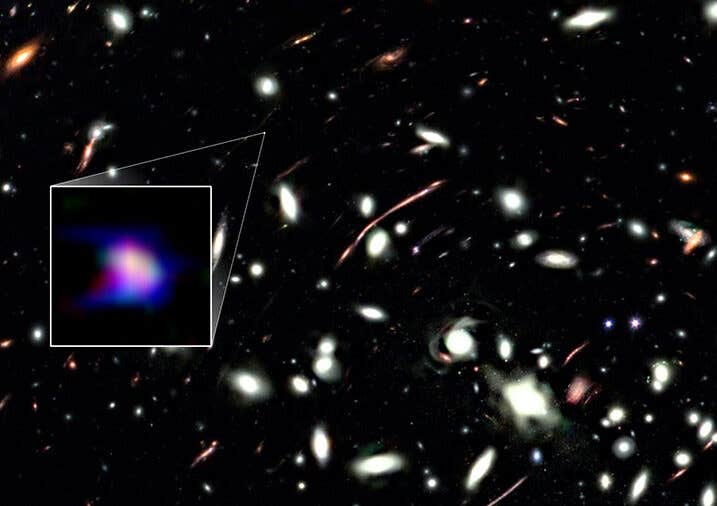
Revealing the Nature of the Ultra-Faint Galaxy LAP1-B through a Giant “Gravitational Lens” (CREDIT: NASA, ESA, CSA & K. Nakajima et al.)
The light reaching JWST from LAP1-B began its trip about 13 billion years ago. By the time it arrived, it carried an unusually sparse chemical record. This points to a galaxy barely touched by earlier generations of stars.
That is what makes the object so striking.
An international team led by Associate Professor Kimihiko Nakajima of Kanazawa University used the James Webb Space Telescope and the magnifying effect of gravitational lensing to study the tiny system in unusual detail. Their target, known as LAP1-B, sits at a redshift of 6.625 and is so faint that it would normally be out of reach. However, a foreground galaxy cluster boosted its light by about a factor of 100. This gave astronomers a chance to inspect one of the most chemically primitive star-forming galaxies yet seen.
After more than 30 hours of deep spectroscopy, the team found that LAP1-B contains oxygen at just 1/240th the level seen in the Sun. That places it far below the metallicity floor confirmed in earlier JWST surveys of galaxies at similar distances.
“I was instantly thrilled by the extreme lack of oxygen revealed in the data,” Nakajima said. “Finding a galaxy in such a primitive state is astonishing. It’s a chemical signature that clearly indicates a primordial galaxy caught in the moments shortly after its formation.”
Where the first heavy elements began to spread
In the early universe, hydrogen and helium dominated. Elements such as oxygen and carbon came later, forged inside stars and scattered by stellar explosions. Astronomers have long wanted to catch galaxies at the point where that chemical enrichment had barely started. However, those systems are expected to be tiny, dim, and hard to confirm.
LAP1-B appears to fit that description almost uncannily well.
The JWST spectra revealed five emission lines, including hydrogen lines, Lyα, [O iii] λ5007, and C iv λ1549. The faint but significant metal-line detections mattered because they showed that the galaxy’s gas had been enriched, but only slightly. In addition, the measured [O iii]/Hβ ratio of 0.69 ± 0.28 pushed the analysis into an extremely low-metallicity regime. This range is beyond the normal empirical calibration range. From that, the team derived an oxygen abundance equal to about 0.42 percent of the Sun’s.
The galaxy also showed almost no sign of dust extinction. Its Hα/Hβ ratio matched the expected value for case B recombination, which is consistent with a near-pristine environment.
LAP1-B is not just chemically poor. It is also extraordinarily small. Based on non-detection in deep JWST imaging, the team placed its stellar mass below 3,300 solar masses at the 3σ level, with a more conservative upper limit of 18,000 solar masses. When compared with roughly 300 other JWST-observed galaxies at redshifts from 4 to 12.5, most are above 10 million solar masses. LAP1-B therefore occupies an extreme corner of the stellar mass-metallicity relation.
A chemical clue from carbon
The oxygen result alone would have made the galaxy notable. The carbon signal made it even more interesting.
LAP1-B appears to have a carbon-to-oxygen ratio about 1 to 2 times the solar value, despite its extremely low oxygen abundance. That puts it above the trend seen in Galactic metal-poor stars and damped Lyα systems at similar oxygen levels. Standard population II chemical enrichment models do not reproduce that pattern well. Those models predict more of a plateau in C/O, not the elevated ratio seen here.
The research points instead toward a more primordial explanation.
In metal-free population III stars, the lack of initial heavy elements changes stellar structure and mass loss. The team notes that these compact stars are thought to be more vulnerable to faint supernova explosions. In such events, fallback prevents much of the oxygen-rich inner material from escaping, while carbon-rich outer layers are expelled into surrounding gas. That kind of enrichment history can produce the unusual chemistry seen in LAP1-B.
Although the exact progenitor remains uncertain, the authors say the abundance pattern strongly suggests recent enrichment from population III supernovae. They add that a single burst of massive stars could in theory create the observed pattern, but only under finely tuned conditions. In contrast, a more natural explanation may be stochastic enrichment from earlier faint population III stars.
“Usually, we act like ‘cosmic archaeologists,’ trying to guess the past by looking at old stars in our own neighborhood. But now, we can analyze the gas directly from the original scene 13 billion years ago,” Nakajima said. “We are witnessing the moment when a galaxy first inherited the chemical building blocks created by the universe’s earliest stars.”
A fossil galaxy in the making
The galaxy’s radiation field adds another layer to the picture. LAP1-B has an ionizing-photon production efficiency above 26.1 in ξion units at the 3σ level, along with an Hα equivalent width greater than 1,800 Å. The team says those values do not fit standard metal-enriched stellar populations or black hole accretion. Instead, they line up with either metal-free population III stars or extreme population II models containing only very massive stars.
The non-detection of He ii λ1640 does not rule out those stellar scenarios. Nor does the presence of C iv settle the question on its own. But together, the hard ionizing spectrum, minimal metal content, and elevated carbon signal point to a primitive galaxy caught close to the threshold of chemical enrichment.
Its internal motions also hint at something larger than the visible matter inside it. The Hα line width gave a velocity dispersion of 58.3 ± 17.8 kilometers per second. Assuming an intrinsic size of about 10 parsecs, the team estimated a dynamical mass on the order of 10 million solar masses. That far exceeds the combined stellar and gas mass. As a result, this implies a baryon fraction below about 1 percent and a dominant dark matter halo.
That matters because present-day ultra-faint dwarf galaxies near the Milky Way are also dark matter-dominated and chemically ancient.
Ultra-faint galaxies
“UFDs are not only the faintest galaxies; they are composed of ancient stars over 12 billion years old and are often described as ‘fossils of the universe,’” said Professor Masami Ouchi of the National Astronomical Observatory of Japan and the University of Tokyo. “Astronomers suspected they might be the remains of the universe’s earliest galaxies because they lack heavy elements, but astronomers never had a direct link – until we found LAP1-B.”
He pushed the point further.
“It is a profound surprise to find that LAP1-B looks exactly like the ‘ancestor’ we had only imagined in theories. This helps us solve the mystery of why these cosmic fossils have survived in their current form to the present day.”
The team argues that LAP1-B may be a direct high-redshift progenitor of those local relics, observed before reionization shut down star formation in such shallow halos. If that view holds, the galaxy is not just another distant faint object. Indeed, it is a missing link between the first enrichment events in the universe and some of the oldest surviving galaxies still orbiting nearby giants today.
Practical implications of the research
This work gives astronomers a concrete target type for studying how the first heavy elements spread through the universe. It also offers a direct way to connect very distant galaxies with ultra-faint dwarf systems around the Milky Way, which are often treated as fossil records of the early cosmos.
By finding more objects like LAP1-B, researchers may be able to trace how the first stars shaped later galaxy formation. They may also learn how reionization shut down star formation in tiny halos.
Finally, they may uncover how the raw ingredients for later planets and life began to accumulate across space.
Research findings are available online in the journal Nature.
The original story "Astronomers discover the most chemically primitive galaxy in the universe" is published in The Brighter Side of News.
Related Stories
- Cosmic simulations reveal how galaxies formed and evolved over billions of years
- Pristine star reveals the dawn of stars and galaxies in the universe
- The surprising link between quasars, black holes and the universe's cosmic dawn
Like these kind of feel good stories? Get The Brighter Side of News' newsletter.
Joseph Shavit
Writer, Editor-At-Large and Publisher
Joseph Shavit, based in Los Angeles, is a seasoned science journalist, editor and co-founder of The Brighter Side of News, where he transforms complex discoveries into clear, engaging stories for general readers. With vast experience at major media companies like The Los Angeles Times, Times Mirror and Tribune Publishing, he writes with both authority and curiosity. His writing focuses on space science, planetary science, quantum mechanics, geology. Known for linking breakthroughs to real-world markets, he highlights how research transitions into products and industries that shape daily life.