Astronomers spot signs of comets transporting water to a young solar system PDS 70
Fast-moving sodium clouds may trace icy comets plunging through one of the youngest planetary systems ever studied this way.
 Lund University Writer: Lotte Billing

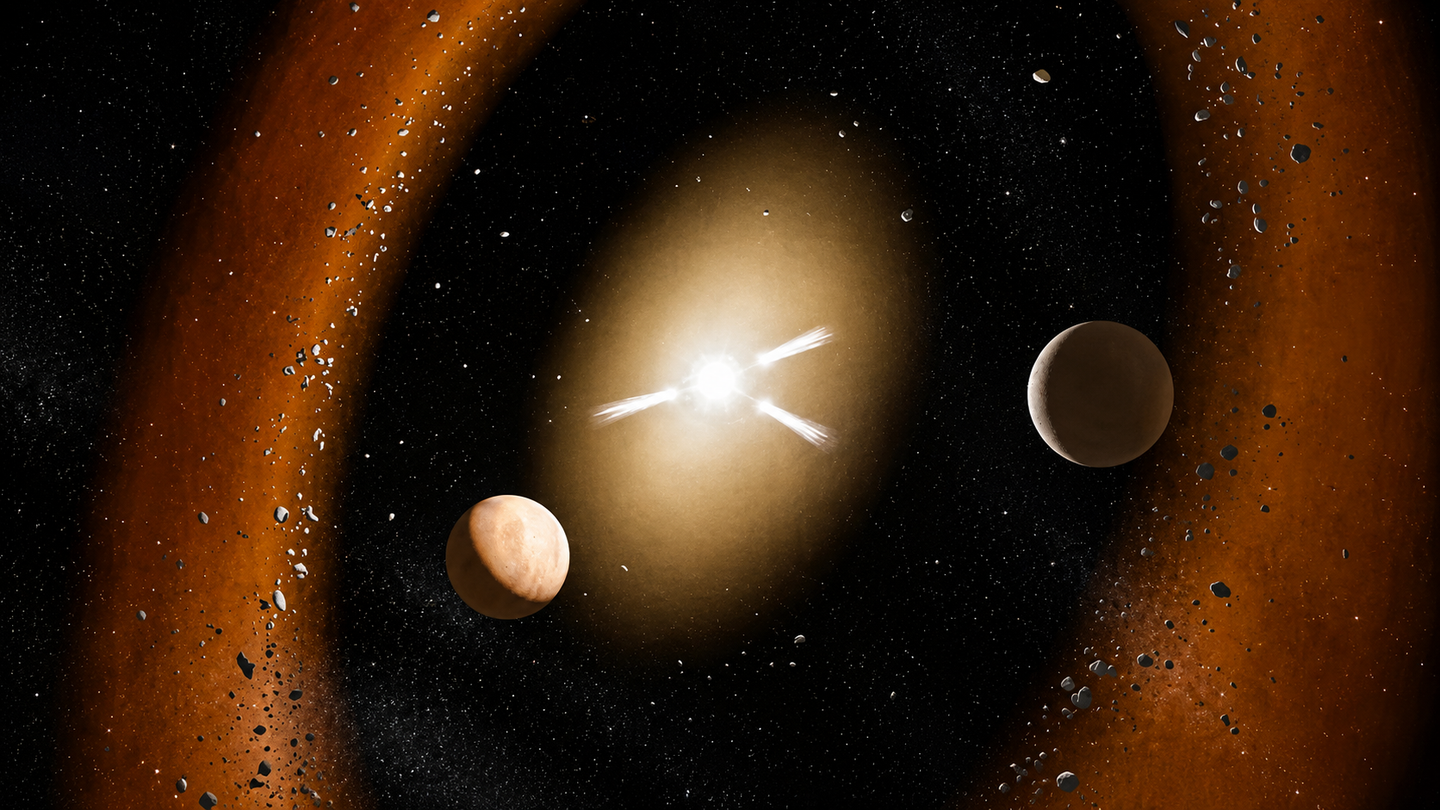
Artistic interpretation of the distant planetary system PDS 70. Possible exocomets around PDS 70 may reveal how giant planets send icy bodies and water toward regions where rocky worlds form. (CREDIT: Aline Novais)
- Fast-changing sodium gas around the 5.4-million-year-old star PDS 70 provides evidence that icy exocomets may be plunging into the young system’s inner regions.
- Computer simulations show that giant planets could scatter planetesimals inward from beyond 54 astronomical units, potentially carrying water and other volatile materials toward forming rocky worlds.
- The exocomet interpretation remains unconfirmed, but if verified, PDS 70 would be the youngest planetary system known to show this kind of comet activity.
A young planetary system 370 light-years away may be showing astronomers something remarkably familiar: icy comets carrying water toward the region where rocky planets could eventually emerge.
Astronomers at Lund University in Sweden have found fast-changing clouds of sodium gas around PDS 70, a 5.4-million-year-old star already famous for its actively forming planets. The signals behave much like material released by comets passing close to a star, raising the possibility that frozen bodies from the system’s distant outskirts are being hurled inward.
The findings, published in Nature Communications, offer a possible explanation for water vapor previously detected close to the star. The researchers stress that the comet interpretation has not been conclusively proven.
“Our study suggests that comets may be responsible for transporting water to the inner parts of the planetary system, where planets can form, in the same way as in the early Solar System,” said Aline Novais, an astronomy researcher at Lund University.
Sodium gas appears and disappears within days
PDS 70 is a young K7 T Tauri star slightly cooler and less massive than the Sun. Its surrounding disk contains a huge gap occupied by two confirmed gas giants, PDS 70 b and PDS 70 c, orbiting about 20.6 and 34.5 astronomical units from their star. One astronomical unit, or AU, is roughly the average distance between Earth and the Sun.
The researchers revisited observations collected with the HARPS spectrograph on the European Southern Observatory's 3.6-meter telescope in Chile. The dataset contained 52 spectra taken across 22 nights in 2018, 2019 and 2020.
The strongest evidence came from 2018. Astronomers found narrow absorption features produced by neutral sodium that repeatedly appeared, disappeared and changed velocity from night to night.
Across 18 observing epochs that year, they identified 43 variable sodium absorption components moving at radial velocities from about minus 25 to minus 115 kilometers per second. The inferred sodium clouds covered only portions of the star and often appeared optically thick, suggesting compact clumps rather than a smooth sheet of gas.
That combination resembles the spectroscopic signatures produced when exocomets pass between other stars and Earth.
A comet can reveal itself without being seen
Astronomers generally cannot photograph an individual exocomet directly. Instead, they can detect material released as one approaches its star.
Ice and other volatile substances on a comet heat up and sublimate, changing directly from solid material into gas. When that gas crosses the face of a star, atoms within it absorb particular wavelengths of starlight. Those temporary absorption lines can reveal both the material's composition and its motion.
The best-known example is Beta Pictoris, where thousands of exocometary events have been identified. Spectroscopic exocomets often create narrow, rapidly changing absorption features at substantial Doppler shifts, indicating material traveling along highly eccentric orbits.
PDS 70 is unusual because it is far younger and cooler than the stars around which most previous candidates have been observed.
“This is the first time we have seen evidence of exocomets orbiting a star that is relatively cool, much like our Sun,” Novais said. “Furthermore, this system is the youngest in which exocomet activity has been proposed.”
The researchers considered another explanation. PDS 70 is known to produce disk winds, which can also create blue-shifted absorption as gas flows outward toward Earth. Their modeling could not completely eliminate that possibility because the system's accretion and wind properties remain uncertain.
However, the sodium clouds contained substantially more material than simple wind models predicted, changed velocity unusually rapidly and covered only portions of the stellar disk. Those properties made sublimating planetesimals the favored explanation.
Giant planets could throw icy bodies inward
Finding possible exocomets is only one part of the story. The astronomers also wanted to know whether objects born in PDS 70's cold outer disk could physically reach its inner regions.
They ran N-body simulations that followed planetesimals interacting gravitationally with the system's giant planets. Models tested both the two confirmed planets and a configuration that included a possible third planet.
Particles moved inward in both cases.
During the final million years of the simulations, an average of 0.47% of particles in the two-planet model and 2.9% in the three-planet model crossed the planetary gap toward the inner disk. For every 10 Earth masses of planetesimals remaining outside, the models suggest roughly 0.047 to 0.29 Earth masses could cross the gap per million years under the assumed configurations.
Many scattered objects also developed highly eccentric and inclined orbits, the kind of trajectories expected for bodies plunging close enough to a star to become active exocomets. PDS 70 c appeared particularly effective at redirecting material inward.
The simulations demonstrate that the transport route is dynamically plausible. They do not establish how much water the objects actually carry or prove that exocomets created the water already observed near PDS 70.
Water already exists where rocky planets could form
That previous water detection makes PDS 70 especially intriguing.
In 2023, observations with the James Webb Space Telescope revealed hot water vapor in the system's inner disk. The roughly 600-kelvin water was detected in the terrestrial planet-forming region close to the star, despite the enormous planet-carved gap separating the inner and outer disks.
Scientists have proposed several possible origins. Water could form chemically within the inner disk, while tiny ice-rich dust particles might also migrate inward through the planetary gap. The new work adds another candidate: much larger icy planetesimals scattered inward by planets.
“It is reminiscent of a possible process in the early Solar System, in which comets may have helped to deliver water to the young Earth,” said Lund University astronomer Alexandra Stockwell Murphy.
Earth's water origin remains debated. Both water-rich asteroids and comets could have contributed, and the importance of each source is still being investigated. PDS 70 does not resolve that debate, but it provides a rare opportunity to watch similar transport processes while planets are still forming.
More observations must confirm the comets
The researchers outline several tests that could strengthen the case. Detecting dusty comet tails crossing the star, tracking individual sodium features long enough to reconstruct their acceleration, and measuring additional chemical species would provide stronger evidence.
Observations taken with the UVES spectrograph in 2026 have already revealed continuing variable sodium absorption, including some red-shifted features. Those observations support the comet interpretation but require further analysis.
Future observations could also reveal additional planets whose gravity changes how material travels through the system. The Extremely Large Telescope, now under construction in Chile, should eventually provide a much sharper view.
“And when the Extremely Large Telescope, which is currently being built in Chile, becomes operational in the coming years, we will be able to find out whether there are any further planets in the system and thus gain an even clearer picture of how water and other building blocks of planets are transported,” said Lund astronomer Jens Hoeijmakers.
If the sodium signals are ultimately confirmed as exocomets, PDS 70 could give astronomers something unavailable in our own mature Solar System: a view of icy planetary building blocks being scattered around while planets, disks and potentially habitable environments are still taking shape.
Dig deeper into exocomets and water delivery
These resources explore exocomets, PDS 70 and the movement of water and planet-building material through young planetary systems.
Water in the terrestrial planet-forming zone of the PDS 70 disk: JWST observations revealed water vapor inside PDS 70's planet-carved gap, establishing the inner water reservoir that the new exocomet hypothesis may help explain. (Nature, 2023)
An Overview of Exocomets: Reviews the definition, detection methods and known candidate systems for comet-like bodies orbiting stars beyond the Sun. (Space Science Reviews, 2025)
The Origins & Reservoirs of Exocomets: Examines where exocomets form and how planetary dynamics can remove small bodies from distant reservoirs and send them toward their stars. (Space Science Reviews, 2025)
Two families of exocomets in the β Pictoris system: Analysis of more than 1,000 spectra identified distinct populations of exocomets around Beta Pictoris, the benchmark system for spectroscopic exocomet studies. (Nature, 2014)
Two accreting protoplanets around the young star PDS 70: Documents the two actively accreting giant planets whose gravity now provides a possible mechanism for scattering icy planetesimals toward PDS 70's inner disk. (Nature Astronomy, 2019)
Research findings are available online in the journal Nature Communications.
The original story "Astronomers spot signs of comets transporting water to a young solar system PDS 70" is published in The Brighter Side of News.
Related Stories
- Astronomers confirm the presence of water on interstellar comet 3I/ATLAS
- Did comets bring Earth its water? Scientists find new evidence
- Astronomers link dark comets to how Earth got its water
Like these kind of feel good stories? Get The Brighter Side of News' newsletter.
Joseph Shavit
Writer, Editor-At-Large and Publisher
Joseph Shavit, based in Los Angeles, is a seasoned science journalist, editor and co-founder of The Brighter Side of News, where he transforms complex discoveries into clear, engaging stories for general readers. With vast experience at major media companies like The Los Angeles Times, Times Mirror and Tribune Publishing, he writes with both authority and curiosity. His writing focuses on space science, planetary science, quantum mechanics, geology. Known for linking breakthroughs to real-world markets, he highlights how research transitions into products and industries that shape daily life.