MIT physicists show why a laser made of neutrinos is impossible
A bold plan to amplify ghostly neutrinos fails two separate quantum tests, according to companion MIT physics papers.
 MIT Writer: Sarah McDonnell

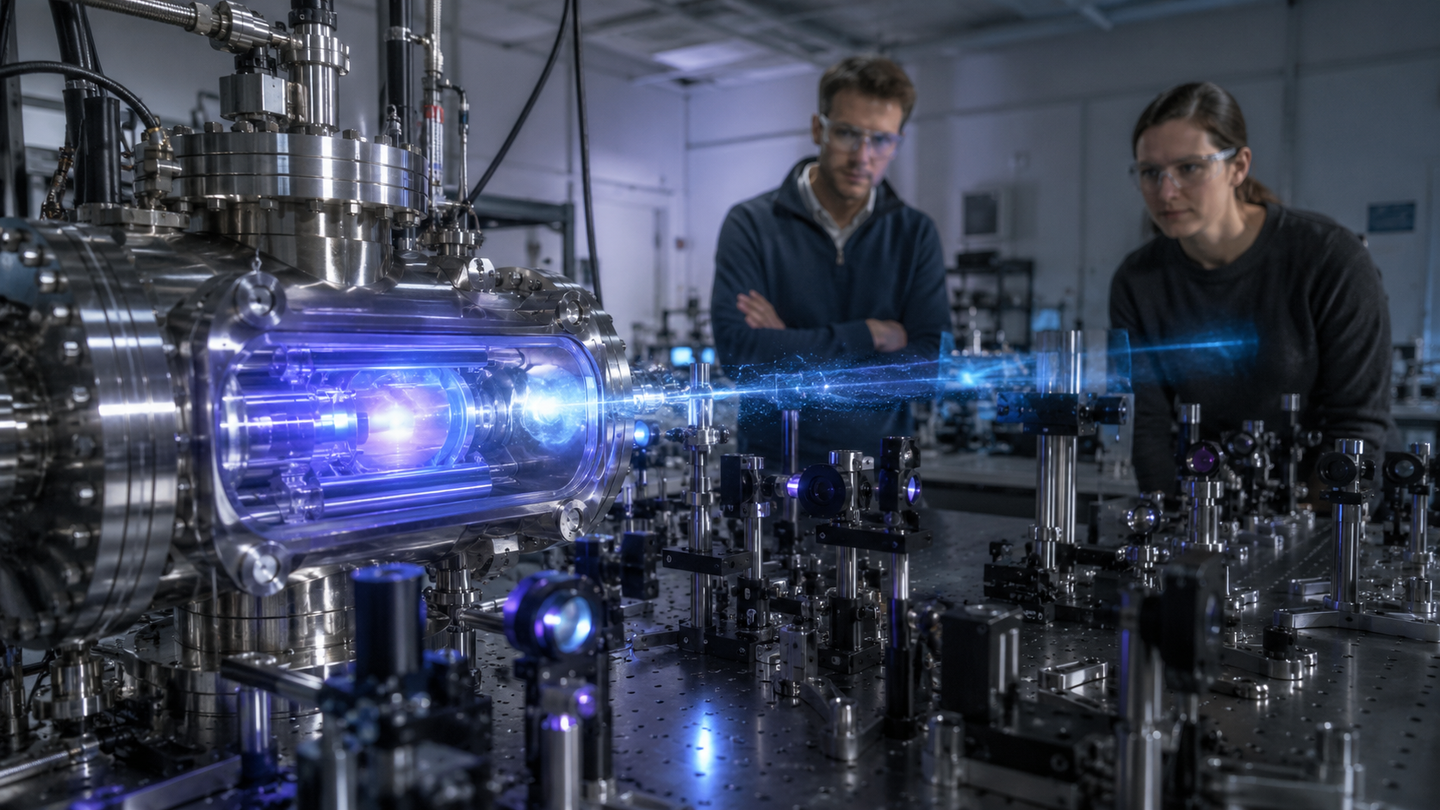
MIT physicists find recoil and fermion statistics prevent a proposed radioactive condensate from producing a neutrino laser. (CREDIT: Shutterstock)
- MIT physicists conclude that a proposed neutrino laser based on an ultracold radioactive gas cannot produce the superradiant amplification needed for a beam.
- One analysis finds that violent atomic recoil destroys the quantum coherence needed for amplification, while another shows that neutrinos’ fermionic nature blocks the required emission cascade.
- The result overturns a 2025 proposal that suggested a condensate of radioactive rubidium could shorten an 86-day decay lifetime to about one minute.
A laser made from some of the universe’s most elusive particles sounded almost too strange to be possible. According to two new theoretical analyses from MIT, it is.
Physicists have found that a recently proposed neutrino laser cannot achieve the collective amplification needed to turn radioactive decay into a concentrated beam. Two companion papers published in Physical Review Letters identify separate problems with the concept: the enormous recoil produced when a neutrino escapes an atom, and the fundamentally fermionic nature of the neutrino itself.
“These two papers are sort of punch one and punch two,” MIT physicist Wolfgang Ketterle said. “Each paper would have killed the proposal.”
The work was carried out by Ketterle, postdoctoral researchers Hanzhen Lin and Yu-Kun Lu, and colleagues at MIT’s Department of Physics, Research Laboratory of Electronics and MIT-Harvard Center for Ultracold Atoms. The findings do not show that every imaginable method of producing directional neutrinos is impossible. Instead, they rule out the specific superradiant mechanism proposed for radioactive Bose-Einstein condensates.
An audacious proposal for ghost particles
Neutrinos barely interact with ordinary matter. Trillions pass through the human body every second, yet detecting even a small fraction requires enormous, highly sensitive experiments. They also come in different varieties, or flavors, and can change from one flavor into another while traveling.
In 2025, physicists Ben Jones and Joe Formaggio proposed an unusual way to turn radioactive decay into something resembling a laser. They suggested cooling radioactive atoms until they formed a Bose-Einstein condensate, or BEC, a state in which many atoms behave as a coherent quantum system.
Their proposal centered on superradiance, a phenomenon in which collective quantum behavior causes radiation from many emitters to reinforce itself. Instead of individual atoms emitting randomly, correlated atoms can release radiation in a highly amplified, directional way.
Jones and Formaggio calculated that a condensate containing about one million radioactive rubidium-83 atoms might accelerate a normal radioactive lifetime of roughly 86 days to about one minute. The emitted neutrinos could then form an intense, laser-like beam.
No radioactive BEC has yet been created. Still, the proposal offered a tantalizing possibility for controlling a particle that normally passes almost untouched through planets, stars and people.
A recoil faster than a fighter jet
The first major problem appears at the instant a neutrino leaves an atom.
Superradiance depends on the emitting atoms retaining information about earlier emissions. In optical experiments, when an atom emits or scatters a photon, the recoil can remain part of the coherent motion of the condensate. That shared response helps subsequent radiation build in the same direction.
Neutrino-producing nuclear reactions operate at vastly higher energies. Visible photons carry energies around an electron volt, while neutrinos produced in radioactive decay can emerge with energies roughly a million times larger. The daughter atom therefore receives an enormous kick.
Ketterle compared the recoil speed to Mach 10. At that velocity, the recoiling atom effectively leaves the ultracold condensate almost instantly. Rather than preserving a useful quantum imprint of the emission, the system loses that information before it can amplify another event.
The companion Physical Review Letters analysis concluded that proposed neutrino and gamma-ray schemes face extremely short coherence times and multimode emission. Instead of producing useful amplification, the calculated gain can fall to about or smaller.
Fermions create an ‘anti-memory’
Even eliminating the recoil problem would not rescue the proposed neutrino laser.
Photons are bosons, particles whose quantum behavior allows large numbers to occupy the same state. That characteristic makes the constructive buildup behind superradiance possible. Under the right conditions, the emission rate from atoms can scale approximately with .
Neutrinos are fermions. Fermions obey different quantum statistics and cannot pile into identical quantum states in the same way.
Lu, Lin and Ketterle solved an idealized version of the problem in which recoil and other practical obstacles were removed. Even under those favorable assumptions, neutrino emission could not generate the enhancement required for superradiance. The maximum emission rate scaled only with , comparable to ordinary incoherent radiation.
The first emitted neutrino effectively leaves what Ketterle describes as an “anti-memory” in the collective system. Instead of encouraging another neutrino to follow the same path, the fermionic excitation blocks further emission into that state. In the simplest coherent model, the process reaches a dark state after one neutrino is emitted.
Why superradiance works for light
The underlying idea dates to physicist Robert Dicke, who showed in 1954 that groups of quantum emitters could radiate collectively rather than independently. Under suitable conditions, their emission amplitudes interfere constructively, greatly increasing the radiation rate.
Bose-Einstein condensates later provided an exceptional platform for exploring such collective effects. Ketterle shared the 2001 Nobel Prize in Physics for work involving Bose-Einstein condensation in dilute gases, following his team’s 1995 observation of a sodium condensate at MIT.
That history partly explains why the neutrino proposal was intriguing. BECs really can produce striking collective phenomena involving atoms and photons. The mistake was assuming that the same quantum amplification could simply be transferred to high-energy radioactive decay and fermionic radiation.
“In superradiance, it is about a memory effect, or quantum correlations in the condensate,” Ketterle said. But for emitted fermions, the team found that the memory works in the opposite direction, suppressing rather than amplifying repeated emission.
A failed idea still advances the science
Formaggio, one of the physicists behind the original proposal, has welcomed the challenge rather than treating it as a setback.
“When a new idea — such as the one we proposed — is shared, it is the duty of the community to scrutinize it. Such is the scientific process,” he said. “Indeed, it was great to see how our paper generated a lot of thinking outside of our original concept. We suspect that will continue.”
The new work does leave room for more limited collective effects involving fermions. The theoretical paper finds that certain states can still exhibit an -fold enhancement, even though the powerful superradiant scaling needed for the proposed laser is forbidden.
Formaggio also expects the argument may eventually face an experimental test. “Nature, as always, is the final arbiter of such things,” he said.
For Ketterle, however, the central conclusion is already clear. “Creative ideas and discussions among scientists are needed to uncover nature’s surprises,” he said. “But in the case of neutrino lasers, the surprise was too good to be true.”
Dig deeper into neutrino superradiance
These resources trace the original neutrino-laser proposal and the physics of superradiance and Bose-Einstein condensates that inspired it.
Superradiant Neutrino Lasers from Radioactive Condensates: The 2025 proposal that suggested radioactive rubidium atoms in a Bose-Einstein condensate could collectively generate an intense, directional neutrino beam. (Physical Review Letters, 2025)
Coherence in Spontaneous Radiation Processes: Robert Dicke’s foundational paper introduced the theory of collective spontaneous emission that became known as superradiance. (Physical Review, 1954)
Bose-Einstein Condensation in a Gas of Sodium Atoms: Ketterle and colleagues reported Bose-Einstein condensation in sodium, establishing the ultracold quantum state central to later superradiance experiments. (Physical Review Letters, 1995)
The onset of matter-wave amplification in a superradiant Bose-Einstein condensate: Experiments explored how optical stimulation and matter-wave amplification operate inside a Bose-Einstein condensate. (Science, 2003)
Phase-coherent amplification of matter waves: This experiment demonstrated coherent matter-wave amplification in a rubidium Bose-Einstein condensate using superradiant effects. (Science, 1999)
Research findings are available online in the journals Physical Review Letters and Physical Review Letters.
The original story "MIT physicists show why a laser made of neutrinos is impossible" is published in The Brighter Side of News.
Related Stories
- Laser-heated electrons can reshape metals in a billionth of a second
- MIT's self-organizing laser revolutionizes 3D imaging of the brain’s protective barrier
- Quantum researchers created a new kind of laser built from sound
Like these kind of feel good stories? Get The Brighter Side of News' newsletter.
Joseph Shavit
Writer, Editor-At-Large and Publisher
Joseph Shavit, based in Los Angeles, is a seasoned science journalist, editor and co-founder of The Brighter Side of News, where he transforms complex discoveries into clear, engaging stories for general readers. With vast experience at major media companies like The Los Angeles Times, Times Mirror and Tribune Publishing, he writes with both authority and curiosity. His writing focuses on space science, planetary science, quantum mechanics, geology. Known for linking breakthroughs to real-world markets, he highlights how research transitions into products and industries that shape daily life.