Big Bang afterglow rules out giant black holes as a major dark matter source
Researchers used ancient cosmic light and galaxy-clustering constraints to limit giant primordial black holes. A substantial population would create stronger fluctuations than observations allow, narrowing one dark matter explanation without resolving the larger mystery.

 Edited By: Joshua Shavit

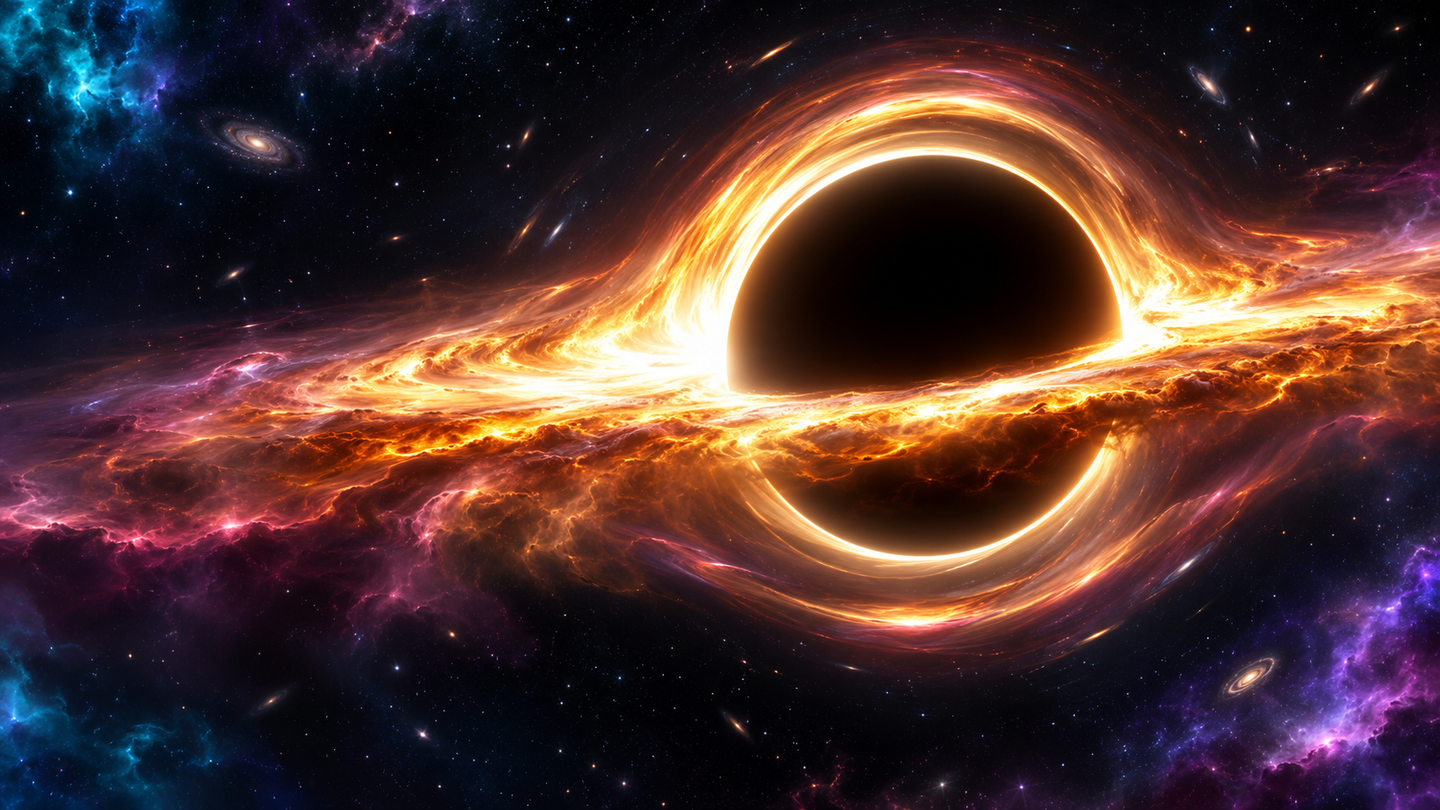
Illustration of a hypothetical giant primordial black hole surrounded by glowing gas. New research constrains such objects as a significant source of dark matter based on their predicted imprint on ancient cosmic light. (CREDIT: The Brighter Side of News)
- Researchers used cosmic microwave background and galaxy-clustering constraints to test whether enormous primordial black holes could hold significant amounts of dark matter.
- A substantial population would create stronger matter–radiation fluctuations than observations permit, excluding that explanation under the study’s assumptions.
- The result does not rule out every primordial black hole, and the identity of dark matter remains unresolved.
Some proposed black holes are so massive that even the giants at galaxy centers would look modest beside them. A new analysis finds that these hypothetical early-universe objects cannot account for a significant share of dark matter without leaving an observational signature that exceeds existing limits.
Researchers at Johannes Gutenberg University Mainz and collaborators tested the idea using constraints from the Big Bang’s ancient afterglow and the distribution of galaxies. Their study in Physical Review Letters narrows one possible explanation for the unseen matter that helps shape cosmic structure.
The authors are Christopher Gerlach, Yann Gouttenoire, Antonio J. Iovino and Nicholas Leister. Gerlach, Gouttenoire and Leister are affiliated with the Mainz Institute for Theoretical Physics and PRISMA research cluster. The paper examines an extreme end of the primordial black-hole mass spectrum, rather than black holes generally.
Its conclusion is specific: giant primordial black holes cannot supply a substantial dark matter component in the modeled scenarios. Rare examples are not excluded simply by that statement. The finding also leaves smaller candidates and other proposals open, including the broader search for primordial black holes.
Defining stupendously large black holes
Primordial black holes are hypothetical objects that could have formed through gravitational collapse in the early universe, before stars existed. That origin distinguishes them from black holes produced by dying stars. Their possible masses span an enormous range, and observations constrain different parts of that range in different ways.
The paper defines stupendously large black holes, or SLABs, as objects weighing at least about 100 billion suns. Its calculations cover a broader interval, from 100 million to 10 quintillion solar masses. At the upper end, the proposed masses are far beyond those of ordinary galactic black holes.
These objects had already been considered too massive to provide all dark matter in the usual galactic picture. However, earlier work left room for a significant cosmological fraction at certain enormous masses. The new research targets that remaining possibility by asking what their uneven distribution would do to the early universe.
The earlier analysis of SLAB constraints explains why this mass range attracted attention. A separate review of primordial black-hole dark matter places it within the wider landscape. Closing one opening in that landscape does not settle every black-hole proposal.
Ancient light preserves a sensitive record
The cosmic microwave background, or CMB, is light that began traveling freely when the universe was about 380,000 years old. Its tiny temperature and polarization variations preserve information about earlier conditions. Researchers can compare predicted patterns with those observations to test ideas about matter, radiation and cosmic evolution.
The European Space Agency’s Planck mission measured that radiation in exceptional detail. Although the spacecraft was switched off in October 2013, its archived observations remain useful for testing new models. A different calculation can reveal implications that were not the original focus when the data were collected.
The new analysis also incorporates constraints informed by baryon acoustic oscillations, or BAO. These are characteristic patterns in the distribution of matter, inherited from sound waves in the early universe. Combining such information with the CMB helps restrict additional fluctuations beyond the standard cosmological picture.
ESA’s explanation of Planck’s cosmic map shows why small variations matter. Its account of the mission’s final command also highlights the difference between a spacecraft’s operational lifetime and the much longer scientific life of its measurements.
Giant objects would make matter too uneven
The central argument begins with discreteness. Black holes are separate objects, rather than an infinitely smooth fluid. If they are scattered randomly, some regions contain more than others by chance. For a fixed total mass contribution, making the individual objects heavier means fewer objects and stronger statistical unevenness.
The researchers modeled the resulting disturbances as isocurvature perturbations. In plain language, these concern changes in the local balance between matter and radiation. Initially, an excess associated with primordial black holes can be compensated by a radiation deficit, without producing the same initial pattern as ordinary primordial density fluctuations.
As the universe expands, radiation loses energy differently from nonrelativistic matter. That early compensation no longer holds in the same way. The black-hole fluctuations then generate gravitational effects that influence the CMB. A sufficiently large population would produce a pattern inconsistent with the observed limits on those disturbances.
The researchers compared those predictions with CMB and BAO constraints described in their paper. This extends the logic behind Planck’s broader cosmological legacy: invisible objects can still face observational tests because their gravity changes radiation and surrounding matter.
What the calculation excludes and what remains
The team found that stupendously large black holes cannot form a significant dark matter component within the framework studied. The conclusion held under two different treatments of where strongly nonlinear fluctuations make the simpler calculations unreliable. Even the more conservative treatment substantially restricted the proposed population.
However, the model assumes a population concentrated at one black-hole mass, called a monochromatic mass function. It also assumes nonspinning black holes and a Poisson distribution for their positions. These choices make the calculation tractable, while defining the conditions under which its abundance limits should be interpreted.
The authors identify broader mass distributions as an extension for future work. They also discuss possible correlations between different fluctuation types. Those possibilities require further calculations; they do not automatically invalidate the present result. Equally, the study does not demonstrate that every individual giant primordial black hole is impossible. Its central output is a limit on abundance across mass, not a direct inventory of objects already observed in space.
Other mass ranges remain separate questions. MIT research on much smaller primordial black holes illustrates that diversity of proposals. Related discussion of hypothetical primordial collapse objects also underscores the need to distinguish a theoretical possibility from an established cosmic population.
Practical implications for dark matter research
The immediate benefit is a narrower set of viable explanations. Researchers searching for dark matter need to know which populations can survive existing observations. The new limits make giant primordial black holes less useful as a substantial hidden mass reservoir, without identifying the particle or object that actually supplies dark matter.
The findings also challenge scenarios connecting abundant primordial black holes with unexpectedly massive early galaxy candidates observed by the James Webb Space Telescope. Likewise, they strengthen constraints on explanations of the nanohertz gravitational-wave background based on primordial black-hole mergers. They do not remove the observed galaxies or gravitational-wave evidence.
NANOGrav’s gravitational-wave background research remains an independent observational achievement. Its explanation of pulsar timing measurements describes how astronomers detect that signal. The Mainz work addresses particular proposed sources, rather than overturning the measurements or proving a single alternative explanation.
Future CMB observations could tighten the limits further, while broader population models could clarify their reach. Leister summarized the remaining challenge: “The early universe still has many puzzles waiting to be solved.” This study advances that search by showing how an apparently invisible population would have made itself known.
Dig deeper into primordial black holes and dark matter
These resources explain alternative primordial black-hole scenarios, observational constraints and the cosmic signals used to test them. Entries appear from newest to oldest and exclude the current paper.
Exotic black holes could be a byproduct of dark matter
This research overview explores a different early-universe scenario involving much smaller primordial black holes and possible observable consequences. (Massachusetts Institute of Technology, June 2024)
Scientists use Exotic Stars to Tune into Hum from Cosmic Symphony
The collaboration explains its evidence for a low-frequency gravitational-wave background and how pulsar timing reveals it. (NANOGrav, June 2023)
A Brief Review on Primordial Black Holes as Dark Matter
This review surveys formation ideas and observations that limit primordial black-hole populations across different masses. (Frontiers in Astronomy and Space Sciences, May 2021)
Constraints on stupendously large black holes
This earlier analysis examines observational limits on exceptionally massive black holes and the remaining scenarios that motivated further tests. (Monthly Notices of the Royal Astronomical Society, November 2020)
From an almost perfect Universe to the best of both worlds
ESA explains Planck’s legacy data release and how microwave measurements constrain the universe’s history and contents. (European Space Agency, July 2018)
Research findings are available online in the journal Physical Review Letters.
The original story "Big Bang afterglow rules out giant black holes as a major dark matter source" is published in The Brighter Side of News.
Related Stories
- Scientists are close to proving that primordial black holes exist
- Astrophysicists are close to proving the existence of primordial black holes
- Evidence of primordial black holes could be hiding inside Earth rocks
Like these kind of feel good stories? Get The Brighter Side of News' newsletter.
Joseph Shavit
Writer, Editor-At-Large and Publisher
Joseph Shavit, based in Los Angeles, is a seasoned science journalist, editor and co-founder of The Brighter Side of News, where he transforms complex discoveries into clear, engaging stories for general readers. With vast experience at major media companies like The Los Angeles Times, Times Mirror and Tribune Publishing, he writes with both authority and curiosity. His writing focuses on space science, planetary science, quantum mechanics, geology. Known for linking breakthroughs to real-world markets, he highlights how research transitions into products and industries that shape daily life.