Researchers reveal how octopuses squeeze and escape through tiny holes
Researchers filmed common octopuses using three-step and four-step sequences to squeeze through narrow holes. Their observations could guide flexible robot design, although the small sample leaves key questions about strategy selection unresolved.

 Edited By: Joshua Shavit

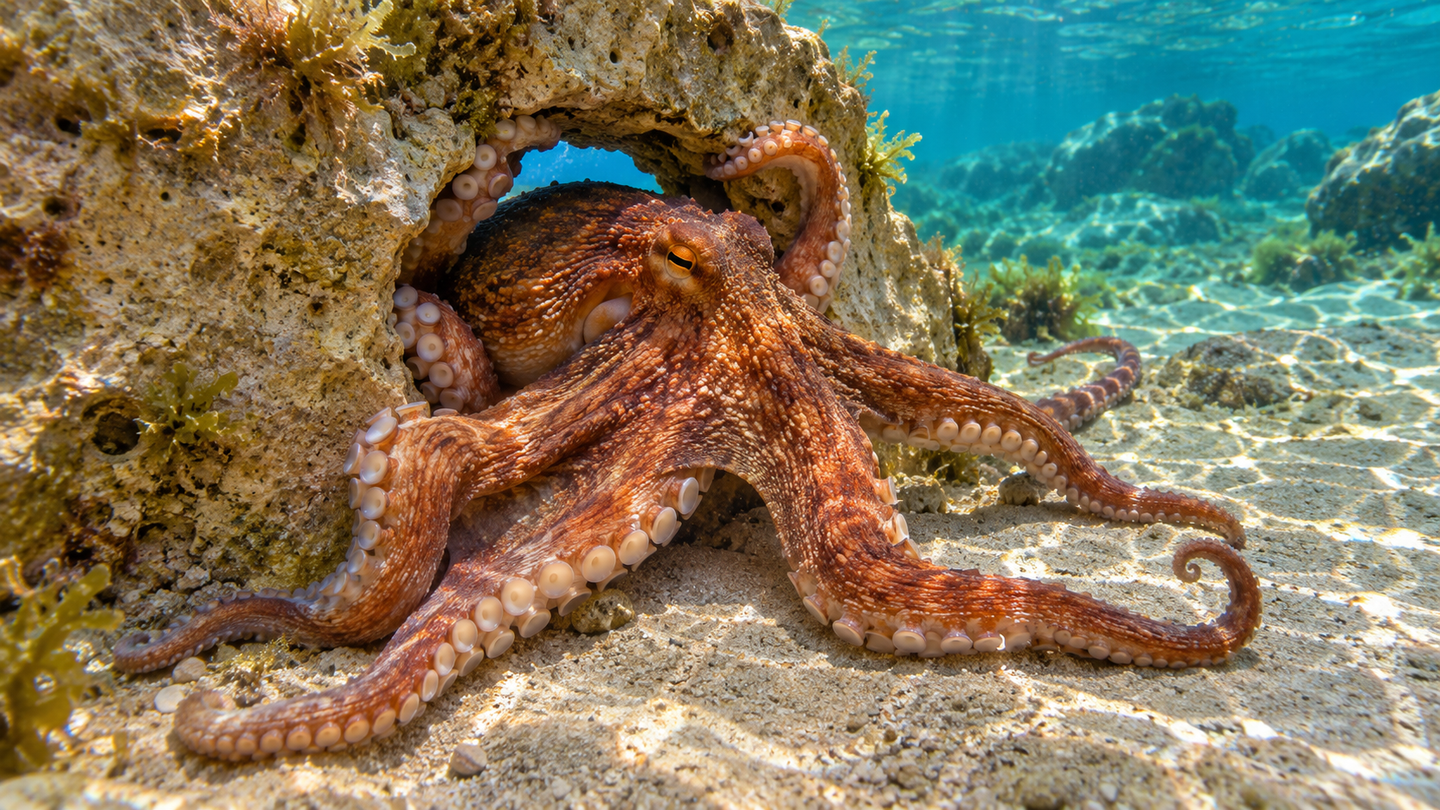
An octopus grips a rocky opening as it pulls its flexible body through in this AI-generated illustration, inspired by research into the coordinated movements behind octopus escapes. (CREDIT: The Brighter Side of News)
- Researchers filmed octopuses using three-step and four-step sequences to move through openings narrower than their bodies.
- Common octopuses tested against relatively tighter holes moved their remaining arms through before pulling their head and mantle after them.
- The small study offers ideas for flexible robots, but larger experiments must separate the effects of hole size from individual differences.
An octopus squeezing through a tiny hole can look as though it is pouring itself through the opening. Close-up recordings reveal something more organized: a sequence of probing, repositioning and bracing that helps the animal pull its body past the barrier.
Researchers working with the National University of Singapore, the University of Naples Federico II and Vienna’s Haus des Meeres–Aqua Terra Zoo documented two versions of that sequence. Their study in the Journal of Experimental Biology examines movements that could inform flexible machines built for cramped environments.
The research team included Wenci Xin, Michael J. Kuba, Tamar Gutnick, Daniel Abed-Navandi and Cecilia Laschi. They studied common octopuses, Octopus vulgaris, and conducted additional exploratory experiments with Mayan octopuses, Octopus maya. Their analysis of octopus squeezing strategies turns an impressive escape behavior into a set of actions researchers can analyze.
“Octopuses can change their body shape to squeeze through tiny holes, almost like water flowing through a gap, so their size doesn’t always limit where they can go,” Xin said. Understanding that coordination could complement existing octopus-inspired robotic arms, which already draw engineering lessons from the animals’ dexterity.
Measuring octopus squeezing strategies
The main experiments involved three subadult common octopuses. Researchers placed clear acrylic partitions inside aquaria, leaving a central opening through which each animal could pass. Cameras recorded the movements from at least two viewpoints, allowing the team to track individual arms and the order of actions.
Rather than judging hole size against the animal’s soft outline, the researchers measured the distance between its eyes. They used this as an indicator of the cartilage capsule surrounding the central nervous system. That provided a reference for comparing the opening with a less deformable part of the body.
One octopus, with an eye spacing of 15 to 20 millimeters, encountered a 20-millimeter opening. The other two, with eye spacing of 30 to 35 millimeters, encountered 30-millimeter holes. Across 33 recorded trials, three unsuccessful trials involved escape attempts elsewhere that damaged the apparatus; 30 trials entered the main strategy analysis.
This approach builds on earlier experiments examining single-arm movements through constrained openings. It also complements research on how octopuses recruit multiple arms. Here, the challenge extended beyond reaching through a barrier: the animals had to move their entire bodies to the other side.
A three-step sequence creates leverage
The simpler sequence began with exploration. An octopus inserted one arm through the opening, producing a bend near the hole and extending the arm beyond it. This probing movement established initial contact with the unfamiliar space before additional arms followed through the same narrow passage.
Next came the shifting stage. Several more arms threaded through, filling much of the available opening. The number shifted ranged from three to five in the reported analysis, with four most common. The remaining arms, head and bulbous mantle stayed on the starting side during this stage.
The final action depended on leverage. Two arms that had already crossed twisted backward and attached their suckers to the far side of the partition. By stiffening and extending against the surface, they generated force that pulled the remaining arms and body through together.
The sequence shows why flexibility alone does not explain the feat. The animals also need attachment and coordinated force. Those same challenges appear in soft-robot research at NUS and in an earlier eight-arm underwater robot designed to combine locomotion with grasping.
Tighter conditions add a fourth step
The common octopuses facing relatively smaller openings divided the final movement into two parts. After probing and shifting, they first transferred the remaining arms through the hole. Only afterward did they pull the head and mantle through, producing the four-step sequence described in the paper.
During the arm-transfer stage, the animals rotated their bodies upward. Twisting and extending movements helped bring the remaining arms past the partition. Once every arm had crossed, the animals restored their orientation and used arms braced against the barrier to pull the final body section through.
Side views also showed the mantle actively changing shape and reducing its diameter before passage. However, the recordings focused mainly on the arms and head. The researchers could not systematically analyze mantle movements, leaving an important part of the squeezing mechanics for future experiments.
These observations connect movement coordination with anatomy. A separate study using MRI to investigate octopus arm muscles explores that relationship for robotics. Earlier work on movement under spatial constraints likewise shows that octopus actions can adapt when an opening restricts their usual range of motion.
Species differences and a small sample
The Mayan octopuses did not complete the same tight-hole maneuver. Four juveniles initially showed no attempt to squeeze through the smaller opening, preventing a comparable systematic analysis. Additional tests showed successful passage through larger openings using the three-step sequence observed in common octopuses.
When offered several openings, a Mayan octopus explored a smaller one and shifted two arms through, but did not complete the next stage. It eventually moved to the larger central opening and passed through. The observations do not establish that Mayan octopuses generally lack the four-step strategy.
The common-octopus sample also limits the conclusions. Each of the three animals was tested under only one relative hole-size condition. Consequently, the association between strategy and opening size could partly reflect individual differences. Repeated trials improve the behavioral record, but they do not replace testing more animals.
Arm use carried another caution. Front-left arms often initiated probing, but the setup provided clearer visibility on one side. That could explain the apparent bias. A different multi-arm foraging study found broadly shared arm use, illustrating why task conditions matter when interpreting octopus-inspired control principles.
Practical implications for flexible robots
For engineers, the lesson from octopus squeezing strategies concerns organization as much as softness. A robot might combine simpler actions such as probing, anchoring and pulling into a coordinated sequence. Dividing a difficult passage into stages could reduce the burden of controlling every part of a continuously deforming body at once, while preserving useful options for adjusting movement when contact changes.
That possibility fits related NUS work on controlling a soft artificial muscle. It also complements advances in robotic arms that sense contact and adjust their grip. Neither development establishes that a complete robot can reproduce the squeezing behavior documented here.
Search-and-rescue and underwater exploration remain potential applications. A machine able to change its effective shape could negotiate passages that would block a rigid body. However, the study tested animals, not rescue robots, and did not demonstrate a working system navigating rubble or operating during a disaster.
The next biological tests need more individuals, several opening sizes for each animal and better measurements of mantle deformation. Even so, the recordings provide a useful starting point. An octopus does more than fit through a gap: it creates contact, finds leverage and moves different body parts through in an organized order.
Dig deeper into octopus movement and soft robotics
These resources explore coordinated arm behavior, muscle anatomy and machines inspired by octopuses. Entries appear from newest to oldest and exclude the current study.
NUS CDE researchers unlock dexterous soft-robot motion from a single artificial muscle
This research overview explains how localized control along one artificial muscle can produce multiple bends in a soft robotic arm. (National University of Singapore, September 2026)
Designing Soft Arms with Octopus-Like Dexterity: Insights from Magnetic Resonance Imaging and Finite Element Analysis
Researchers connect MRI measurements of octopus arm anatomy with simulations of soft robotic designs. (Soft Robotics, January 2026)
How octopuses use and recruit additional arms to find and manipulate visually hidden items
This study examines how octopuses coordinate several arms while searching for and manipulating objects they cannot see. (Biology Open, July 2025)
Bioinspired locomotion and grasping in water: the soft eight-arm OCTOPUS robot
An early underwater robot demonstrates how soft arms can support both movement and grasping. (Bioinspiration & Biomimetics, May 2015)
Octopus arm movements under constrained conditions: adaptation, modification and plasticity of motor primitives
This experiment investigates how individual octopus arms adapt reaching and retrieval movements when constrained by a small opening. (Journal of Experimental Biology, April 2015)
Research findings are available online in the Journal of Experimental Biology.
The original story "Researchers reveal how octopuses squeeze and escape through tiny holes" is published in The Brighter Side of News.
Related Stories
- New DNA findings may explain how octopuses evolved complex brains
- Octopus-inspired robot arm can feel and grasp like living creatures
- Giant octopuses were the ocean's apex predators 100 million years ago
Like these kind of feel good stories? Get The Brighter Side of News' newsletter.
Hannah Shavit-Weiner
Medical & Health Writer
Hannah Shavit-Weiner is a Los Angeles–based medical and health journalist for The Brighter Side of News, an online publication focused on uplifting, transformative stories from around the globe. Having published articles on AOL.com, MSN and Yahoo News, Hannah covers a broad spectrum of topics—from medical breakthroughs and health information to animal science. With a talent for making complex science clear and compelling, she connects readers to the advancements shaping a brighter, more hopeful future.