Primordial naked singularities could reveal physics hidden deep inside black holes
Physicists propose that early cosmic collapse could create naked singularities, offering a possible route to studying extreme gravity if such objects exist.

 Edited By: Joshua Shavit

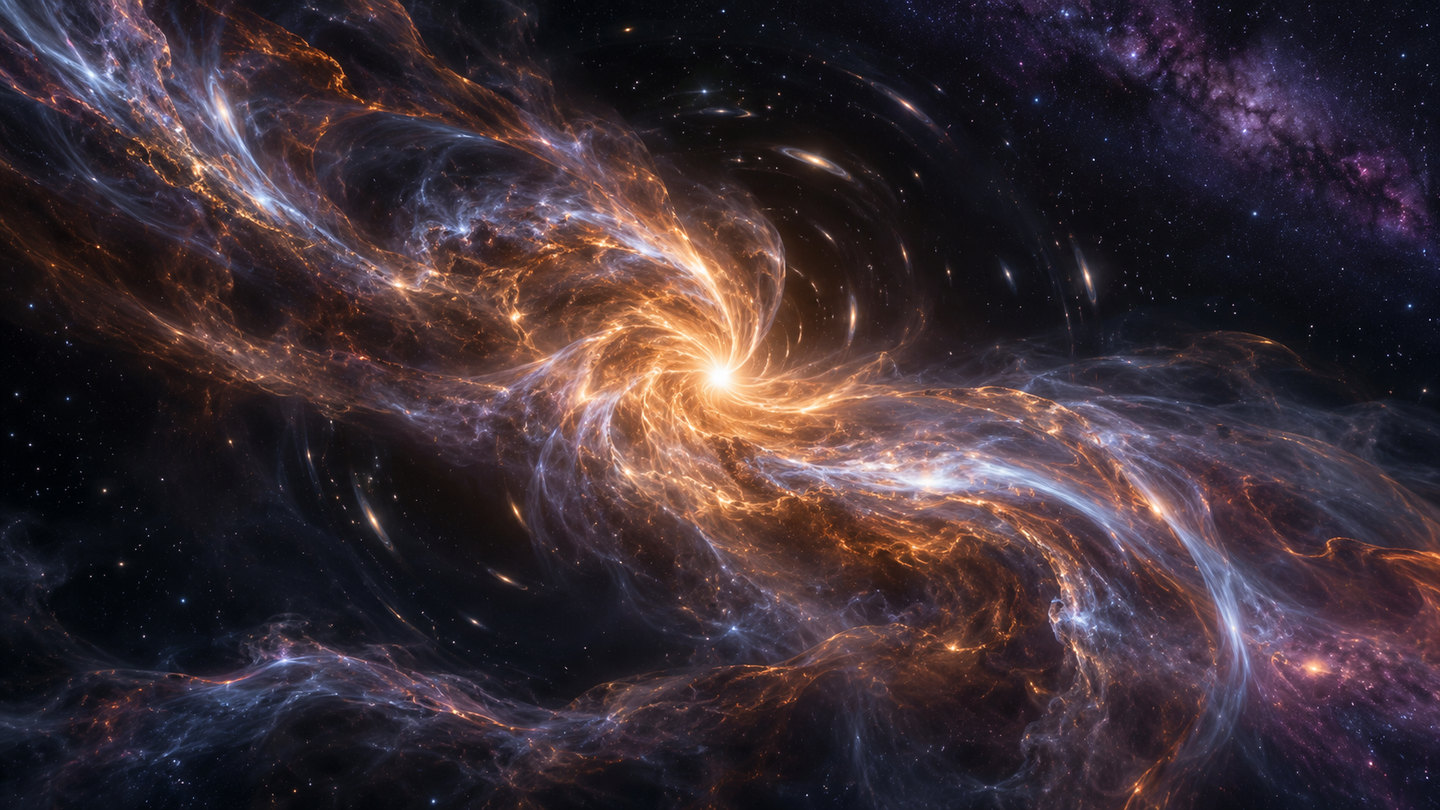
Artist’s impression of a hypothetical primordial naked singularity surrounded by luminous gas and distorted starlight. If such objects exist, their exposed extreme-gravity regions could offer clues to quantum gravity. (CREDIT: The Brighter Side of News)
- A theoretical study proposes that early-universe collapse could produce naked singularities, extreme gravitational regions exposed to distant observers.
- The models describe both temporary exposure and potentially lasting objects, with implications for dark matter and fundamental physics.
- Their existence and abundance remain unconfirmed, and testing the proposal will require distinctive observational predictions.
The early universe may have produced extreme gravitational objects whose deepest regions remained exposed to space. Called primordial naked singularities, these hypothetical objects would differ from black holes in one crucial respect: no event horizon would conceal their central region. If they exist, their surroundings could offer an unusual opportunity to investigate gravity under extreme conditions.
Pankaj Joshi of Ahmedabad University and Sudip Bhattacharyya of the Tata Institute of Fundamental Research explore that possibility in Journal of Cosmology and Astroparticle Physics. Their theoretical work considers how collapsing matter could produce different outcomes in the young cosmos. It places naked singularities alongside primordial black holes as possible products of early gravitational collapse. Neither proposed population has been established through confirmed observations.
The attraction for physicists is the potential connection to quantum gravity. This field seeks a consistent description of gravity that incorporates quantum physics. A region where gravity becomes extraordinarily strong could help reveal which ideas describe nature accurately. The researchers propose a possible setting for those tests, with its physical existence still to be determined.
A boundary that changes what can be seen
A black hole's event horizon marks the boundary beyond which light cannot escape to distant observers. Matter can cross this boundary on its way inward. Signals from within remain hidden from the outside universe. Astronomers therefore study black holes through their gravitational effects and the behavior of material around them.
Gas outside a black hole can become hot and luminous before falling through the horizon. That surrounding material can reveal much about the object's environment. Its radiation nevertheless originates outside the region that the horizon conceals. Observations of bright gas and a central shadow provide a different kind of evidence from direct access to the innermost region.
Classical general relativity predicts singularities where its description reaches an extreme limit. Familiar models involve quantities such as density becoming infinite. Physicists do not know whether that mathematical result corresponds to a literal physical structure. A more complete description may require quantum effects that classical relativity leaves out.
A naked singularity would expose the relevant extreme region because it lacks a concealing event horizon. Here, “visible” means that signals could potentially reach a faraway observer. It does not specify an object's brightness, appearance or ease of detection. Establishing what those signals would look like is part of the scientific challenge.
Collapse before the first stars
Many familiar black holes arise from stellar evolution, but primordial black holes belong to a different formation scenario. They would originate when unusually dense regions in the early universe collapsed under gravity. Such regions could form long before stars existed. This proposed pathway allows scientists to investigate compact objects with histories different from stellar remnants.
Density fluctuations are differences between denser and less dense regions of matter. Gravity can amplify those differences as sufficiently dense regions contract. The outcome depends on the properties of the collapsing material and its initial arrangement. Studying that process requires following local collapse within the broader evolution of the universe.
Joshi and Bhattacharyya investigate outcomes in which the extreme central region remains exposed. Their analysis draws on collapse models involving different descriptions of matter, including fluids and scalar fields. These calculations identify conditions under which naked singularities can arise. Determining how frequently those conditions occurred would require further work on their formation and abundance.
That question connects the proposal with wider research into the early universe. A model must describe a possible physical process before researchers can investigate its consequences. It must then be connected to measurable quantities. For primordial objects, that connection includes how many formed, how they evolved and whether any remain accessible today.
Two ways an extreme region could remain exposed
The authors distinguish event-like singularities from object-like singularities. In the event-like case, the central region becomes exposed during collapse before a horizon eventually conceals it. The object-like case describes a potentially lasting configuration. These categories imply different lifetimes and different opportunities for observations.
Their consequences would also depend on the behavior of matter near the central region. Gravity, pressure and the surrounding environment influence how material evolves. Researchers must understand those processes to predict a signal reliably. The useful comparison is between complete physical models that produce distinguishable observations.
One illustration of that difficulty appears in a separate study in Physical Review D. Its authors constructed a naked-singularity spacetime that casts a shadow without a photon sphere. A photon sphere is associated with light following circular orbits. The result shows that shadow-like features can emerge in different mathematical descriptions of gravity.
Such similarities make detailed comparisons essential. An observed feature becomes more informative when researchers can identify which models reproduce it and which fail. Additional measurements can narrow the possibilities further. Testing a proposed naked singularity would require this kind of scrutiny across its predicted behavior, rather than identification from a single resemblance.
A possible contribution to dark matter
The possibility of lasting primordial objects raises another question: could they contribute to dark matter? This unseen component reveals itself through gravity and helps explain the behavior of galaxies and larger structures. Its composition remains unknown. Cosmological estimates assign about 27% of the universe's total energy budget to dark matter and approximately 5% to ordinary matter.
Most of the remaining budget is attributed to dark energy, associated with accelerated cosmic expansion. Dark matter and dark energy therefore describe separate problems. Understanding the balance among these components is central to reconstructing how cosmic structure developed.
A review in Frontiers in Astronomy and Space Sciences explains how researchers assess primordial black holes as dark-matter candidates. Formation is only the beginning of that assessment. Scientists also examine possible masses, population sizes and observable effects. A candidate must fit the evidence already available as well as offer predictions for future tests.
Primordial naked singularities would need their own assessment alongside other compact-object dark-matter models. Their proposed contribution remains unmeasured. Some observational constraints could overlap with those applied to black holes, while differences in their behavior could matter. Establishing those similarities and differences is necessary before assigning them a share of the unseen matter.
From extreme gravity to measurable predictions
The broader motivation is to connect fundamental physics with evidence. Quantum theory describes microscopic systems, while general relativity describes gravity through the geometry of spacetime. Both frameworks have extensive successful applications. Regions where quantum effects and intense gravity become important together pose especially difficult questions for a unified description.
Researchers approach those questions through both cosmic observations and efforts to test gravity in quantum systems. Laboratory experiments allow controlled comparisons between measured behavior and theoretical predictions. Astronomical settings offer access to conditions far beyond laboratory capabilities. Each approach can test particular aspects of physics within the conditions it reaches.
For naked singularities, a useful prediction must connect the proposed object's structure with a signal that astronomers could measure. Observability in principle leaves open practical questions about distance, strength and competing explanations. Researchers would need to show how a proposed signature differs from other cosmic sources.
Primordial naked singularities remain a theoretical candidate for exploring that frontier. Their importance depends on whether nature creates them, how long they persist and what their surroundings reveal. Connecting collapse calculations with constrained populations and distinctive signals is the next challenge. Those predictions would give astronomers a concrete basis for deciding whether exposed extreme-gravity regions belong in the observable universe.
Dig deeper into primordial singularities and gravity
These resources explain related collapse models, observational ambiguities and the background physics.
On Formation of Primordial Naked Singularities
This follow-up preprint examines formation scenarios in more detail; it should be distinguished from the original journal study. (arXiv preprint, updated July 2025)
Low mass naked singularities from dark core collapse
This separate theoretical study explores how a collapsing dark core could produce different compact outcomes. (Journal of Cosmology and Astroparticle Physics, July 2024)
A Brief Review on Primordial Black Holes as Dark Matter
This review explains formation proposals and observational constraints on primordial black-hole dark matter. (Frontiers in Astronomy and Space Sciences, May 2021)
Shadow of a naked singularity without photon sphere
This study illustrates why shadow-like features require careful interpretation when comparing gravitational models. (Physical Review D, July 2020)
Anatomy
NASA explains black-hole horizons, surrounding matter and the uncertainty associated with singularities. (NASA)
Research findings are available online in the journal Nature Communications.
The original story "Primordial naked singularities could reveal physics hidden deep inside black holes" is published in The Brighter Side of News.
Related Stories
- Quantum Gravity: How Information Theory Could Reveal the Universe’s Deepest Secrets
- A falling quantum object just passed a century-old test of Einstein’s gravity
- New research links quantum collapse to time and gravity
Like these kind of feel good stories? Get The Brighter Side of News' newsletter.
Joseph Shavit
Writer, Editor-At-Large and Publisher
Joseph Shavit, based in Los Angeles, is a seasoned science journalist, editor and co-founder of The Brighter Side of News, where he transforms complex discoveries into clear, engaging stories for general readers. With vast experience at major media companies like The Los Angeles Times, Times Mirror and Tribune Publishing, he writes with both authority and curiosity. His writing focuses on space science, planetary science, quantum mechanics, geology. Known for linking breakthroughs to real-world markets, he highlights how research transitions into products and industries that shape daily life.