Bio-metals: Ancient sea worms hold the secret to a strange new class of materials
Microscopic tests reveal how an ancient bristle worm builds jaws that blur the boundary between living tissue and metal.

 Edited By: Joseph Shavit

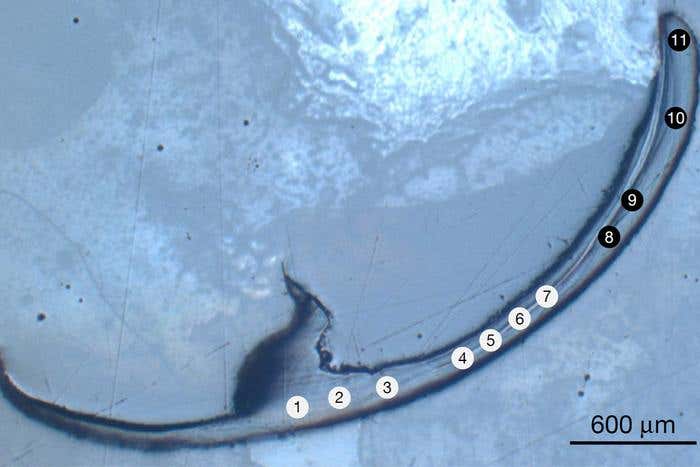
A cross-section of a bristle worm jaw sample with the indentation testing sites labeled 1 to 11. (CREDIT: Zelaya-Lainez et al.)
Perinereis cultrifera carries jaws that blur the boundary between biology and metal. Built from proteins and metal ions, the ancient sea worm’s biting tools harden toward their tips and behave in ways usually associated with copper or silver.
Researchers from TU Wien and the University of Vienna examined those unusual mechanics in Biophysics Reviews. Their work supports a proposed category called “bio-metals,” which describes natural materials that combine polymer-like structures with metal-like hardness and deformation.
The term is more specific than labels such as “metallike biomaterials.” The researchers argue that a bio-metal should be judged by three features: hardness, strain behavior and an ion-protein structure.
Perinereis cultrifera, a predatory bristle worm that remains alive today, offers a useful test case. Its jaws contain structural proteins coordinated with metal ions. The worm uses them to bite, crush and eat.
Harder tips emerge from an uneven jaw
The team studied a single jaw along its midplane rather than only at the outer surface. They tested 11 areas across its central and tip regions.
Using nanoindentation, the researchers pressed a tiny probe into the material at six different depths. The method creates microscopic dents and measures how strongly the sample resists them.
Chemical analysis and imaging showed that metal ion concentrations were greater near the jaw tips than in the center. That pattern confirmed earlier observations and probably explains why the tips are harder.
The jaw was not uniformly hard at every scale. Shallower indents met greater resistance than deeper ones, meaning smaller tested regions appeared harder.
That behavior matches the Nix-Gao nanoindentation size effect, a relationship commonly associated with crystalline metals. Under that relationship, squared hardness increases as indentation depth decreases.
Copper and silver can show the same pattern. In those materials, the effect is generally linked to dislocations, which are line-like irregularities within an atomic lattice.
The worm jaw has no conventional metallic crystal lattice. Instead, its structure consists of ion-coordinated proteins. Yet its hardness followed the same size-dependent law in both the central and tip regions.
A metal-like effect inside a protein matrix
The result strengthens earlier evidence that strain-gradient plasticity also operates in this biological material. Strain describes how a material changes shape under force. A strain gradient describes how that deformation varies across space.
At very small indentation depths, strain changes sharply over a short distance. That can increase resistance to deformation and make the tested area appear harder.
The finding stands out because the Nix-Gao effect is widely treated as a major feature of crystalline metals. Detecting it in a protein-based jaw shows that similar mechanical behavior can emerge from a very different microscopic structure.
The researchers did not stop with hardness. Their measurements also revealed a size-dependent change in elasticity.
“Bristle worm jaws also showed size-dependent elasticity — this is a distinguishing feature of bio-metals when compared to standard crystalline metals like copper or silver,” said author Christian Hellmich.
Elasticity describes how a material deforms and then returns toward its original shape. In the bristle worm jaw, that response changed with the size of the tested region.
Copper and silver may display a hardness size effect, but they do not show the same elastic pattern described in the jaw. That difference helps separate bio-metals from ordinary crystalline metals.
Modeling forces at smaller scales
To explain the elastic effect, the team used mathematical modeling based on “manifold micromechanics.” The framework connects tiny structural forces with the larger mechanical response of a material.
The researchers considered concentrated microscopic forces known as Peach-Koehler forces. These forces are associated with dislocation-like folds inside the ion-coordinated protein matrix.
According to the model, those folds can produce strain gradients large enough to affect the material at the scale represented in the experiments. The result offers a theoretical explanation for why elasticity changes with indentation depth.
The work connects all three parts of the proposed bio-metal definition. The jaw combines unusual hardness, size-dependent strain mechanics and a structure built from proteins coordinated by ions.
The classification does not claim that the jaw is a conventional metal. Instead, it recognizes a blend of properties that does not fit comfortably within older descriptions.
That distinction matters because phrases such as “metal-like biomaterial” can broadly describe natural substances with strength or conductivity resembling metals. The bio-metal concept adds structural and mechanical requirements.
An ancient material raises new questions
The findings come from one jaw belonging to one species. The team plans to examine additional bristle worms and expand the experimental database.
A larger sample could show whether the same hardness and elasticity patterns appear across species. It could also help refine the theoretical framework behind the proposed classification.
“We plan to extend the experimental database by investigating additional species to refine the theoretical concept and perform dedicated computations, and — perhaps most interestingly — to explore the link between genetic interventions and the corresponding material design space,” Hellmich said.
“All this comes with true excitement about the beauty, elegance, and refinement found in and produced by nature.”
The planned genetic work raises a further question: whether changes in genes could alter the jaw’s composition and mechanical behavior.
For now, the research establishes a clearer experimental basis for treating these jaws as a distinct material. Their combination of polymeric and metallic traits makes them unusual within biology and materials science.
Practical implications of the research
A stronger definition of bio-metals could help biophysicists compare natural materials that use ions to strengthen protein structures. It may also guide studies of how hardness and elasticity emerge without a conventional metal lattice.
Testing more species could reveal which features are widespread and which belong only to certain worms. Those comparisons would help refine models of strain, deformation and ion-protein organization.
The research also creates a framework for studying how genetic changes might influence material properties. Such work could clarify how living organisms control the design of hard tissues at microscopic scales while expanding the emerging fields of biophysics and bioengineering.
Research findings are available online in the journal Biophysics Reviews.
The original story "Bio-metals: Ancient sea worms hold the secret to a strange new class of materials" is published in The Brighter Side of News.
Related Stories
- Flatworms defy stem cell rules, offering a blueprint for human regeneration
- Earth's first animals may have been sea sponges, study finds
- Scientists discover giant predatory worms dating back 518 million years
Like these kind of feel good stories? Get The Brighter Side of News' newsletter.
Mac Oliveau
Writer
Mac Oliveau is a Los Angeles–based science and technology journalist for The Brighter Side of News, an online publication focused on uplifting, transformative stories from around the globe. Having published articles on MSN, and Yahoo News, Mac covers a broad spectrum of topics including medical breakthroughs, health and green tech. With a talent for making complex science clear and compelling, they connect readers to the advancements shaping a brighter, more hopeful future.