Astronomers discover four nearby white dwarfs hiding in plain sight
Four faint stellar remnants escaped detection for decades while brighter red dwarf companions concealed their ultraviolet glow.

 Edited By: Joseph Shavit

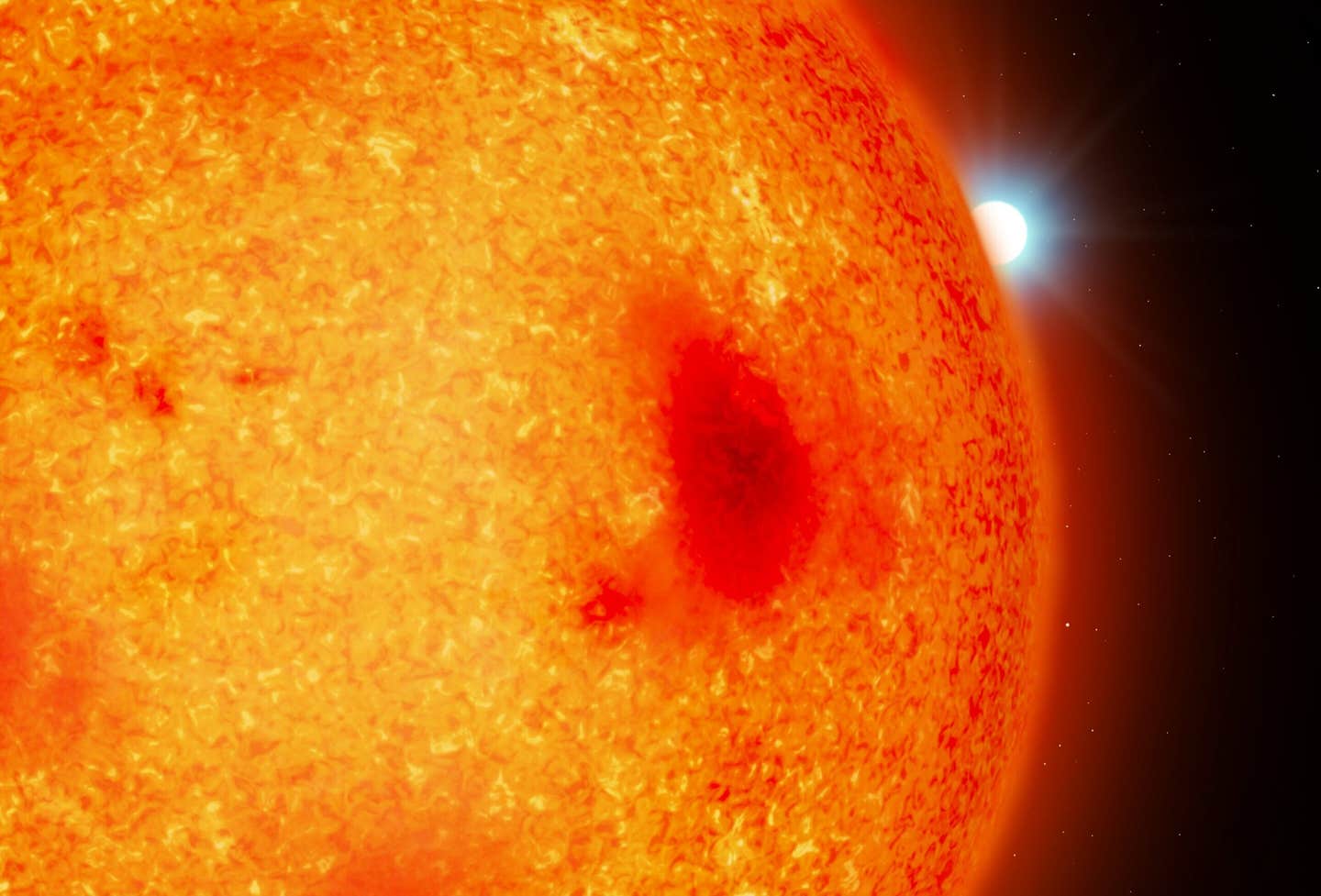
An artist impression of a red dwarf with a white dwarf binary companion peeking out from behind. The diameters of the two stars are shown to scale. (CREDIT: Mark A. Garlick / University of Warwick)
Four white dwarfs have been sitting next door in astronomical terms, yet brighter stellar companions kept them out of sight. Ultraviolet observations have now exposed the compact stars within 65 light-years of Earth.
Each white dwarf orbits a red dwarf, a small main-sequence star that shines more strongly in visible light. From Earth, the pairs looked like single stars. Their motion, however, hinted that something massive was tugging at them.
The systems are G 203-47, GJ 207.1, LHS 1817 and Wolf 1130. Researchers from the University of Warwick and the University of Colorado Boulder confirmed their white dwarfs with the Hubble Space Telescope and the Neil Gehrels Swift Observatory. The findings appeared in Monthly Notices of the Royal Astronomical Society.
“Nearby isolated white dwarfs are usually easy to find, but we couldn't see these four stars directly in visible wavelengths because their red dwarf companions were drowning out their light,” said first author Dr. Mairi O’Brien, a research fellow at Warwick. “It's a reminder that even in our own cosmic neighborhood, we can still find surprises if we look in the right way, at the right wavelengths.”
A wobble pointed to unseen companions
Astronomers became interested in the four red dwarfs because their motion showed substantial radial velocity shifts. This back-and-forth wobble can reveal an unseen companion’s gravitational pull.
Earlier measurements indicated that the hidden objects had masses consistent with white dwarfs, the dense remnants left after stars exhaust their fuel. Yet none had been directly detected in visible light.
Ultraviolet observations offered another route because white dwarfs can stand out at those wavelengths. Red dwarfs complicated the search. Their flares can produce ultraviolet light that imitates a white dwarf signal.
The team used Hubble’s Space Telescope Imaging Spectrograph to separate the white dwarf continuum from red dwarf activity. Swift observations helped determine whether flares occurred during some Hubble visits.
One Hubble setting also scattered red light into the detector, creating false ultraviolet flux. The researchers developed a custom correction by comparing two observations of G 203-47 made with different settings.
After correcting the data and masking stellar emission, the team identified all four white dwarfs. Their estimated temperatures ranged from about 5,300 to 6,300 kelvins.
A nearby system waited 27 years
G 203-47 lies about 25 light-years away, making its white dwarf the ninth closest known white dwarf to the Sun.
The system was identified as a spectroscopic binary in the 1990s. Its wobble suggested a compact companion, but direct confirmation took 27 years after the initial radial velocity observation.
G 203-47 also occupies an unusual place among post-common-envelope binaries. These systems form after one star expands late in life and surrounds both stars in a shared gas envelope. The interaction can shrink the orbit by removing angular momentum.
The stars in G 203-47 orbit each other every 14.9 days. Yet photometric variation and hydrogen emission indicate that the red dwarf may take more than 100 days to rotate.
That mismatch means the pair is probably not tidally locked. In a locked system, rotation becomes synchronized with the orbit, similar to the Moon keeping the same face toward Earth.
“What's fascinating is that G 203-47 shouldn't be rotating this slowly if it formed the same way as similar systems,” said co-author Dr. David Wilson of the University of Colorado Boulder. “This suggests that these binaries have had very different evolutionary histories. Some underwent violent, prolonged interactions early on that locked them tidally. Others, like G 203-47, experienced gentler, briefer encounters that left them in this unusual state.”
Four detections match the models
The confirmations allowed the team to update the white dwarf census within 20 parsecs, or about 65 light-years. The researchers counted 153 confirmed white dwarfs, plus as many as 10 unverified candidates.
Their estimate placed the local density at 5.2 white dwarfs per 1,000 cubic parsecs, with an uncertainty of 0.4. That is 16 percent higher than an earlier estimate based on Gaia’s second data release.
The four close white dwarf-red dwarf systems also matched population predictions. Binary Population and Spectral Synthesis models predicted about 4.4 systems within 20 parsecs. The team confirmed four.
The nearby census is probably incomplete. Only about 30 percent of red dwarfs within 20 parsecs have received systematic radial velocity surveys capable of revealing hidden white dwarfs.
“Only about 30 per cent of red dwarfs within 20 parsecs have been systematically surveyed for hidden white dwarf companions,” said Professor Pier-Emmanuel Tremblay of Warwick. “We think there could be as many as 9 or 10 additional binary systems in our local stellar environment that we haven’t found yet. If we put more targeted effort into observing red dwarfs, perhaps we will find more surprises like this.”
Ultraviolet light exposes a difficult population
The work shows why broad ultraviolet photometry alone can misidentify these binaries. Temperatures estimated from photometric measurements were 5 to 8 percent higher than estimates based on Hubble spectra.
Red dwarf activity added ultraviolet emission, while standard models did not fully reproduce their chromospheres. Photometric fits therefore assigned too much ultraviolet light to the white dwarfs.
Near-ultraviolet spectra let the team isolate the smoother white dwarf signal and remove emission features. Even then, the coolest companions could remain undetectable. White dwarfs below roughly 4,700 to 5,500 kelvins might escape detection in these systems.
Practical implications of the research
A more complete local census can help astronomers test how often close binaries survive the common-envelope phase and what orbits emerge afterward. These observations can constrain models of angular momentum loss, stellar rotation and binary evolution.
G 203-47 may help distinguish systems that experienced long, forceful envelope interactions from those that underwent shorter encounters. Rotation measurements in other binaries with several-day orbits could test that possibility.
Future multi-epoch radial velocity surveys of nearby red dwarfs could uncover the estimated nine or 10 missing systems. Gaia’s future astrometric data may identify more binaries through subtle changes in stellar position, expanding a population that remains difficult to see in the Sun’s neighborhood.
Research findings are available online in the journal Monthly Notices of the Royal Astronomical Society.
The original story "Astronomers discover four nearby white dwarfs hiding in plain sight" is published in The Brighter Side of News.
Related Stories
- Student astronomer discovers rare white dwarf star feeding on a red dwarf companion
- Gamma Cassiopeiae may be hiding a magnetic white dwarf companion
- White dwarf star is still feasting on dead Earth-like planet 3 billion years later
Like these kind of feel good stories? Get The Brighter Side of News' newsletter.
Joshua Shavit
Writer and Editor
Joshua Shavit is a NorCal-based science and technology writer with a passion for exploring the breakthroughs shaping the future. As a co-founder of The Brighter Side of News, he focuses on positive and transformative advancements in technology, physics, engineering, robotics, and astronomy. Having published articles on AOL.com, MSN, Yahoo News, and Ground News, Joshua's work highlights the innovators behind the ideas, bringing readers closer to the people driving progress.