Bird-inspired robot swims, plunges, and flies using flapping wings
MIT and EPFL engineers built a bird-like robot that swims, plunges, and launches from water using only flapping wings.

 Edited By: Joshua Shavit

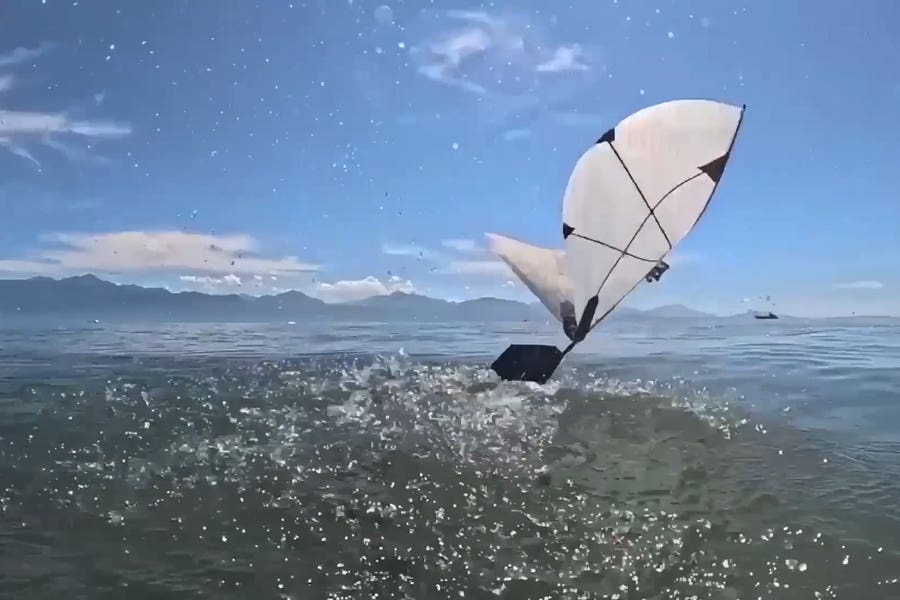
The aerial-aquatic robot can swim underwater, then flap out of the water to continue flying through air, much like diving birds. (CREDIT: Raphael Zufferey)
A lightweight robot modeled on diving birds can swim underwater, break through the surface, and continue flying without using feet or propellers. The feat exposes a difficult mechanical compromise between movement in dense water and thin air.
Engineers at MIT and EPFL in Lausanne, Switzerland, built the flapping-wing aerial-aquatic vehicle, or FAAV, to explore how animals such as puffins, petrels, gulls, and loons move through both environments.
The untethered robot weighs about 250 grams and resembles a small bird. It has a slender waterproof body, two flexible membrane wings, a battery-powered motor, and a steerable tail. Researchers can replace the wings and tail to test different dimensions and mechanical properties.
Balanced design
Experiments in tanks, a wind tunnel, indoor flight spaces, and Lake Geneva showed that one carefully balanced design could fly, swim, plunge into water, and launch back into the air. The results will appear in the journal Science.
The work provides a robotic test bed for questions that are difficult to study in living birds. It could also support future vehicles that collect ocean data in places too hazardous or expensive for ships.
“Our dream vision is for oceanographers, marine biologists, and members of coastal communities to launch this robot from a boat, or from shore, and it would fly close to the area of interest, such as an iceberg or a port facility, or over a pod of whales,” said Raphael Zufferey, an MIT assistant professor of mechanical engineering and the study’s lead author.
“It would dive into the water to take a measurement or collect a sample, and fly back to deliver the data at a fraction of the cost of traditional methods. Then it could go back out to dive for more.”
One set of wings, two conflicting jobs
Water is about 1,000 times denser than air. Wings moving through water face far greater resistance, yet they must still produce enough lift and thrust for flight once the vehicle becomes airborne.
Diving birds solve that problem partly by changing their wing motion. Smaller species generally flap about 10 times per second in air and roughly four times per second underwater. Larger birds use somewhat lower frequencies because of their wider wingspans.
The robot could vary its flapping rate from 0.1 to 6 hertz underwater and from 5.2 to 11 hertz in air. Instead of copying the complex wing-folding movements of birds, the engineers used passive flexibility.
As the wings push against water, they bend and reduce their effective travel. That deformation lowers the speed of the wingtips and limits the force placed on the motor. Underwater, the wingtip movement fell by 60 to 90 percent as flapping frequency increased.
Different sized wings
The team tested small, medium, and large wings. In the wind tunnel, the medium and large versions produced enough forward thrust above 6 hertz. The small wings required frequencies above 10 hertz, near the motor’s limit.
Underwater, however, smaller wings moved faster. At five flaps per second, the small-winged robot reached 0.95 meters per second. Medium wings produced 0.79 meters per second, while large wings reached 0.64 meters per second.
The larger surfaces generated more propulsive force, but they also created more drag. That finding supports the idea that diving birds reduce effective wing area partly to increase underwater speed, rather than simply to save energy.
Wing stiffness produced another trade-off. Softer wings improved underwater speed and lowered transport costs at slow flapping rates. Yet wings that bent too easily could not produce enough lift or forward thrust in air. Stiffer wings loaded the motor more heavily and destabilized the vehicle near the surface.
Medium-sized wings with medium stiffness offered the best overall compromise. With that configuration, the robot averaged 6.3 meters per second in flight and could swim at nearly 1 meter per second.
The difficult second between water and air
Leaving the water posed the greatest challenge. The robot had to accelerate upward while part of its body remained submerged, shedding water as its wings switched from pushing against a liquid to pushing against air.
The tail’s position proved critical. Without a tail, the robot could leave the water but became unstable in flight. A long tail remained submerged too long, creating drag that tipped the nose downward. A short tail reduced that force while retaining enough control for stable flight.
Lake and tank tests also revealed a narrow range of successful exit angles. Below 55 degrees, drag on the submerged tail prevented a complete escape. At 80 degrees or more, the robot often tipped backward after becoming airborne and fell into the water.
At 70 degrees, every tested exit succeeded.
The maneuver took less than one second. The fuselage emerged after about 0.3 seconds, the rear edges of the wings cleared the surface near 0.8 seconds, and the tail followed at roughly one second. The vehicle needed eight to 10 wing strokes to complete the launch.
Most birds launch from water differently
Most puffins, ducks, and other aquatic birds paddle with their feet while flapping to take off from water. The robot had no legs, yet it still escaped using its wings alone.
“If you look at birds, most birds need to paddle at the surface to take off. And the question was, do we need the same for robots? And it turns out we don’t,” Zufferey said.
The launch remained costly. The robot used about 190 watts per kilogram during water exit, compared with 74 watts per kilogram in cruising flight and 18 watts per kilogram while swimming. Only about one-fortieth of the electrical energy used during egress became useful kinetic and potential energy.
The vehicle also survived the opposite transition. During plunge-diving tests, it entered the water at 5 meters per second and rapidly slowed to 0.5 meters per second, experiencing an impact force of about 60 g. It then began swimming regardless of the wings’ position at impact.
A mobile laboratory for animal movement
The robot cannot reproduce every feature of a bird. Its wings are far more flexible than biological wings, and its neutral buoyancy means it does not spend energy counteracting the upward force that diving birds experience underwater.
The experiments also did not fully explain the fluid flow and pressure around the bending wings. The authors said that analysis would be needed to clarify why highly flexible wings perform well underwater but fail to provide adequate force in air.
Still, the system allows researchers to change wing size, stiffness, flapping rate, tail position, and exit angle in ways that animal experiments cannot. Computer models also struggle with the large wing deformations and rapidly changing forces at the water’s surface.
The team now plans to develop wings that can turn as well as flap. Future tests will examine performance in choppy water and wind, conditions far less predictable than a tank or calm lake.
Practical implications of the research
A vehicle that repeatedly flies to a site, dives for a measurement, and returns could expand how frequently scientists sample oceans, lakes, and coastal waters. It might approach icebergs, ports, wildlife groups, or other areas that place boats and crews at risk.
“One of the major challenges in ocean science is collecting data both frequently and across many locations, which is something this robot could do in the future,” Zufferey said. “You could send this out not just every week, but every hour. It could fly out at high speeds, dive in fly back, deliver its data, and go back out, multiple times.”
The current robot establishes the mechanics rather than a finished field system. Yet its successful wing-only launch shows that legs, propellers, and explosive assistance are not always necessary. Flexible wings, controlled flapping, and a steep exit path may be enough to connect underwater travel with sustained flight.
Research findings are available online in the journal Science.
The original story "Bird-inspired robot swims, plunges, and flies using flapping wings" is published in The Brighter Side of News.
Related Stories
- Bee-inspired navigation system lets tiny robots fly without GPS
- Incredible ‘flying dragon’ robot fights fires from a distance with powerful water blasts
- Magical fairy-like robot flies by the power of wind and light
Like these kind of feel good stories? Get The Brighter Side of News' newsletter.
Joseph Shavit
Writer, Editor-At-Large and Publisher
Joseph Shavit, based in Los Angeles, is a seasoned science journalist, editor and co-founder of The Brighter Side of News, where he transforms complex discoveries into clear, engaging stories for general readers. With vast experience at major media companies like The Los Angeles Times, Times Mirror and Tribune Publishing, he writes with both authority and curiosity. His writing focuses on space science, planetary science, quantum mechanics, geology. Known for linking breakthroughs to real-world markets, he highlights how research transitions into products and industries that shape daily life.