Scientists unlock the secret role of ocean microbes in Earth’s climate
Scientists identify key microbial roles in oceans, improving understanding of carbon cycling and climate change predictions.

 Edited By: Joseph Shavit

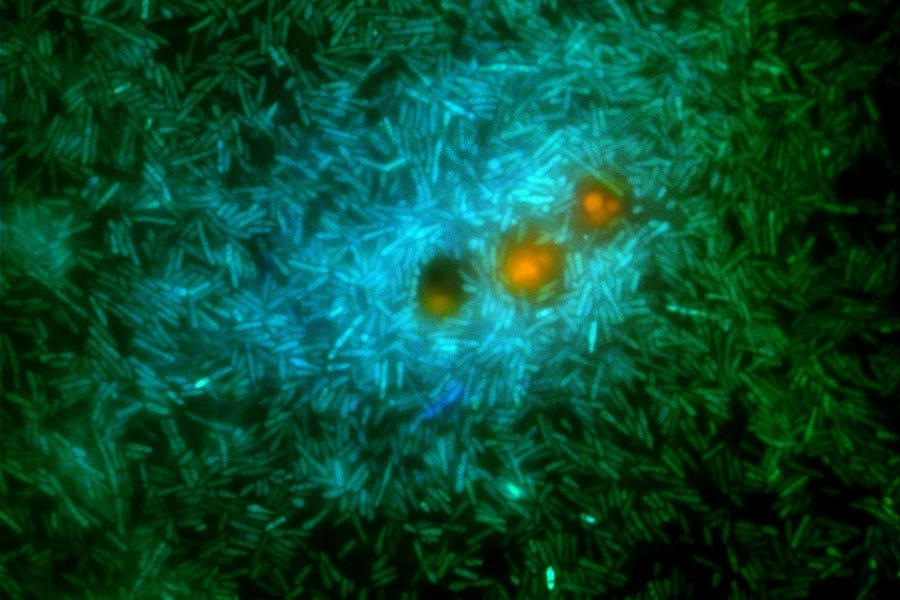
New research reveals how ocean microbes shape the carbon cycle, offering a clearer path to understanding climate change. (CREDIT: Cherry Gao, Roman Stocker)
Beneath the ocean’s surface, an unseen system works without pause. Tiny microbes drift through the water, breaking down organic matter and recycling carbon. These microscopic organisms quietly influence Earth’s climate, yet their complexity has long puzzled scientists.
A new study from USC Dornsife College of Letters, Arts and Sciences offers a clearer way to understand this hidden world. Published in Science Advances, the research groups marine microbes into a small number of functional roles, helping explain how they shape the global carbon cycle.
“These microbes are incredibly diverse, but we found that their behavior can be grouped into a manageable number of strategies,” said Naomi Levine, a professor at USC Dornsife. “That gives us a much clearer way to connect microbial life to the carbon cycle.”
A Hidden Workforce Beneath The Waves
Marine microbes play a central role in how carbon moves through the ocean. Some use sunlight to turn carbon dioxide into organic matter. Others consume that material and release carbon back into the water.
This constant exchange helps determine how much carbon the ocean stores and how much returns to the atmosphere. The balance affects global temperatures and climate patterns.
Despite their importance, these communities are difficult to study. A single drop of seawater can contain thousands of microbial species. Each one behaves differently, responding to changes in nutrients and environmental conditions.
“The big challenge has been figuring out how to simplify that complexity without losing what really matters,” Levine said.
Turning Complexity Into Patterns
To address this challenge, researchers analyzed genetic data from thousands of microbes collected worldwide. They used advanced computer models to simulate how each organism grows and uses nutrients.
The models tested how microbes respond to different food sources, such as sugars, amino acids, and organic acids. Scientists also examined how growth changed when certain nutrients became scarce.
This approach revealed which resources each microbe depends on most. From there, the team used machine learning to group organisms based on shared behaviors.
The result was a framework of eight distinct “metabolic niches,” or functional strategies. Each group represents a different way microbes survive and compete in the ocean.
Eight Ways To Survive In The Ocean
Some of these groups consist of fast-growing “generalists.” These microbes can consume many types of nutrients and adapt quickly to changing conditions.
Others are slower-growing “specialists.” They rely on specific resources and thrive in stable, nutrient-poor environments.
“It’s a little like categorizing people by how they eat,” Levine said. “Some will eat almost anything, while others depend on very particular diets.”
Between these extremes, several intermediate groups show mixed traits. Each one responds differently to changes in nutrient availability.
This simplified structure helps scientists understand how microbial communities function without tracking every individual species.
Where Different Microbes Thrive
The study also revealed clear patterns across the ocean.
Fast-growing generalists dominate in nutrient-rich areas, such as coastal waters and river outflows. These environments provide abundant food, allowing flexible microbes to flourish.
In contrast, slower specialists are more common in the open ocean, where nutrients are limited. Their efficiency allows them to survive in harsher conditions.
These patterns reflect trade-offs. Organisms that grow quickly tend to be adaptable. Those that grow slowly often specialize in specific resources.
By linking these strategies to geography, the study explains why microbial communities differ from place to place.
Why Microbes Matter For Climate
Understanding these patterns is critical for climate science. Marine microbes drive the ocean’s carbon cycle, influencing how much carbon remains trapped in water versus released into the atmosphere.
Current climate models struggle to include microbial activity because of its complexity. Thousands of species interacting in unpredictable ways make accurate predictions difficult.
By reducing this diversity into a small number of functional groups, the new framework offers a practical solution.
“If we want to understand climate, we have to understand the microbes,” Levine said. “They’re the engines driving carbon cycling in the ocean.”
This approach could improve predictions about how oceans respond to climate change, including how much carbon they can store in the future.
A New Layer Of Detail
The study builds on earlier research that grouped microbes based on growth rates. Previous work identified broad categories such as fast-growing and slow-growing organisms.
The new framework adds detail by focusing on metabolism, or how microbes use resources. It identifies not just how quickly organisms grow, but what they consume and how they respond to scarcity.
Together, these insights create a more complete picture of marine ecosystems. They show how biological processes shape the movement of carbon on a global scale.
Breaking Old Assumptions
One surprising finding is that microbial function does not always match species identity. Closely related organisms can behave very differently, while distant species may share similar strategies.
This challenges traditional approaches that focus on classification by species. Instead, it suggests that understanding function is more important than knowing names.
By focusing on what microbes do rather than what they are called, scientists can better understand how ecosystems operate.
Limits And Future Research
Despite its promise, the framework does not capture all microbial diversity. Some groups remain poorly understood due to limited genetic data.
The models also rely on predictions about how microbes use nutrients. Real-world behavior may differ in ways not fully captured by simulations.
Future research will aim to refine these models using laboratory experiments and improved genomic data. Scientists hope to include more microbial groups and expand the framework over time.
Even with these limits, the study represents a major step forward in understanding one of Earth’s most complex systems.
A New Way To See The Ocean
The ocean may appear vast and simple from above, but it is powered by invisible life below. These microbes influence everything from nutrient cycles to climate stability.
By uncovering patterns in their behavior, scientists have created a clearer map of this hidden world. Instead of chaos, there is structure. Instead of endless complexity, there are recognizable strategies.
“We’re trying to take something incredibly complicated and find the underlying patterns,” Levine said. “Once you see those patterns, it becomes much easier to understand how the whole system works.”
Practical Implications Of The Research
This research offers a powerful tool for improving climate predictions. By simplifying microbial diversity into functional groups, scientists can better include these processes in large-scale models. This could lead to more accurate forecasts of how oceans absorb and release carbon in a warming world.
The findings also highlight the importance of protecting marine ecosystems. Changes in nutrient levels, temperature, or pollution could shift microbial communities, altering how carbon moves through the ocean. Understanding these dynamics may help guide conservation efforts.
For future research, the framework opens new opportunities to study how microscopic life shapes global systems. It may also inspire similar approaches in other fields, where complex biological networks need simplification.
Ultimately, the study shows that even the smallest organisms can have a profound impact. By understanding their roles, scientists move closer to understanding the planet itself.
Research findings are available online in the journal Science Advances.
The original story "Scientists unlock the secret role of ocean microbes in Earth's climate" is published in The Brighter Side of News.
Related Stories
- Scientists turn carbon dioxide into renewable methane using microbes
- Warming ice awakens microbes that could speed climate change
- Study finds microbes used oxygen far earlier than scientists thought
Like these kind of feel good stories? Get The Brighter Side of News' newsletter.
Rebecca Shavit
Writer
Based in Los Angeles, Rebecca Shavit is a dedicated science and technology journalist who writes for The Brighter Side of News, an online publication committed to highlighting positive and transformative stories from around the world. Having published articles on MSN, AOL News, and Yahoo News, Rebecca's reporting spans a wide range of topics, from cutting-edge medical breakthroughs to historical discoveries and innovations. With a keen ability to translate complex concepts into engaging and accessible stories, she makes science and innovation relatable to a broad audience.