Mirror universe where time runs backwards could help explain dark matter, antimatter and neutrinos
Soon after the Big Bang, the universe was remarkably simple: space was nearly flat, filled mostly with radiation, and accurately described by the standard Friedmann-Robertson-Walker model.

 Edited By: Joshua Shavit

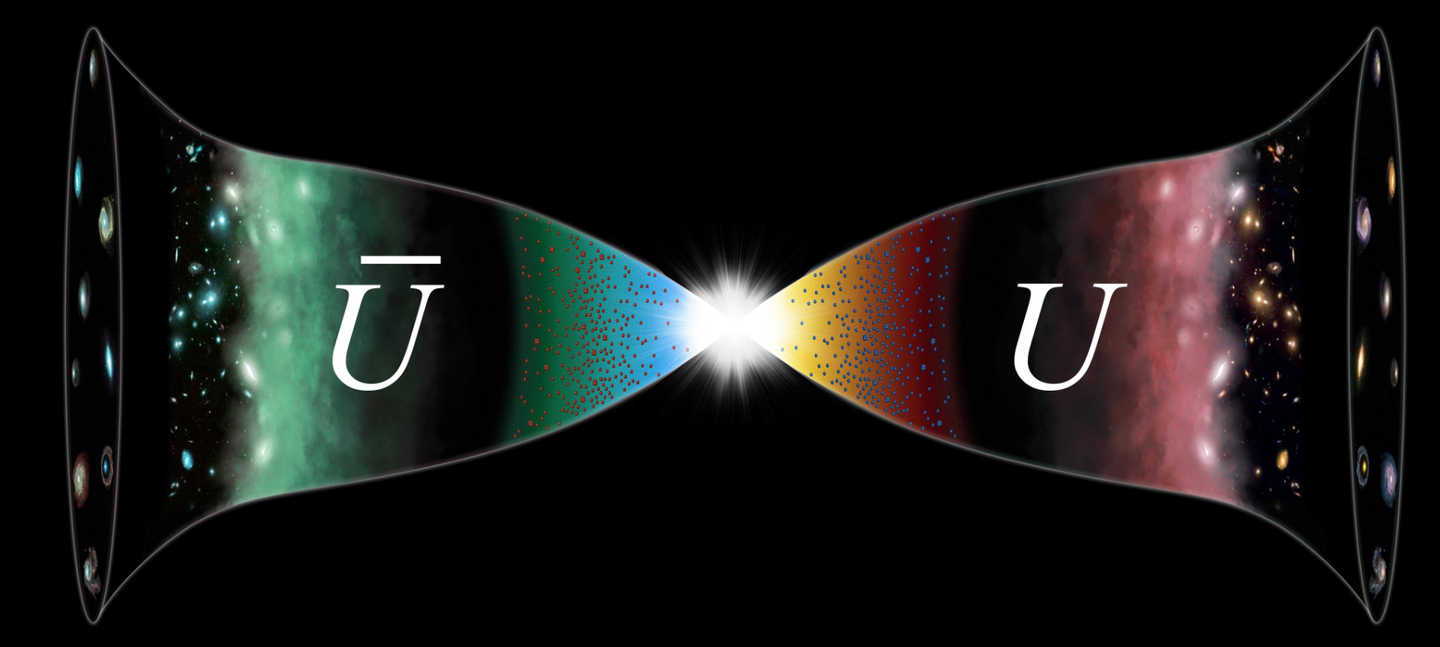
CPT symmetry states that the laws of physics stay the same when electric charge, spatial coordinates, and the direction of time are all reversed simultaneously. (CREDIT: Physical Review Letters)
The Big Bang may not have been the absolute beginning of everything. Instead, a controversial cosmological model suggests it was a boundary separating our universe from a mirror universe where time runs in the opposite direction.
Developed by Neil Turok, Latham Boyle, and colleagues at the Perimeter Institute, the idea starts with a striking feature of the early cosmos. Soon after the Big Bang, the universe was remarkably simple: space was nearly flat, filled mostly with radiation, and accurately described by the standard Friedmann-Robertson-Walker model. Its tiny density fluctuations were almost perfectly scale-invariant and Gaussian, with no evidence of primordial vector or tensor disturbances.
For decades, cosmologists have explained these conditions with cosmic inflation, a brief period of extremely rapid expansion before the hot Big Bang.
Turok and Boyle propose a different approach. Rather than introducing an earlier inflationary phase, they extend the laws of physics smoothly through the Big Bang itself and require the universe to obey CPT symmetry, the principle that the laws of physics remain unchanged when charge, spatial coordinates, and the direction of time are all reversed simultaneously.
A universe reflected through the Big Bang
CPT symmetry combines three transformations. Charge conjugation swaps matter with antimatter. Parity reverses spatial directions. Time reversal changes the direction in which events unfold. Physics should remain unchanged when all three occur together.
“The most natural assumption is that the Universe as a whole respects CPT symmetry, encompassing not just our universe but an anti-universe as well,” Turok explains.
In this picture, the scale factor that tracks cosmic expansion is proportional to conformal time near the Big Bang. Extending that relationship through the singularity produces a geometry symmetric under time reversal.
The result is not a conventional bounce. The scale factor passes through zero at the Big Bang, which remains a singular boundary in the classical description. On the other side lies a counterpart whose internal arrow of time points away from the bang, just as ours does.
To observers there, time would feel normal. From our side, their history would appear to run backward. Matter here would correspond to antimatter there, while spatial orientation would also reverse.
The Big Bang therefore becomes the meeting point of two halves of a larger structure rather than a lone beginning.
Symmetry selects the safe cosmic modes
Near the Big Bang, the equations allow both regular and singular forms of scalar, vector and tensor perturbations. The CPT condition removes modes that would diverge at the boundary and keeps those that remain finite.
For scalar perturbations, that selection preserves the mode needed to produce the acoustic oscillations seen in the cosmic microwave background. Inflation usually receives credit for setting those initial conditions. Here, the same behavior follows from symmetry across the bang.
The argument also suppresses primordial vorticity and removes dangerous tensor modes that would disrupt the smooth geometry near the singularity. Because massless gravitational waves do not experience the same particle-producing effect as massive fields, the model predicts no long-wavelength primordial gravitational waves from this mechanism.
That creates a direct test. A confirmed background of long-wavelength gravitational waves from the earliest universe would challenge a perfectly CPT-symmetric account.
A vacuum that is not truly empty
Curved spacetime makes “empty space” surprisingly complicated. Different observers can disagree about whether a vacuum contains particles, much as observers near a black hole can disagree about particles associated with Hawking radiation.
In an ordinary expanding universe, the geometry does not identify one unique vacuum. A universe symmetric across the Big Bang, however, allows a preferred state that respects CPT.
Late-time observers would not see that vacuum as empty. They would instead measure a finite population of particles emerging from the bang.
The theory identifies one candidate as especially important: a stable right-handed neutrino. This sterile neutrino would interact only weakly with known matter, would be its own antiparticle and would be extraordinarily heavy.
The team calculated that a mass of about 4.8 × 10^8 giga-electronvolts would give these particles the abundance needed to account for dark matter. That is roughly 500 million times the proton’s mass.
Unlike many dark matter proposals, this mechanism does not rely on thermal production or a new force. The particles appear because the CPT-symmetric vacuum differs from the vacuum defined by observers in the far future.
Turok has called the idea an economical explanation because it uses a minimal extension of the Standard Model, adding right-handed neutrinos already motivated by neutrino masses.
Matter here, antimatter there
Ordinary cosmology must explain why the visible universe contains far more matter than antimatter. In the CPT picture, the imbalance reverses across the Big Bang. Our side contains matter, while the other side contains a corresponding excess of antimatter.
Across the complete universe and anti-universe pair, the balance is restored.
The two other right-handed neutrinos would remain unstable and thermally coupled. Their behavior could support leptogenesis, a process that may generate the observed imbalance on each side.
The proposal also predicts that all three light neutrinos are Majorana particles, meaning each is its own antiparticle, and that the lightest neutrino has exactly zero mass.
Future searches for neutrinoless double-beta decay could test the Majorana prediction. Improved cosmological measurements of total neutrino mass could test whether one mass eigenstate is massless.
Claims linking the model to unusual ANITA radio events remain tentative. The Antarctic balloon experiment recorded upward-going signals that inspired speculation about extremely energetic particles crossing Earth. A later interpretation suggested the events might relate to the dark matter candidate, but that connection is not required by the core theory.
Practical implications of the research
The theory turns several cosmic mysteries into linked experimental questions. Neutrino mass measurements, neutrinoless double-beta decay searches and primordial gravitational-wave surveys could each rule out key parts of the model.
Its practical value may be that it narrows the search. Instead of introducing many unknown particles and forces, it points toward specific neutrino properties and a specific gravitational-wave prediction.
The idea remains incomplete. It treats the background geometry classically near a singularity where quantum gravity may matter, and inflation still explains the observed universe with notable success.
For now, the CPT-symmetric universe stands as an alternative rather than a replacement. Its appeal comes from asking whether one symmetry, extended across the Big Bang, can explain dark matter, cosmic structure and the matter-antimatter divide at once.
Research findings are available online in the journal arXiv.
The original story "Mirror universe where time runs backwards could help explain dark matter, antimatter and neutrinos" is published in The Brighter Side of News.
Related Stories
- Ancient Milky Way stars challenge the age of the universe and the Hubble tension
- Astronomers built the largest and most accurate 3D map of the ultraviolet universe
- Scientists develop a new way to measure the expansion rate of the universe
Like these kind of feel good stories? Get The Brighter Side of News' newsletter.
Joseph Shavit
Writer, Editor-At-Large and Publisher
Joseph Shavit, based in Los Angeles, is a seasoned science journalist, editor and co-founder of The Brighter Side of News, where he transforms complex discoveries into clear, engaging stories for general readers. With vast experience at major media companies like The Los Angeles Times, Times Mirror and Tribune Publishing, he writes with both authority and curiosity. His writing focuses on space science, planetary science, quantum mechanics, geology. Known for linking breakthroughs to real-world markets, he highlights how research transitions into products and industries that shape daily life.