Breakthrough AI system helps self-driving cars remember the road
AI system called KEPT lets self-driving cars use scene memory to predict safer paths and reduce planning errors.

 Edited By: Joshua Shavit

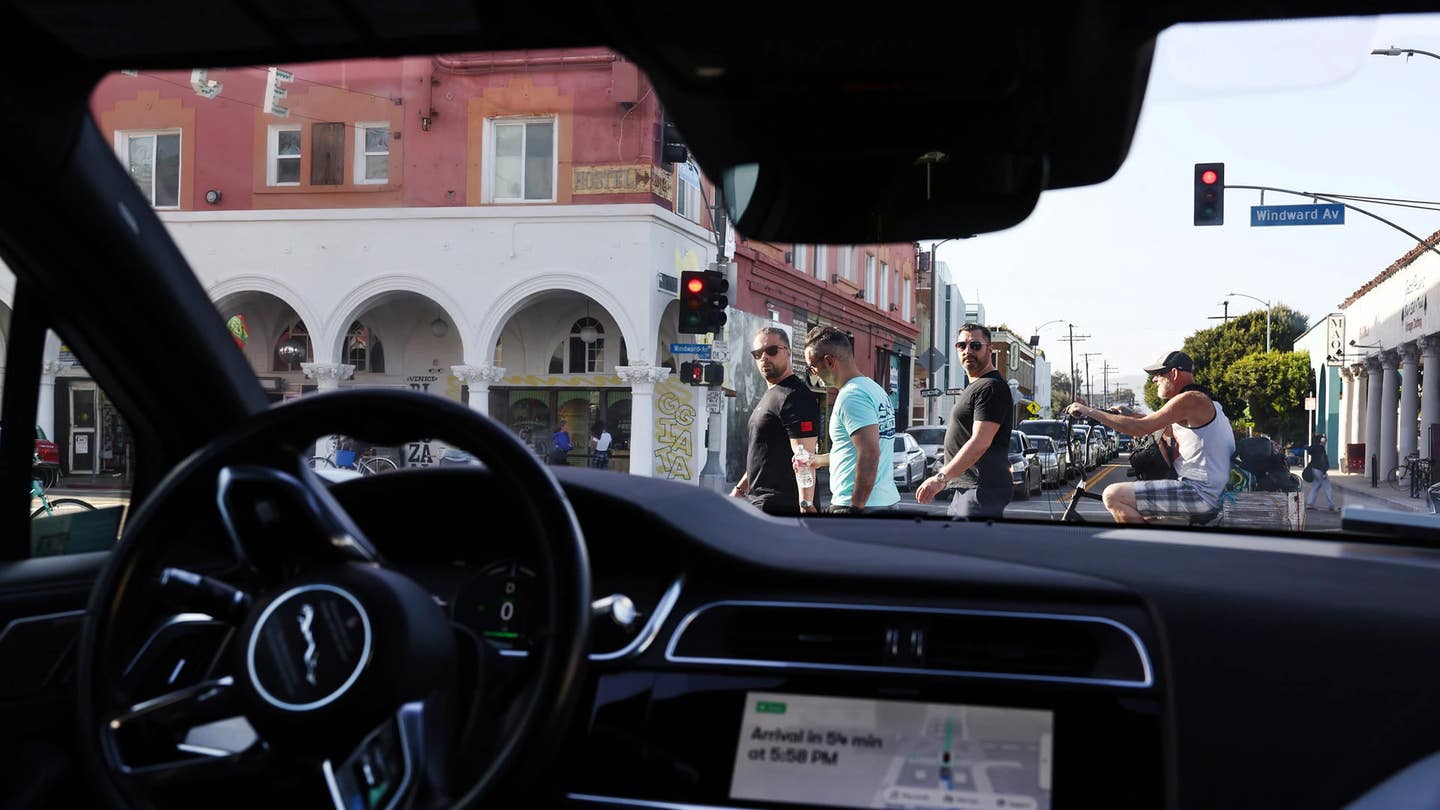
KEPT helps self-driving cars recall similar past scenes to predict safer short-term paths in traffic. (CREDIT: Shutterstock)
A self-driving car moves through traffic one moment at a time. A bus blocks part of the road. Rain throws reflections across the pavement. A merging vehicle appears from the side. In scenes like these, the hardest part is often not seeing what is there, but deciding what to do next.
That is the problem a research team behind a system called KEPT set out to tackle. Their idea is simple in principle: instead of asking an AI driving model to react to each new scene in isolation, give it a way to recall similar situations from the past and use those memories to guide its next move.
“Short-horizon trajectory prediction is where many autonomous driving systems still struggle, especially in complex, busy scenes,” said first author Yujin Wang from the School of Automotive Studies at Tongji University. “Our idea was to let a vision-language model not only look at the current frames, but also recall how similar scenes have unfolded before, and then plan a safe, feasible motion based on that prior experience.”
The result is KEPT, short for Knowledge-Enhanced Prediction of Trajectories, a framework that predicts a vehicle’s path over the next three seconds using front-view camera video and a library of past driving clips. In tests on the public nuScenes benchmark, the system lowered trajectory prediction errors and reduced collision indicators compared with several existing planning methods.
A planner that does not work alone
Many end-to-end driving systems take in sensor data and output a plan directly. That can work well in routine settings, but it creates problems in messy, uncommon, or crowded scenes. Some models also skip explicit scene understanding, which makes them harder to interpret and harder to validate for safety.
KEPT takes a different route. It still uses a large vision-language model, but it does not leave that model to guess its way through the task. Instead, it gives the model extra structure.
First, KEPT analyzes a short video clip from the car’s front camera, seven frames sampled over three seconds. Then it searches a large database of earlier driving clips for the most similar scenes. It retrieves a small set of matching examples and the real trajectories that followed in those cases. Those examples are then fed into the planner as guidance, alongside the current video and explicit constraints related to safety, smooth motion, and collision avoidance.
The research team said this helps the model reason with something closer to experience rather than abstraction alone.
“Vision-language models are powerful reasoners, but in driving they can easily hallucinate or ignore physical constraints if we just ask them to ‘draw a path,’” said corresponding author Prof. Bingzhao Gao. “By grounding the model in a bank of real trajectories and training it on metrics that directly reflect motion feasibility and collision risk, KEPT turns this reasoning ability into something much closer to an engineerable planning module.”
Teaching the system what matters in motion
A large part of the work went into building the memory system that makes retrieval possible.
The team designed a new video encoder called a temporal frequency-spatial fusion module, or TFSF. It converts short clips into compact vector representations that capture both scene layout and motion. To do that, it combines a frequency-based attention mechanism with multi-scale spatial features and a lightweight temporal transformer.
That sounds technical, but the aim is practical. Driving decisions depend on subtle movement. A vehicle drifting in from one lane, weak lane markings, reflections on wet pavement, or a partially blocked intersection can all change the right response. The encoder is meant to preserve those cues.
The model was trained without manual labels. Instead, it learned through self-supervision, pulling similar clips closer together in its embedding space and pushing dissimilar ones apart. The end result was a set of robust clip-level embeddings that could be used directly for retrieval.
Once those embeddings were created, the researchers built a searchable driving memory. All clips in the driving corpus were encoded and stored in a vector database. During inference, the current scene is embedded, routed into a nearby cluster, and matched to its nearest neighbors through an efficient search index.
That efficiency matters. In an ablation study, the full k-means and HNSW retrieval setup took an average of 0.014 milliseconds per query, much faster than a simple search over the same database.
Better numbers, especially when the road gets harder
The team evaluated KEPT on nuScenes, a widely used benchmark in autonomous driving research. They compared it with both established end-to-end planners and newer vision-language-based systems.
Across the standard open-loop metrics, KEPT posted the best overall performance. Under the NoAvg protocol without ego-status inputs, it reached an average L2 error of 0.70 meters and an average collision rate of 0.21%, compared with 0.85 meters and 0.29% for Drive-OccWorld, and 1.03 meters and 0.31% for UniAD. With ego-status inputs under the TemAvg protocol, KEPT achieved an average L2 error of 0.31 meters and an average collision rate of 0.07%, outperforming several other strong baselines.
The gains were especially clear at longer short-term horizons, around two to three seconds. That matters because this is where planning errors can begin to compound. A model that looks steady at one second may start drifting or reacting too late by three seconds.
The researchers also tested which pieces of KEPT mattered most. Removing either of the first two fine-tuning stages weakened long-horizon accuracy and raised collision rates. Using retrieval also helped, but only up to a point. The best setting was Top-2 retrieval, meaning the model worked best when shown two similar examples. More than that started to add noise.
Where the system still falls short
The paper does not present KEPT as finished.
The authors note that the system currently focuses on short-horizon, open-loop evaluation using a single dataset and one camera configuration. Its retrieval priors come from nuScenes-like data, which means unusual scenes, unfamiliar driving regions, or extreme weather could still lead to weaker matches. The framework also uses only seven front-view frames over a short window, so richer sensor inputs and longer temporal context may help.
In case studies, KEPT handled several difficult scenes well, including low-visibility intersections and rain-soaked roads with strong reflections. But it also failed in some challenging moments, such as a T-junction with a merging car and a blocked lane where it should have changed course sooner.
The team found that refining the prompting strategy helped in some of these failure cases, suggesting the system remains sensitive to how its reasoning instructions are framed.
Practical implications of the research
This work points to a broader shift in how autonomous driving systems may be built. Rather than treating large AI models as black boxes, engineers may increasingly surround them with retrieval systems, structured prompts, and training objectives tied directly to safety and motion quality. That could make driving models more transparent, more efficient, and easier to audit.
The researchers also suggest that similar knowledge-enhanced planners could one day support advanced driver-assistance systems, not just fully automated vehicles.
A system that can both recommend an action and explain it in everyday language could be useful long before fully autonomous cars become routine.
Research findings are available online in the journal Communications in Transportation Research.
The original story "Breakthrough AI system helps self-driving cars remember the road" is published in The Brighter Side of News.
Related Stories
- OmniPredict AI can help cars accurately predict pedestrian behaviors
- Simple printed signs can hijack self-driving cars and robots
- New AI systems are teaching machines to verifiably function safely
Like these kind of feel good stories? Get The Brighter Side of News' newsletter.
Shy Cohen
Writer