Breakthrough ion clock experiments reveal that time can go quantum
Atomic clocks may soon probe whether time can tick faster and slower at once in the quantum world.

 Edited By: Joseph Shavit

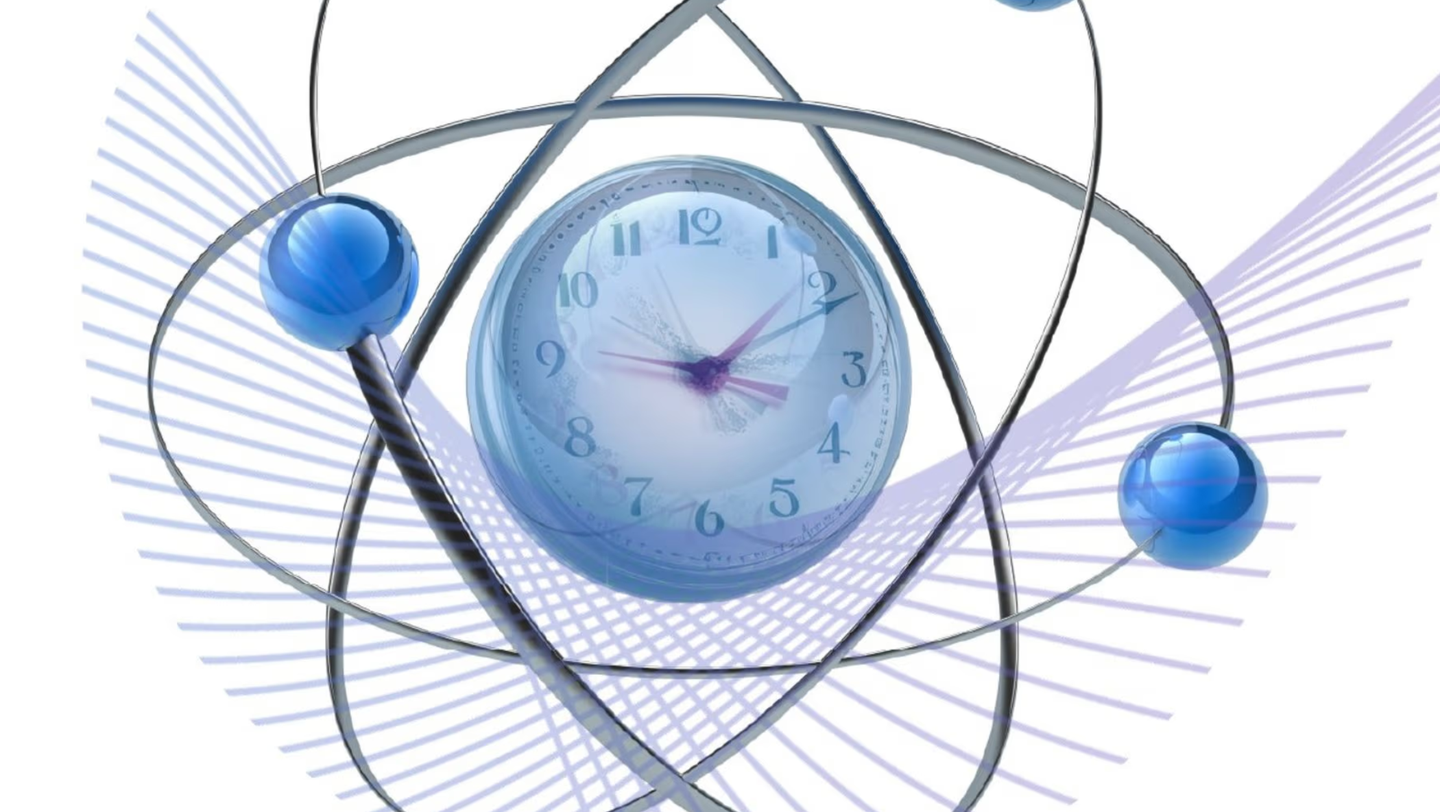
Trapped ions already power quantum computers and the world’s most precise clocks. Now, by merging those strengths, researchers are probing something deeper: time itself behaving as a quantum superposition. (CREDIT: Igor Pikovski)
Time already behaves strangely in modern physics. It can stretch, slow, and split depending on speed and gravity. Now a new theoretical study pushes that weirdness into even stranger territory. It argues that time itself may carry quantum signatures that could soon be tested with some of the most precise clocks ever built.
That idea sounds almost like science fiction. In everyday life, a clock ticks one second at a time, in one direction, at one rate. In relativity, that neat picture breaks down because motion changes how quickly time passes. A moving clock runs differently from one at rest, even if the difference is tiny. But quantum physics adds another twist, because motion itself can exist in superposition. With this, a particle can effectively occupy more than one state at once.
Put those two ideas together and the result is startling. A clock whose motion follows quantum rules may not experience one clean flow of time. In principle, it could evolve along different time paths at once, ticking both faster and slower in a quantum superposition.
“Time plays very different roles in quantum theory and in relativity,” says Igor Pikovski, assistant professor of theoretical physics at Stevens Institute of Technology. “What we show is that bringing these two concepts together can reveal hidden quantum signatures of time-flow that can no longer be described by classical physics.”
Pikovski led the new work with Gabriel Sorci of Stevens, alongside collaborators from the experimental groups of Christian Sanner at Colorado State University and Dietrich Leibfried at the National Institute of Standards and Technology. Their paper argues that trapped-ion atomic clocks, among the most sensitive devices in physics, may now be close to probing this regime directly.
Where relativity stops feeling intuitive
Relativity has long taught physicists that time is personal. Every clock follows its own “proper time,” shaped by its motion and location. That is why the famous twin paradox works. One twin travels at high speed and returns younger than the twin who stayed home.
The size of the effect in ordinary conditions is tiny. A clock moving at 10 meters per second for 57 million years would fall behind a clock at rest by only one second. Yet those differences are real. Ultraprecise atomic clocks have measured them.
The new study asks a sharper question. What happens when the moving clock is not simply moving, but moving in a quantum way? Can one clock take part in a kind of “quantum twin paradox,” where it experiences different amounts of elapsed time at once?
The researchers say yes, at least in principle. They focus on ion clocks, devices that trap single ions such as aluminum or ytterbium, cool them to near absolute zero, and use laser pulses to manipulate their quantum states. These clocks are already precise enough to pick up tiny effects from motion. Moreover, the study argues they could also reveal distinctly quantum aspects of relativistic time.
A clock that feels the vacuum
One part of the work centers on a familiar relativistic effect called the second-order Doppler shift. In simple terms, motion changes a clock’s ticking rate. Usually, that shift is associated with thermal motion, the small jiggling that remains when an object is not perfectly still.
But the new analysis points to something subtler. Even if an ion is cooled to its motional ground state, the lowest state allowed by quantum mechanics, the clock should still pick up a shift. The reason is that the ground state is not perfectly motionless. As a result, quantum fluctuations remain.
“Atomic clocks are now so sensitive, they can detect tiny differences in time caused by just the thermal vibrations at miniscule temperatures,” says Sorci. “But even at the absolute zero temperature, the ground state, the ticking rate will still be affected by just the quantum fluctuations alone.”
That effect, which the team calls the vacuum-induced second-order Doppler shift, comes from the fact that a trapped quantum particle still has a spread in momentum. Its motion is not classical. Yet the passage of time recorded by the clock still changes. The researchers estimate that this vacuum contribution could produce a fractional frequency shift of about 5 × 10⁻¹⁹ in a megahertz trap. Thus, it is within sight of current or near-future clock technology.
That matters because it moves time-dilation experiments into a domain where the motion is not just small, but irreducibly quantum.
Squeezing motion, entangling time
The team then pushes further by proposing the use of squeezed states. In quantum physics, squeezing reshapes uncertainty, reducing it in one variable while increasing it in another. For a trapped ion, that means researchers can prepare motion with special quantum properties. These do not exist in an ordinary classical description.
In those squeezed states, the clock and the ion’s motion can become entangled through relativistic time dilation. The ticking of the clock depends on the motional state, and the motional state in turn evolves differently depending on the clock’s internal state. Instead of a clock simply measuring a fixed average passage of time, the clock and its motion become linked. In this way, it carries genuine quantum information.
That entanglement has a measurable consequence. It should reduce the visibility of the clock’s interference signal during a Ramsey sequence, a standard technique in precision measurements. The visibility drop is important because it would signal more than a simple relativistic correction. It would point to a deeper quantum feature of proper time itself.
According to the study, an aluminum-ion clock in a 20 megahertz trap, combined with strong squeezing and long coherence times, could make that visibility loss observable. The frequency shift caused by squeezing may also be seen. However, the loss of visibility would be the more interesting prize because it would reflect the underlying entanglement.
“We have the technology to generate the required squeezing and a path to reach the clock precision needed in ion clocks to observe such effects for the first time,” says Sanner.
What still remains out of reach
The study also identifies an even more delicate effect called the quantum second-order Doppler shift. Unlike earlier shifts, this one cannot be captured by treating the clock as evolving with respect to a simple average proper time. Instead, it arises from a fully quantum part of the motion-clock dynamics.
For now, though, that signal appears too small to detect. Even with special control and measurement schemes, the predicted phase offset is on the order of 10⁻¹⁰ radians for the aluminum-ion clock considered in the paper. Therefore, it leaves the effect beyond current and near-future capabilities.
The paper is careful about this point. Not every predicted signature is ready for the lab. The vacuum shift may be observable. Time-dilation-induced entanglement may be within reach using squeezed motional states. The deeper quantum Doppler effect is still out of range.
Even so, the broader message is clear. Precision clocks are no longer just tools for keeping time or testing small corrections to relativity. They are becoming probes of a place where two major theories of physics meet and still do not fully agree.
Pikovski sees that larger horizon clearly. “Physics is still full of mysteries at the most fundamental level. Quantum technologies are now giving us new tools to shed light on them.”
Practical implications of the research
This work suggests that next-generation atomic clocks could do more than improve navigation, communications, and timing standards. They may also become experimental tools for testing whether proper time itself must be treated quantum mechanically.
If these effects are measured, physicists would gain a new way to study the boundary between quantum theory and relativity using laboratory devices. This would be a shift from studying distant astrophysical events or unreachable energies.
That would not settle the nature of time. Nevertheless, it would sharpen the questions in a way experiments can finally touch.
Research findings are available online in the journal Physical Review Letters.
The original story "Breakthrough ion clock experiments reveal that time can go quantum" is published in The Brighter Side of News.
Related Stories
- Light can travel for billions of years yet experience no time
- Physicists measured time without a clock at the quantum scale
- New research has scientists rethinking how the brain tells time
Like these kind of feel good stories? Get The Brighter Side of News' newsletter.
Shy Cohen
Writer