SETI checked 3I/ATLAS for alien signals — Here’s what they found
3I/ATLAS looked like a natural comet, but SETI researchers still checked it for radio signals from technology.

 Edited By: Joshua Shavit

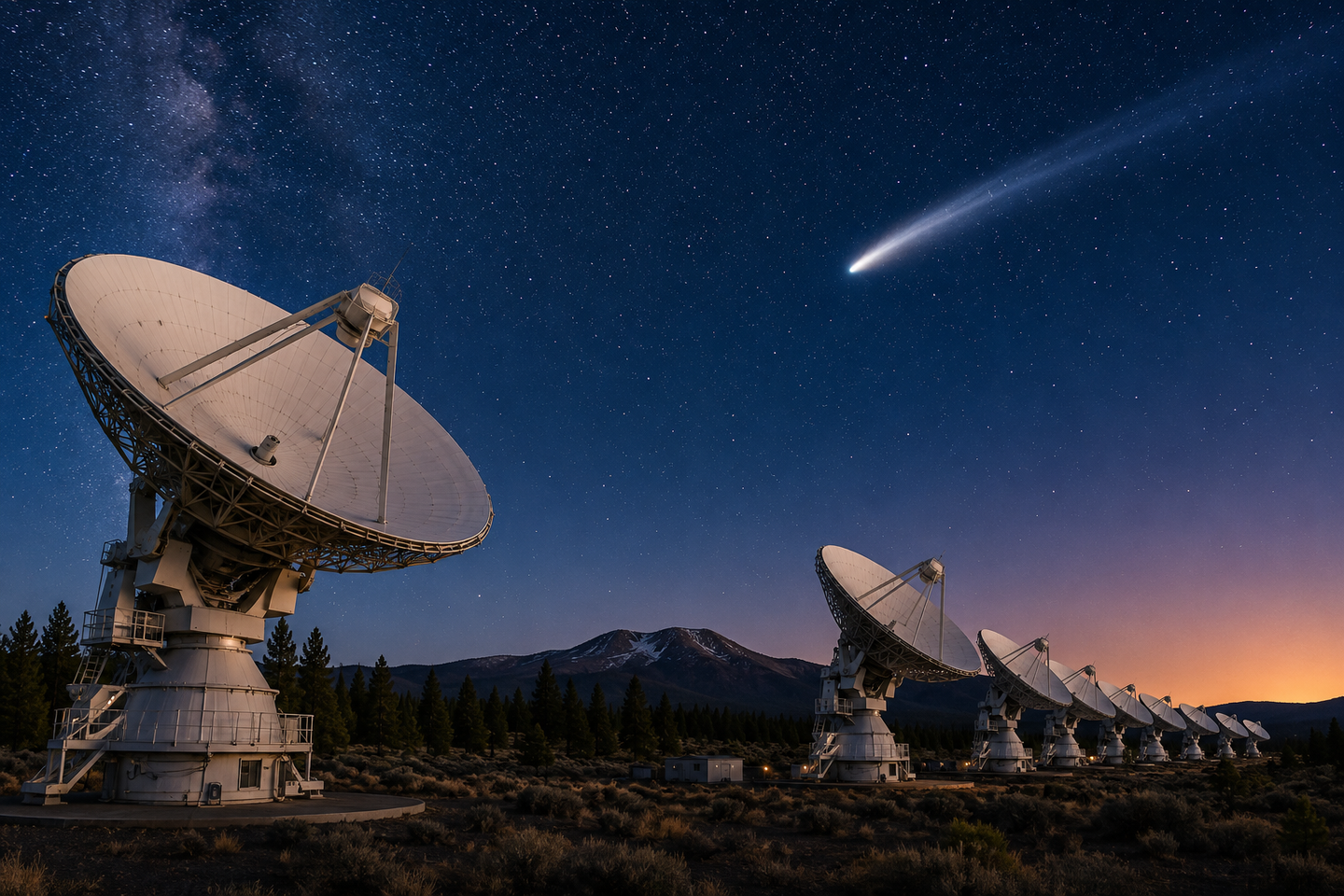
SETI scientists scanned interstellar object 3I/ATLAS for radio technosignatures and found no evidence of artificial signals. (CREDIT: AI-generated image / The Brighter Side of News)
A comet from another star system does not arrive every year. That is part of what made 3I/ATLAS so compelling when it appeared in July 2025. It streaked into the Solar System on a path so extreme that astronomers could quickly tell it did not originate here.
It was only the third confirmed interstellar object ever seen passing through the Sun’s neighborhood, after 1I/'Oumuamua and 2I/Borisov. Telescopes around the world soon found signs that it behaved like a natural comet. For instance, it had a coma and a red color in early observations. It also had other features consistent with volatile-rich material heating up near the Sun.
Even so, a team at the SETI Institute gave the object another kind of test.
Using the Allen Telescope Array in Northern California, the group searched 3I/ATLAS for narrowband radio signals, a classic kind of technosignature because such emissions are not known to arise from natural astrophysical processes. After more than seven hours of observations across a wide swath of radio spectrum, from 1 to 9 gigahertz, the answer was straightforward: nothing artificial turned up.
That result was expected. It still mattered.
“Eventually, our own Voyager spacecraft will be extraterrestrial artifacts in other stellar systems,” said Dr. Sofia Sheikh, lead author on the paper. “Given that, it is important that we understand the natural distribution of interstellar objects so that we will be able to identify any anomalies that could one day be signs of an artificial interstellar object.”
A rare target, and a fast response
3I/ATLAS was first reported on July 1, 2025, by the ATLAS facility in Rio Hurtado, Chile. Prediscovery images later pushed its known track back 55 days. By October 2025, its orbital eccentricity had been estimated at 6.137. This made it even more extreme than the first two known interstellar visitors and gave it a higher inbound speed as well.
That made it a scientifically valuable target on several fronts. Interstellar objects carry material from other planetary systems. This offers rare clues about how those systems form and evolve. At the same time, researchers in technosignature science argue that such objects are worth checking for anomalies, even if the odds of finding anything artificial are slim.
The Allen Telescope Array moved quickly. Observations began about 23 hours after the initial announcement of the object. This shows how rapidly the system can pivot to a newly discovered target of opportunity.
The observing campaign covered three chunks of spectrum, low, mid, and high, eventually spanning 1,000 to 9,064 megahertz over five sessions for a total of 7.25 hours on target. The telescope used a beam aimed at 3I/ATLAS and a second beam pointed slightly away from it. This setup was designed to help distinguish a real sky source from human-made interference.
Millions of signals, almost all from us
The raw search produced a staggering number of candidates: 73,974,799 narrowband hits.
That number did not mean the telescope was hearing something mysterious. It meant the telescope was operating in a radio environment packed with interference from Earth.
The team first blanked out contaminated frequency ranges, removing regions crowded with known radio noise. Those excluded bands made up about 16 percent of the total coverage. After that, the researchers applied drift-rate limits based on how a signal from 3I/ATLAS should shift in frequency as the object and Earth moved relative to one another.
That step was especially important. The team calculated the object’s apparent radial acceleration during the observing window and translated it into expected signal drift rates. Across the survey, they filtered for hits between 0.05 and 1.5 hertz per second. This is a range broad enough to capture the known motion of 3I/ATLAS, while allowing for some uncertainty from possible rotation or tumbling.
Those cuts reduced the pool from nearly 74 million hits to about 1.9 million. A further spatial filtering step compared the on-target beam with the off-target beam. It looked for signals that were stronger in the direction of 3I/ATLAS and behaved like a localized source in the sky.
That process trimmed the list to 211 events worth visual inspection.
In the end, every one of them was attributable to radio frequency interference. Some came from Earth-based transmitters. Others were linked to human technology in orbit, including satellites.
Of the 211 reviewed plots, 11 appeared brighter in the target beam and at first glance could have looked more interesting. But none held up. Some were broader-band modulated signals rather than the narrowband emissions the search was designed to find. Others matched known human communication bands.
Limits, not just a null result
The absence of technosignatures did more than confirm expectations. It allowed the team to place upper limits on the strength of any radio transmitter that could have been operating on or near 3I/ATLAS during the observations.
At the object’s distance of roughly 3.35 astronomical units from Earth, the Allen Telescope Array would have detected narrowband transmitters with effective isotropic radiated powers ranging from about 10 to 110 watts, depending on frequency and drift conditions. That is roughly the scale of a household appliance.
“The results from 3I/ATLAS show how realistic it is to detect a signal with the technology we have today,” said Valeria Garcia Lopez, co-author. “That is why it is important to keep searching for technosignatures, even from objects we might not expect to have signals."
The limits were not the most sensitive ever achieved for this object. The researchers note that MeerKAT had already reported a minimum EIRP value of 0.17 watts, far more sensitive than this campaign. But that search covered only 900 to 1,670 megahertz. The ATA work expanded the frequency coverage by roughly a factor of 10. This pushed the search into much less explored radio territory, especially above 5 gigahertz.
The study also served as a field test for methods the team plans to use again. As far as the authors know, this was the first time expected drift-rate contributions were used as a filter in a technosignature search of a Solar System object.
Practical implications of the research
The clearest takeaway is not that 3I/ATLAS was likely artificial. The evidence points the other way, and this search reinforced that. The practical value lies in building a repeatable playbook for the next interstellar object, and the one after that.
Rare visitors like 3I/ATLAS now trigger a broader scientific response than they once did. Astronomers can study their composition, motion, and cometary activity. Meanwhile, technosignature researchers can rapidly test whether anything about them stands out as unnatural.
Even a null result sharpens those methods, narrows the range of possibilities, and improves the odds of spotting a true anomaly if one ever appears.
Research findings are available online in The Astronomical Journal.
The original story "SETI checked 3I/ATLAS for alien signals — Here’s what they found" is published in The Brighter Side of News.
Related Stories
- 3I/ATLAS had a far colder birthplace than our Solar System
- Astronomers confirm the presence of water on interstellar comet 3I/ATLAS
- Astronomers intrigued by odd light emitted by interstellar visitor 3I/ATLAS
Like these kind of feel good stories? Get The Brighter Side of News' newsletter.
Joseph Shavit
Writer, Editor-At-Large and Publisher
Joseph Shavit, based in Los Angeles, is a seasoned science journalist, editor and co-founder of The Brighter Side of News, where he transforms complex discoveries into clear, engaging stories for general readers. With vast experience at major media companies like The Los Angeles Times, Times Mirror and Tribune Publishing, he writes with both authority and curiosity. His writing focuses on space science, planetary science, quantum mechanics, geology. Known for linking breakthroughs to real-world markets, he highlights how research transitions into products and industries that shape daily life.