Can AI solve a Millennium Prize problem? OpenAI says its system just did
A 10,000-agent AI effort may have cracked a Millennium Prize problem and opened a deeper debate over how mathematics gets done.

 Edited By: Joseph Shavit

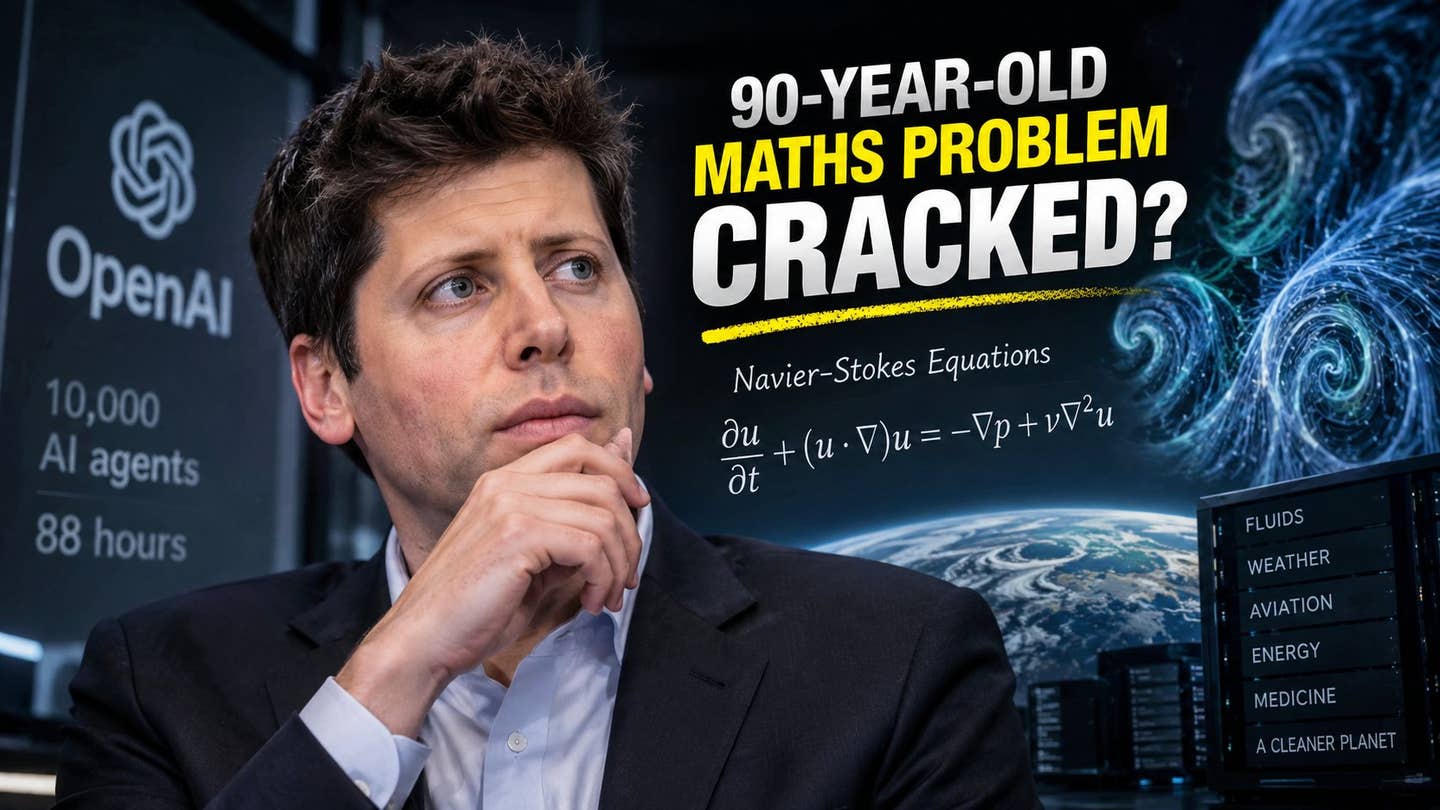
OpenAI says AI produced a Navier-Stokes proof, raising questions about verification, priority, and the future of mathematics. (CREDIT: X.com / @GuyRazzy)
- OpenAI says an unreleased AI system produced a proof that the three-dimensional Navier-Stokes equations can develop a singularity in finite time.
- The system used roughly 10,000 concurrent AI agents and reached its result after about 88 hours of work.
- The announcement has also triggered debate over mathematical priority, AI-assisted research, and how credit should be assigned when machines help solve major problems.
One of mathematics’ most famous unsolved questions may have reached a turning point through artificial intelligence. OpenAI says an internal system produced a proof addressing the Navier-Stokes existence and smoothness problem, one of the seven Millennium Prize Problems established by the Clay Mathematics Institute.
The company released both a written argument and a formalized proof in Lean, software used to verify mathematical reasoning. If the result survives expert scrutiny and satisfies the official requirements of the problem, it would represent a historic mathematical achievement.
OpenAI said it does not intend to claim the $1 million Millennium Prize attached to the problem.
The question asks whether smooth fluid motion can break down
The Navier-Stokes equations describe the movement of fluids such as air and water. They are widely used in areas including aircraft design, weather forecasting, and the study of blood flow.
The equations date to the 19th-century work of Claude-Louis Navier and George Gabriel Stokes. Their importance lies partly in their ability to treat fluids as continuous materials rather than tracking individual molecules.
The unresolved question concerns what happens in three dimensions when a fluid begins in a smooth, well-behaved state. Mathematicians have long asked whether the equations always continue producing smooth solutions or whether the motion can become singular in finite time.
A singularity, in this context, means quantities such as fluid velocity grow without bound. That would mark a breakdown in the mathematical description, even though a real fluid cannot literally accelerate to infinite speed.
The Clay Mathematics Institute selected the Navier-Stokes problem in 2000 as one of seven Millennium Prize Problems. Each carries a $1 million award for an accepted solution. So far, the Poincaré Conjecture is the only one officially listed as solved.
OpenAI says its system found a finite-time singularity
OpenAI says its proof follows one of the official routes allowed under the Clay formulation. Instead of proving that all smooth solutions remain smooth forever, the system produced an example in which smooth initial conditions develop a singularity.
In the construction, the fluid begins at rest and experiences a smooth external force. The resulting motion forms a vortex that spirals inward while stretching along its axis.
The central region shrinks as its speed increases. Despite that acceleration, the total energy remains finite.
That balance is crucial. A successful construction cannot simply force the system to blow up by inserting an infinite or badly behaved external influence. The applied force itself must remain smooth while the fluid dynamics generate the breakdown.
OpenAI says the argument establishes the breakdown cases known as statements C and D in the official problem description.
Thousands of AI agents worked on the problem
The scale of the computational effort was unusual even by modern AI standards.
OpenAI said the project began Sept. 1 after hearing rumors that major mathematical problems had been resolved elsewhere. The company then tested an unreleased internal model across several open Millennium Prize Problems and other difficult questions.
The system organized AI agents into groups that could communicate internally. The agents could also run code and consult a cached version of the internet.
Roughly 10,000 concurrent agents participated in the Navier-Stokes effort. OpenAI said they reached the result on Sept. 5, about 88 hours after the first agents began working.
Formalization and verification in Lean required another 17 hours using GPT-6 Astra.
The company said its agents exchanged about 2.7 million messages during the Navier-Stokes effort and generated roughly 130 billion output tokens. Across all attempted problems, the larger project involved 4.9 million messages and about 300 billion output tokens.
Another AI-assisted research effort was already underway
The announcement also exposed tensions over priority and the growing role of AI in mathematical discovery.
New York University mathematician Tristan Buckmaster and Anthropic researcher Levent Alpöge had been pursuing related blowup problems using several large language models, including OpenAI’s Codex.
Buckmaster said their work built on ideas developed by mathematicians Diego Córdoba and Luis Martínez-Zoroa, who had explored constructions involving forced blowups.
Buckmaster and Alpöge obtained finite-time blowup results with smooth forcing for several related equations, including the three-dimensional incompressible Euler equations. They also believed they had a result for hypo-dissipative Navier-Stokes, although Buckmaster said that work was not ready for release because formal verification remained unfinished.
As rumors circulated about their progress, Buckmaster contacted OpenAI before the company made its announcement public.
Afterward, questions arose over whether OpenAI’s internal system could have benefited from information connected to their work. Buckmaster stopped short of making that accusation.
“I have not seen OpenAI’s proof. I do not know what their model did, or how,” he wrote. “I do not know whether our data was used. I am not accusing anyone of anything.”
OpenAI said its agents did not access Buckmaster and Alpöge’s work before it became public. The company later said an internal investigation found that Buckmaster’s recent Codex prompts could not have influenced the model used to produce the Navier-Stokes result.
Mathematics now faces a broader question about AI
The episode is forcing mathematicians to consider more than whether one proof is correct.
Buckmaster described the broader shift as a “Deep Blue-Kasparov moment,” comparing it to the point when computers demonstrated that they could compete with elite human chess players. His concern was not only about speed, but about how mathematics should assign credit, train students, referee papers, and decide which problems deserve years of human effort.
Terence Tao, a UCLA mathematician and Fields Medalist, has raised a related concern about using AI to jump directly to solutions without preserving the intellectual path that makes difficult mathematics valuable.
“It’s a little like going to watch a movie and jumping straight from the first ten minutes to the last ten minutes,” Tao told The Brighter Side of News. “Technically, all the plot lines are resolved, but most of the value of the experience was lost.”
That tension may become harder to avoid if systems can generate frontier mathematics at scale.
For now, the central issue remains verification. The proof must withstand detailed examination by experts and satisfy the Clay problem’s formal requirements before the broader mathematical community can treat the question as settled.
Whatever the final verdict, the episode suggests that AI-assisted mathematics is moving from experimentation into territory once reserved for the most difficult human research problems.
Dig deeper into the Navier-Stokes problem
These resources provide authoritative background on the equations, the Millennium Prize framework, and the mathematics surrounding fluid singularities.
Navier-Stokes Equation: The Clay Mathematics Institute’s official overview explains the problem, its fluid-dynamics background, and why existence and smoothness matter. (Clay Mathematics Institute, 2026)
Existence and Smoothness of the Navier-Stokes Equation: Charles L. Fefferman’s official mathematical formulation sets out the four statements whose proof or disproof can resolve the Millennium problem. (Clay Mathematics Institute, 2000)
The Millennium Prize Problems: Clay’s official summary describes the seven problems, the $1 million awards, and the broader purpose of the prize program. (Clay Mathematics Institute, 2026)
Navier-Stokes existence and smoothness: This Clay resource features Luis Caffarelli’s general-audience lecture on why the equations are difficult and why regularity remains central. (Clay Mathematics Institute, 2001)
Poincaré Conjecture: Clay’s page on the only Millennium Prize Problem officially listed as solved provides context for how landmark solutions enter accepted mathematics. (Clay Mathematics Institute, 2026)
The original story "Can AI solve a Millennium Prize problem? OpenAI says its system just did" is published in The Brighter Side of News.
Related Stories
- Scientists are rethinking how much we can trust ChatGPT
- Are people more creative writers than ChatGPT?
- Can ChatGPT revolutionize the world? Here is what it "thinks"
Like these kind of feel good stories? Get The Brighter Side of News' newsletter.
Shy Cohen
Writer