Canada’s last epishelf lake vanished after recent Arctic ice shelf collapse
A decade of observations captured how the 2020 collapse of an Ellesmere Island ice shelf transformed an Arctic fjord.
 UBC Writer: Lou Bosshart

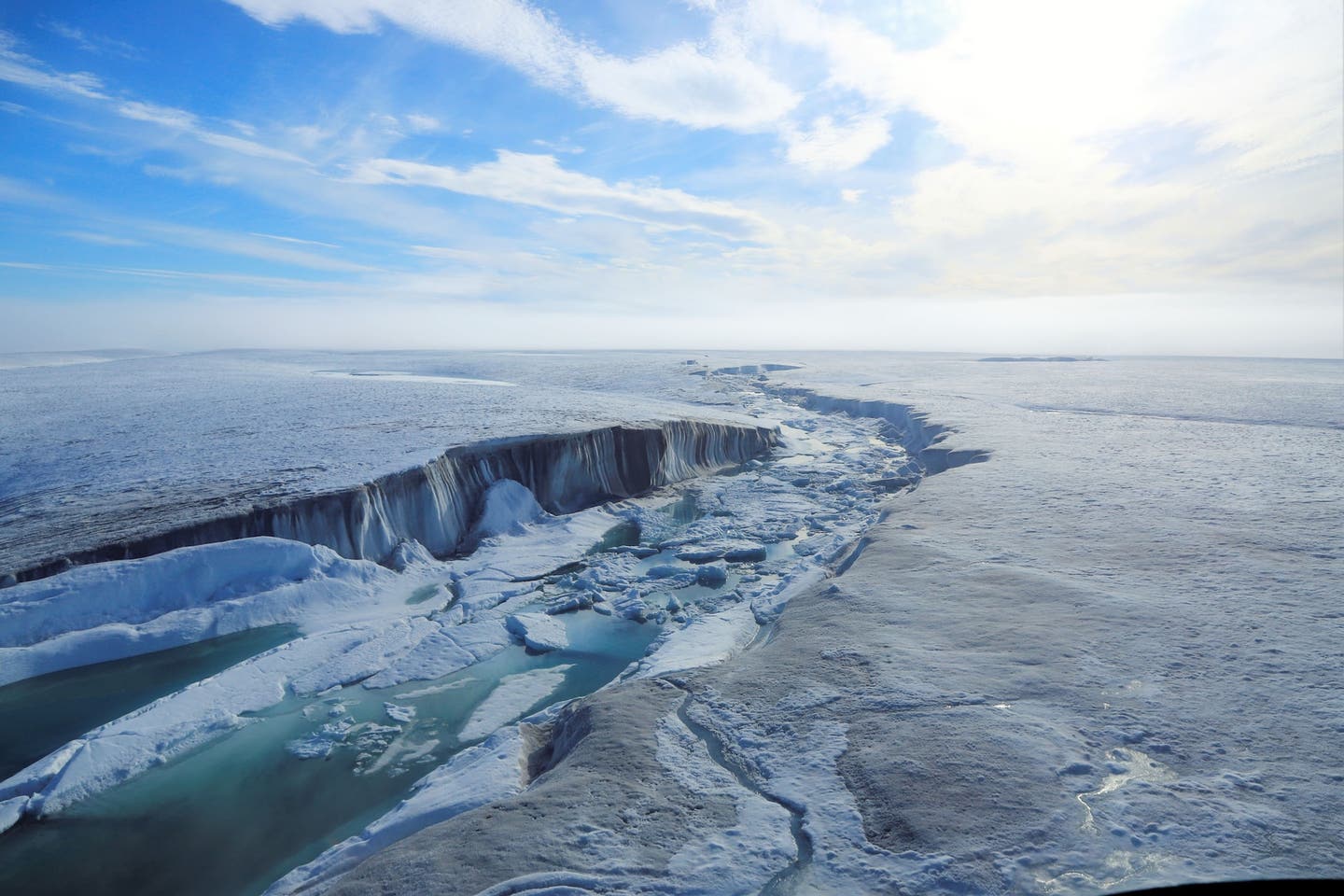
A former channel beneath the Milne Ice Shelf, exposed after the ice broke apart. The channel carried freshwater from the epishelf lake to the Arctic Ocean. (CREDIT: Cameron Fitzpatrick)
- Canada’s last epishelf lake largely drained into the Arctic Ocean within months after the Milne Ice Shelf broke apart in July 2020.
- Measurements show its distinct freshwater layer had been replaced by brackish water by 2022 and has shown no sign of returning.
- The loss occurred within the Last Ice Area, revealing how rapidly even one of the Arctic’s expected long-term ice refuges can change.
The disappearance of Canada’s last epishelf lake happened not over centuries, but within months of a major Arctic ice-shelf collapse.
The Milne Fiord epishelf lake on northern Ellesmere Island survived for decades as a layer of fresh water floating above seawater. That unusual arrangement depended on the Milne Ice Shelf, which acted like a dam at the mouth of the fjord. When nearly half of the shelf broke away in July 2020, the barrier failed and the lake began draining into the Arctic Ocean.
A reconstruction published in Scientific Reports now confirms that the freshwater ecosystem did not recover. Researchers from the University of British Columbia, Université Laval, the University of Alberta and Carleton University combined more than a decade of ocean measurements, satellite imagery and field observations.
A lake held in place by floating ice
Epishelf lakes form in polar fjords when an ice shelf blocks freshwater runoff from escaping to the sea. Because fresh water is less dense than salt water, it can form a distinct layer above the marine water below.
Milne Fiord contained the last known epishelf lake in Canada. Earlier observations showed that its surface layer remained very fresh, generally below 1 gram of salt per kilogram of water. From 2011 to 2018, the freshwater layer was typically about 8 to 12 meters deep.
The system also supported an unusual ecological arrangement. Freshwater organisms occupied the upper layer, while marine organisms lived below, separated by a sharp salinity boundary called a halocline.
“Epishelf lakes are remarkable because a freshwater ecosystem sits directly above a marine one, separated only by a thin boundary between fresh water and salt water,” said co-author Dr. Andrew Hamilton of the University of Alberta. “When the ice shelf broke apart, that unique ecological structure disappeared.”
Warning signs appeared before the collapse
The Milne Ice Shelf had already been weakening for years. Salinity near the surface first rose above 1 gram per kilogram in November 2018, suggesting the ice dam was losing some ability to retain freshwater.
The shelf also had several structural weaknesses, including a basal channel beneath the ice, an old rift and a newer fracture. Surface melting and melting from ocean water below the shelf had gradually reduced its mass.
On July 30 and 31, 2020, calving followed pre-existing fractures. The event removed about 45 percent of the shelf and produced a roughly 64.9-square-kilometer tabular iceberg before it separated into two large ice islands.
Several processes appear to have prepared the shelf for failure. Long-term thinning, open-water conditions and increased melting along the basal channel all contributed to its vulnerability. Large meltwater ponds near a relatively recent fracture also point to hydrofracture as a possible trigger.
“The ice shelf and lake had been thinning for decades, but the 2020 breakup was the last straw. The lake drained within months,” said study author Dr. Jérémie Bonneau of Université Laval.
Freshwater escaped faster than it arrived
After the breakup, salinity near the surface began rising even while summer meltwater continued entering Milne Fiord. That meant freshwater was escaping faster than it was being replenished.
The change accelerated after meltwater inflow ended in September 2020. Although researchers could not conduct their usual field season during the COVID-19 pandemic, instruments left in the fjord continued recording conditions.
Those measurements showed the lake was rapidly salinizing in autumn 2020. Researchers later recovered the instruments and used the records to reconstruct what happened during the gap in field observations.
The first post-calving water profile, collected in July 2022, showed the halocline had risen to just 2.4 meters. The distinct freshwater layer had been replaced by brackish water.
Annual profiles collected since 2022 found no evidence that the lake was returning. The team concluded that freshwater entering Milne Fiord is now flushed directly into the ocean because the remaining shelf lacks the structural integrity needed to hold it back.
An ecosystem disappears with the dam
The loss is more than a physical change in the fjord. Epishelf lakes are rare ecosystems in which freshwater and marine communities occupy the same water column.
Earlier work at Milne Fiord documented freshwater plankton, marine organisms and microbial communities arranged according to the strong salinity gradient. With that gradient gone, the upper ecosystem is expected to reorganize under much saltier conditions.
“Epishelf lakes can signal when an ice shelf is under stress, and that’s what we saw here,” said UBC co-author Dr. Bernard Laval. “The data showed the ice shelf was failing. Once the ice is gone, the ecosystem goes with it. There’s no coming back.”
Scientists describe epishelf lakes as sentinel ecosystems because changes in their depth and salinity can reveal changes in the ice shelves containing them. Continuous monitoring at Milne Fiord allowed researchers to watch the system move from relative stability toward collapse.
Change reaches the Last Ice Area
Milne Fiord lies within the Last Ice Area, the region along northern Canada and Greenland expected to retain perennial sea ice longer than other parts of the Arctic. It also sits within the Tuvaijuittuq Marine Protected Area, whose Inuktitut name means “the place where the ice never melts.”
That setting makes the loss particularly significant. The region has been identified as a potential refuge for ecosystems that depend on persistent ice, yet Milne Fiord shows that even this high-Arctic environment is undergoing major change.
The remaining sections of the Milne Ice Shelf are thinner and more fractured than the portion that broke away in 2020, leaving them vulnerable to further collapse.
Re-establishing the epishelf lake would require the ice shelf to recover enough to dam freshwater again. The authors conclude that such a recovery is not possible under the current climate trajectory.
“These systems took thousands of years to form and were lost in months,” Bonneau said. “On any human timescale, they are not coming back.”
Dig deeper into epishelf lakes and Milne Fiord
These studies provide additional scientific context on the lake, its ecosystem and the ice structures controlling Milne Fiord.
Arctic epishelf lakes as sentinel ecosystems: Past, present and future: Documents the decline of Arctic epishelf lakes and explains why their water properties can reveal changes in surrounding ice shelves. (Journal of Geophysical Research: Biogeosciences, 2008)
Microbial Community Structure and Interannual Change in the Last Epishelf Lake Ecosystem in the North Polar Region: Examines the distinct freshwater, marine and interface microbial communities that once occupied Milne Fiord. (Frontiers in Marine Science, 2017)
Winter Dynamics in an Epishelf Lake: Quantitative Mixing Estimates and Ice Shelf Basal Channel Considerations: Uses observations from 2011 to 2019 to investigate winter mixing and freshwater drainage through the Milne Ice Shelf’s basal channel. (Journal of Geophysical Research: Oceans, 2021)
Ocean Modification and Seasonality in a Northern Ellesmere Island Glacial Fjord Prior to Ice Shelf Breakup: Milne Fiord: Describes Milne Fiord’s ocean structure before the 2020 breakup and how the ice shelf restricted water exchange. (Journal of Geophysical Research: Oceans, 2021)
The impact of ice structures and ocean warming in Milne Fiord: Models how removing the ice shelf and glacier tongue changes Milne Fiord’s water properties and submarine melting. (The Cryosphere, 2025)
Research findings are available online in the journal Scientific Reports.
The original story "Canada’s last epishelf lake vanished after recent Arctic ice shelf collapse" is published in The Brighter Side of News.
Related Stories
- The lost inland sea that dwarfed the Great Lakes and reshaped North America
- Glaciers are disappearing faster than ever, and scientists now know when the loss will peak
- Rising temperatures and widespread pollution are making glaciers melt at record rates, study finds
Like these kind of feel good stories? Get The Brighter Side of News' newsletter.
Joshua Shavit
Writer and Editor
Joshua Shavit is a NorCal-based science and technology writer with a passion for exploring the breakthroughs shaping the future. As a co-founder of The Brighter Side of News, he focuses on positive and transformative advancements in technology, physics, engineering, robotics, and astronomy. Having published articles on AOL.com, MSN, Yahoo News, and Ground News, Joshua's work highlights the innovators behind the ideas, bringing readers closer to the people driving progress.