Brain-inspired AI model adapts and plans without massive data centers
Researchers built an adaptable AI model inspired by how the brain maps, imagines, and reuses information.

 Edited By: Joseph Shavit

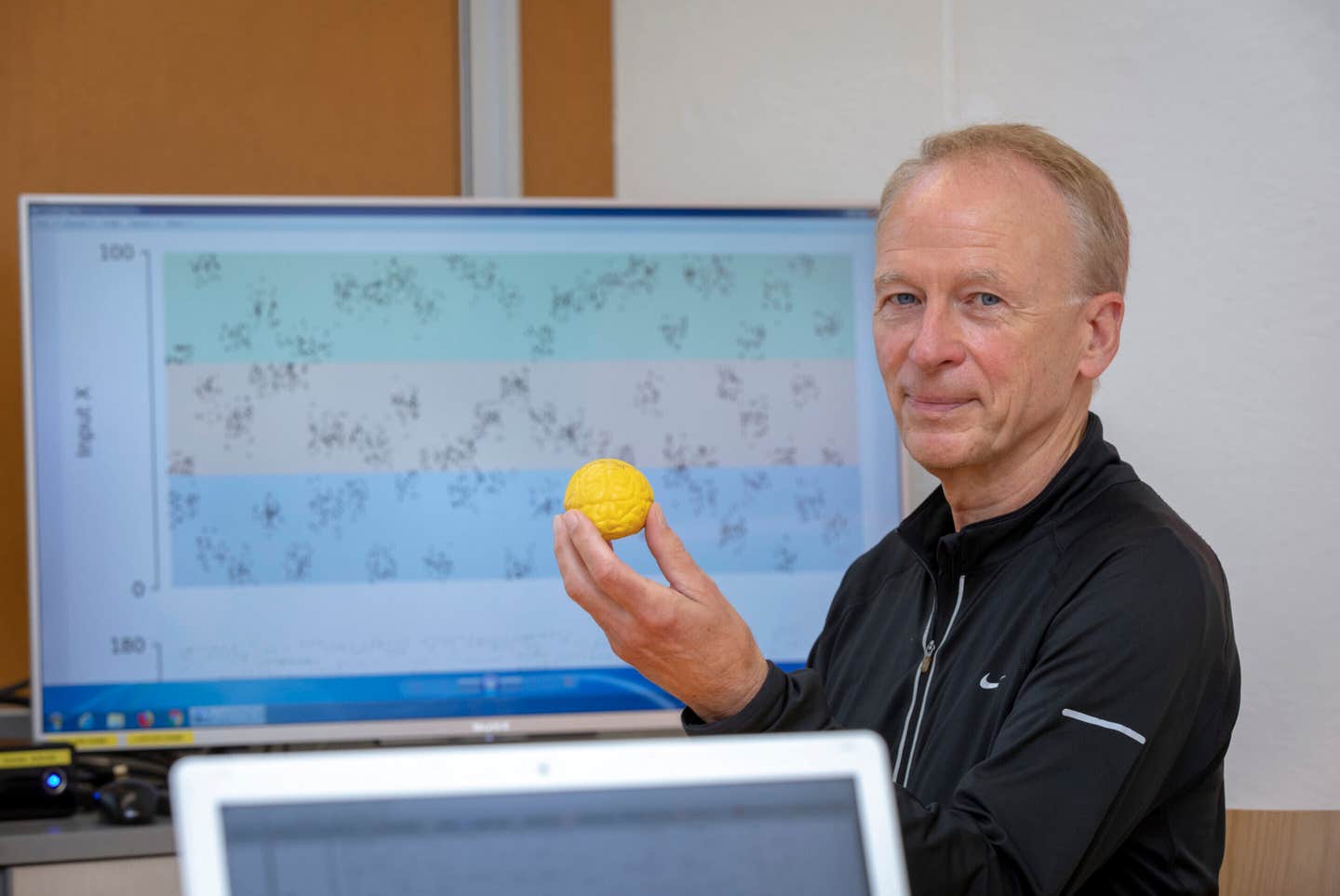
Wolfgang Maass from the Institute of Machine Learning and Neural Computation at Graz University of Technology. (CREDIT: Lunghammer – TU Graz)
- Researchers developed a brain-inspired AI model that uses cognitive maps, controlled randomness, and reusable information to solve problems without testing every possible path.
- The system adapted to changing conditions without retraining and successfully handled physical navigation, abstract multidimensional planning, and shape-building tasks.
- Although still experimental, the low-energy approach could support robots, autonomous vehicles, and edge devices that need flexible decision-making without relying on large data centers.
The human brain runs on roughly 20 watts.
That modest energy supply supports planning, adaptation, movement, memory, and problem-solving. Modern artificial intelligence often requires far more electricity to perform a narrower set of tasks.
That contrast guided researchers at Graz University of Technology toward a different kind of AI model.
Instead of expanding a neural network, they studied how the brain approaches unfamiliar problems. Their system uses internal maps, controlled randomness, and reusable pieces of information.
The model can test possible actions without calculating every path to completion. It can also adjust when a problem changes, without starting its training again.
“The brain works in a completely different way to today’s AI systems,” said Wolfgang Maass.
“We are trying to translate the way it works into algorithms and apply them to AI systems.”
Maass works at the Institute of Machine Learning and Neural Computation at Graz University of Technology. He developed the approach with colleague Yukun Yang and international partners.
Intelligence Without Constant Expansion
Large AI systems continue to gain new abilities.
Those improvements often depend on larger models, more training data, and greater computing power. Training and operating such systems can consume substantial amounts of energy.
The Graz team pursued another direction. Their work does not aim to defeat large language models at the tasks those systems already perform. It offers an alternative foundation for applications that need flexible planning with limited power.
The model draws inspiration from studies of the hippocampus, a brain region linked to navigation and memory.
Researchers identified three mechanisms that may help the brain plan and solve problems.
The first involves cognitive maps.
A cognitive map turns relationships between objects or situations into geometric relationships between neural codes. It gives the system something like a sense of direction.
The second mechanism uses stochastic neural computation.
In simpler terms, the system introduces randomness while generating possible scenarios. It does not always follow one fixed sequence. The third mechanism, compositional coding, divides information and action plans into reusable parts.
Together, these features allow the model to explore possible solutions without exhaustively checking every option.
The system takes a promising step, reassesses its position, and chooses again.
Following a Direction Rather Than a Script
Traditional planning can require calculating long chains of actions before anything happens.
The brain-inspired model behaves differently. It selects a possible intermediate step. The cognitive map then indicates whether that move points toward the desired outcome. When the direction looks useful, the system follows it.
From the new position, it evaluates another set of possible actions. This process repeats as the model moves gradually toward its goal.
The randomness matters because it creates alternatives.
A rigid system may repeat the same unsuccessful plan. Controlled variation gives the model other routes to consider.
The map prevents those choices from becoming aimless. Even when the system samples possible actions, it retains information about where the goal lies.
“With this approach, our AI model can also react flexibly to changed or new situations without needing to be retrained,” Yang said.
That ability separates the model from systems built for one fixed environment. A change in the problem does not automatically erase what the model has already learned.
Three Tests of Flexible Planning
The researchers tested the model on three tasks.
One involved navigation through a two-dimensional space. The model had to orient itself and move toward a destination. This task reflected the familiar idea of a map guiding movement through a physical environment.
A second test moved beyond ordinary space.
The researchers asked the system to navigate an abstract, multidimensional environment. There, direction referred to relationships between problem states rather than physical locations. The third task involved a silhouette made from several building blocks.
The system had to assemble and disassemble the shape.
That problem required more than movement toward a point. The model needed to work with components that could appear in different combinations.
Compositional coding helped it reuse those pieces.
A known part could serve a new role inside a different arrangement. The system did not need a separate rule for every complete silhouette.
All three tests examined the same basic question. Could one brain-inspired framework plan across different kinds of problems?
The researchers report that it could.
A Different Kind of Efficiency
The model’s efficiency comes partly from what it avoids.
It does not need to calculate every possible solution before choosing an action. Instead, it samples promising steps and uses its map to stay oriented. That process resembles how people and animals often behave.
A person navigating an unfamiliar place may not evaluate every possible turn. They may choose a direction, check their surroundings, and correct course.
The researchers translated that general strategy into algorithms. Their work also challenges the assumption that powerful problem-solving always requires a massive network.
Artificial intelligence has often advanced by increasing scale. More layers and more computing resources can produce impressive results. Yet scale brings costs. Large systems can depend on energy-intensive data centers. They may also require retraining when tasks or conditions shift.
The new model remains at an early stage. It does not match the broad abilities of today’s largest AI systems.
“We are still at a relatively early stage of development,” Maass said.
“But our work shows that powerful AI does not necessarily require huge data centres and enormous amounts of energy.”
The human brain’s roughly 20-watt energy use served as inspiration, not a reported power measurement for the model itself. The researchers describe the system as significantly less energy-intensive than multilayer neural networks or large language models.
Robots That Cannot Rely on the Cloud
The approach could matter most where energy and computing capacity remain limited.
Robots often need to react locally.
An autonomous machine may face an obstacle, a changed route, or an unfamiliar arrangement of objects. Waiting for a distant data center may not suit every situation.
Vehicles present similar demands. They must interpret changing conditions and choose actions while operating with a limited onboard energy supply.
The researchers also point to edge devices. These systems process information near the place where they collect it, rather than sending every task to centralized computing infrastructure.
A flexible, low-energy planning model could fit that setting.
Such devices would still need dependable hardware and further development. The current work provides a foundation rather than a finished commercial system.
Its main contribution lies in the planning method. The model uses learned relationships to guide new decisions. It does not require a complete solution before taking the first step.
Collaboration Across Institutions
The study involved researchers from Graz University of Technology, Tsinghua University, and Italy’s National Research Council.
Maass also works as a key researcher at the Bilateral AI Cluster of Excellence. The international collaboration joined machine learning with ideas drawn from neuroscience.
That combination shaped both the model and the questions behind it.
Rather than copying the brain in full, the researchers selected particular mechanisms that could become useful algorithms.
Cognitive maps supplied direction. Stochastic computation supplied variation. Compositional coding supplied reusable parts.
The result does not think like a human brain in every respect. The researchers do not make that claim.
It does suggest that neuroscience can offer more than metaphors for AI.
Specific principles may lead to systems built around different assumptions.
Practical Implications of the Research
Brain-inspired planning could give smaller devices more independence.
A robot might adjust to a changed environment without returning to a central system for complete retraining. Autonomous vehicles could benefit from planning methods that reconsider options while preserving a sense of direction.
Edge devices may gain flexible decision-making without relying on the energy demands of very large models.
The approach could also broaden the debate about AI efficiency.
Energy savings do not have to come only from faster chips or smaller versions of existing networks. They may also come from changing how an AI system approaches a problem.
This model replaces exhaustive calculation with guided exploration. Its future value will depend on how well that strategy works outside controlled tests.
For now, the research offers a clear challenge to one dominant idea in artificial intelligence.
More capable machines may not always need to become larger. Sometimes, they may need a better sense of direction.
Research findings are available online in the journal Nature Machine Intelligence.
The original story "Brain-inspired AI model adapts and plans without massive data centers" is published in The Brighter Side of News.
Related Stories
- Tiny flapping drone matches insect speed with an AI brain
- Brain implant helps paralyzed man move his hand and feel touch again
- University of Cambridge breakthrough could help the brain and spinal cord repair themselves
Like these kind of feel good stories? Get The Brighter Side of News' newsletter.
Shy Cohen
Writer