Can rockets ride on a microwave beam? A radical launch idea is moving beyond the lab
Japanese experiments are turning microwave-powered launch from a distant proposal into a series of measurable engineering challenges.

 Edited By: Joshua Shavit

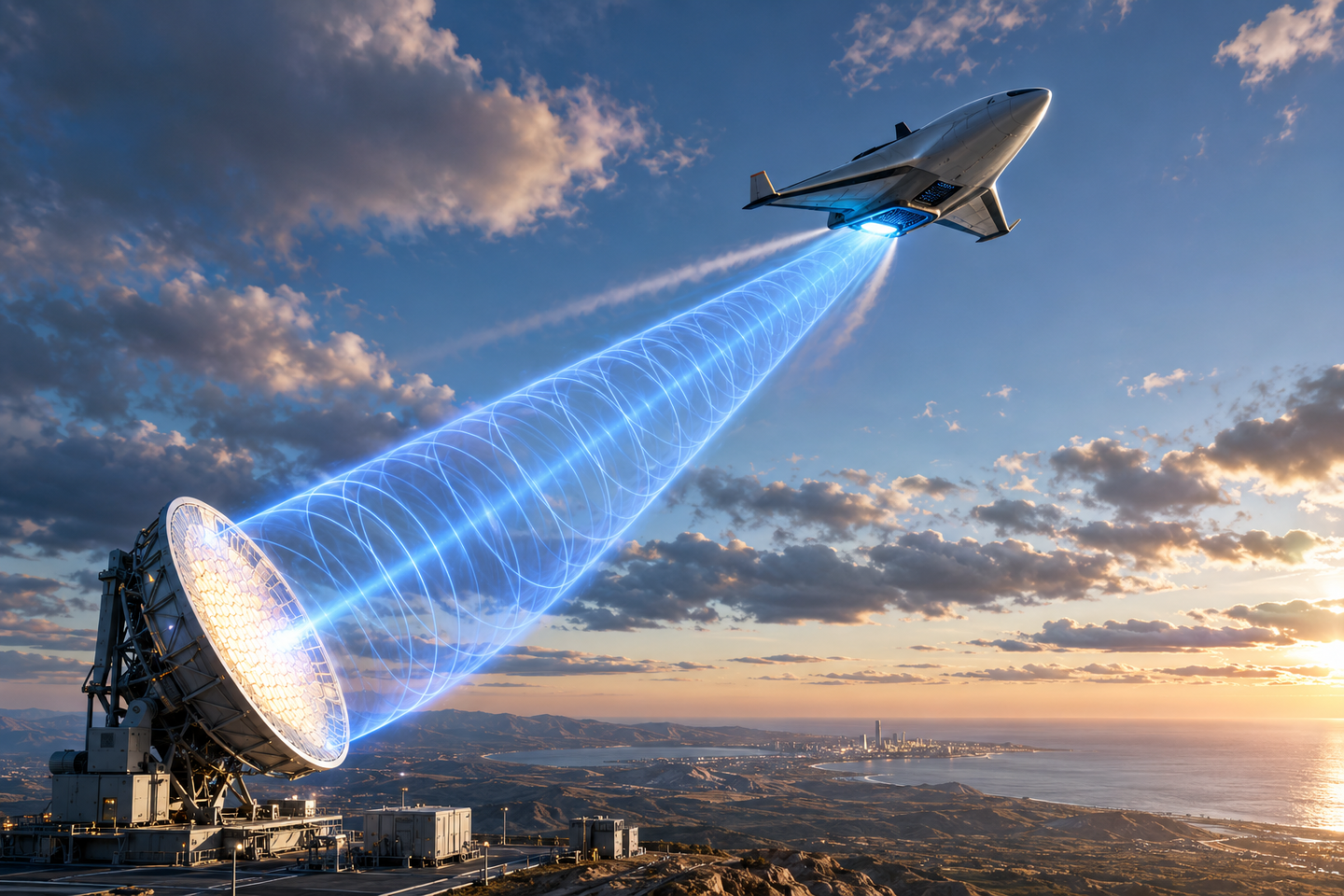
Microwave rocket propulsion tests reveal progress in beam tracking, plasma control and thrust, but major efficiency barriers remain. (CREDIT: Wikimedia / AI-Generated / CC BY-SA 4.0)
Every rocket that leaves Earth must lift not only its payload, but also the enormous supply of propellant needed to keep climbing. Fuel and oxidizer can account for roughly 90% of a conventional rocket’s starting mass, forcing engineers to build larger tanks, stronger structures and more powerful engines.
Microwave-powered propulsion offers a different possibility. Instead of carrying nearly all the energy needed for flight, a vehicle could receive it from a transmitter on the ground, or perhaps one day from a satellite in orbit. The beam would follow the craft as it climbed, allowing the vehicle to remain lighter and potentially simpler.
Japanese researchers have spent years turning that vision into measurable experiments. A short flight by a microwave-powered drone has led to studies of beam tracking, plasma, shock waves, thruster geometry and a “tractor beam” arrangement.
The advances are real, but no microwave rocket is close to orbit. The latest work shows scientists solving the smaller problems that must come first.
A drone becomes the first test
The research gained wider attention after Satoru Suganuma, Kohei Shimamura, Maho Matsukura, Duc Hung Nguyen and Koichi Mori published a study in the Journal of Spacecraft and Rockets. The experiment, later covered by The Brighter Side of News, used a 28-gigahertz microwave beam to send power to a free-flying drone.
The aircraft weighed about 0.4 kilograms and hovered for 30 seconds at a height of 0.8 meters above the transmitter. A tracking system followed the moving drone, while phase shifters adjusted the microwave signal to direct as much energy as possible toward its receiver.
Transmitting power to a stationary target is far easier than feeding a moving aircraft. A rocket would accelerate, change its distance from the transmitter and be pushed by wind. If the beam drifted away, its energy supply could fall immediately.
The experiment also exposed the scale of the efficiency problem. Only about 4% of the transmitted power traveled effectively through the beam. The drone captured about 30% of that energy, and roughly 40% of the captured energy was converted into electricity for propulsion. After all losses were included, total transmission efficiency was just 0.43%.
That was far below the 60.1% efficiency previously measured with a fixed receiver. Tracking, movement and receiver size could determine whether the system worked at all.
The drone was not a microwave rocket in the strict sense. It converted microwave energy into electricity for conventional propellers. A true microwave rocket uses the beam to create plasma and pressure inside a thruster. Still, the test showed that a concentrated beam could follow a freely moving vehicle, although with heavy losses.
Turning air into thrust
In the rocket version, a high-power millimeter-wave pulse enters the vehicle and is focused inside a nozzle or chamber. The electric field becomes strong enough to break down the surrounding gas, creating hot, electrically charged plasma.
Energy from the plasma heats nearby neutral gas and produces a shock wave. Pressure from that wave pushes against the thruster’s internal surfaces, creating an impulse. While the vehicle remains in the atmosphere, ordinary air can serve as the working gas. The rocket would need another propulsion method after climbing beyond the useful atmosphere, but it could potentially reduce the propellant required during the demanding first stage.
The beam comes from a gyrotron, a vacuum tube developed for uses such as heating plasma in fusion research. Gyrotrons can generate extremely powerful millimeter waves. Japanese teams have used 28-gigahertz systems producing beams in the hundreds of kilowatts.
Keeping the energy source on the ground could reduce vehicle mass and some of the complex plumbing and combustion equipment used in chemical rockets.
However, a rocket riding a beam must remain centered inside it. That problem became the focus of a 2024 study by Shimamura, Matsukura and colleagues in the Journal of Propulsion and Power. The team measured how moving a microwave thruster away from the beam’s ideal position affected propulsion efficiency.
The work showed that misalignment changes how energy enters the thruster and where plasma forms. A full-scale vehicle would need rapid steering, precise position data and constant beam adjustment.
A tractor beam that produces thrust
A major update arrived in 2025, when researchers including Shimamura reported an experimental demonstration of “tractor millimeter-wave beam propulsion” in Scientific Reports.
Traditional microwave-rocket designs send energy into the nozzle from behind the vehicle, the same direction from which exhaust must leave. That creates a problem during repeated pulses. Plasma left after one pulse can absorb the next pulse too early. The point where energy is deposited can move out of the useful part of the nozzle, causing thrust to fall and eventually disappear.
The tractor-beam design separates the beam entrance from the exhaust. Microwave energy enters from the front and passes through a polytetrafluoroethylene, or PTFE, lens. The lens focuses the beam near the rear of the model, where it creates plasma and a shock wave. Pressure pushes the vehicle toward the microwave source, while heated gas escapes in the opposite direction.
Using 28-gigahertz beams above 100 kilowatts, the researchers observed dense plasma and measured a positive net impulse. The model did not fly, but front-fed microwave energy produced force in the intended direction.
The researchers also found that small design changes mattered. If the pulse was too short, the gas did not heat enough to create a strong shock wave. If it was too long, plasma traveled beyond the chamber and wasted energy. A longer-focus lens improved performance by keeping the hottest region inside the thruster for more of the pulse. Simulations suggested that a narrower chamber could trap pressure more effectively.
The arrangement also suggests a more distant possibility. A microwave transmitter placed in orbit around another planet could theoretically beam energy toward a vehicle on the surface, helping it climb toward the satellite. Researchers have discussed the concept as a possible way to launch payloads from places such as Mars without first landing a fully fueled chemical rocket there. That idea remains speculative and would require enormous orbital power systems.
Shaping the beam like a doughnut
A second 2025 study, also published in Scientific Reports, placed a vortex phase plate in front of a microwave-driven in-tube accelerator. The plate reshaped the usual concentrated beam into an annular, or doughnut-shaped, pattern.
Without the plate, the strongest electric field formed near the front of the center body. Plasma appeared in the wrong location and created a negative impulse. With the doughnut-shaped beam, the central electric field weakened while energy concentrated around the rear section. Plasma and shock waves then formed where they could push the thruster in the desired direction.
The researchers used a 210-kilowatt, 28-gigahertz gyrotron and varied the pulse length between 0.6 and 1.5 milliseconds. The result showed that beam shape is not merely a transmission detail. It can control where gas breaks down and whether the force helps or opposes the vehicle.
The doughnut-shaped beam also offers a glimpse of how future launch systems might be controlled. Instead of only steering an entire beam left or right, operators could alter its phase and energy distribution to change where plasma forms inside the vehicle. The beam could become part power source and part adjustable engine component.
Monitoring a violent process
Another 2025 paper in Physics of Plasmas addressed how a future system might monitor that violent process. Researchers used a small rectifying antenna, known as a rectenna, to measure changes in standing waves reflected by the moving plasma front. The signal revealed whether the ionization front was moving continuously or breaking into intermittent streamer-like structures.
Monitoring has usually required large, expensive high-speed cameras. A compact sensor could help a control system detect changes inside a thruster before performance collapses.
That type of feedback would be essential during flight. A rocket climbing through the atmosphere would encounter changing air pressure, temperature, speed and beam intensity. Conditions inside the thruster could shift in milliseconds, leaving little time for human operators to respond. Sensors would need to recognize the change and allow computers to adjust the pulse length, beam shape or aim automatically.
The enormous gap between a pulse and orbit
Despite the progress, the infrastructure required for an orbital launch would be immense. An estimate cited by the tractor-beam researchers calculated that placing an 8-kilogram payload into a 300-kilometer orbit could require an 80-megawatt beam and a transmitting antenna 90 to 175 meters across.
That is far beyond the latest tests. It would likely require many megawatt-class gyrotrons, large phased-array antennas, major energy storage and extremely precise tracking controls.
Efficiency also remains a central concern. Energy would be lost while electricity was converted into microwaves, as the beam moved through the atmosphere and as the vehicle converted the incoming energy into thrust. Even a system that dramatically reduced onboard fuel might be uneconomical if most of the electricity never became useful motion.
Safety would also shape any launch site. A beam powerful enough to create plasma and shock waves could not be allowed to wander across aircraft, wildlife, workers or nearby communities. Weather, atmospheric turbulence and rain could affect transmission. Engineers would need automatic shutdown systems and restricted corridors similar to those surrounding conventional rocket ranges.
Environmental impacts of the technology
Microwave propulsion would not eliminate environmental questions. It could reduce the need for solid rocket motors and some chemical exhaust during the lower portion of flight, but the electricity powering the beam must still come from somewhere. The full benefit would depend on the energy source, launch rate, atmospheric effects and the propulsion system used after the craft left the air.
The technology could also shift environmental impacts rather than remove them. A large microwave launch complex would require power generation, cooling equipment, antennas and substantial land. Its footprint would have to be compared with the manufacturing, transportation and exhaust associated with conventional launch vehicles.
For now, the strongest case for the technology is not that it is ready to replace chemical rockets. It is that researchers are converting a century-old proposal into engineering problems that can be tested one by one.
The drone proved microwave power could follow a freely moving aircraft. The misalignment work measured the penalty when the beam missed its target. The tractor-beam experiment separated energy delivery from exhaust. The vortex plate placed plasma in a more useful location, and the rectenna study offered a way to watch the plasma without bulky cameras.
A microwave beam has not carried a rocket into space. But the research has moved beyond asking whether the idea violates physics. The question now is whether engineering, economics and safety can make the beam powerful, precise and reliable enough to lift something larger than a laboratory model.
The original story "Can rockets ride on a microwave beam? A radical launch idea is moving beyond the lab" is published in The Brighter Side of News.
Related Stories
- Flying into space on a microwave-propelled rocket
- Laser-powered, ‘metajets’ could be the future of interstellar flight
- Relativistic electron beams: A new frontier in interstellar travel
Like these kind of feel good stories? Get The Brighter Side of News' newsletter.
Joseph Shavit
Writer, Editor-At-Large and Publisher
Joseph Shavit, based in Los Angeles, is a seasoned science journalist, editor and co-founder of The Brighter Side of News, where he transforms complex discoveries into clear, engaging stories for general readers. With vast experience at major media companies like The Los Angeles Times, Times Mirror and Tribune Publishing, he writes with both authority and curiosity. His writing focuses on space science, planetary science, quantum mechanics, geology. Known for linking breakthroughs to real-world markets, he highlights how research transitions into products and industries that shape daily life.