Chang’e-6 samples reveal how Earth’s magnetosphere changed the solar wind reaching the Moon
Far-side lunar soil records faster solar-wind particles, while Earth’s magnetic environment slowed those reaching the near side.

 Edited By: Joseph Shavit

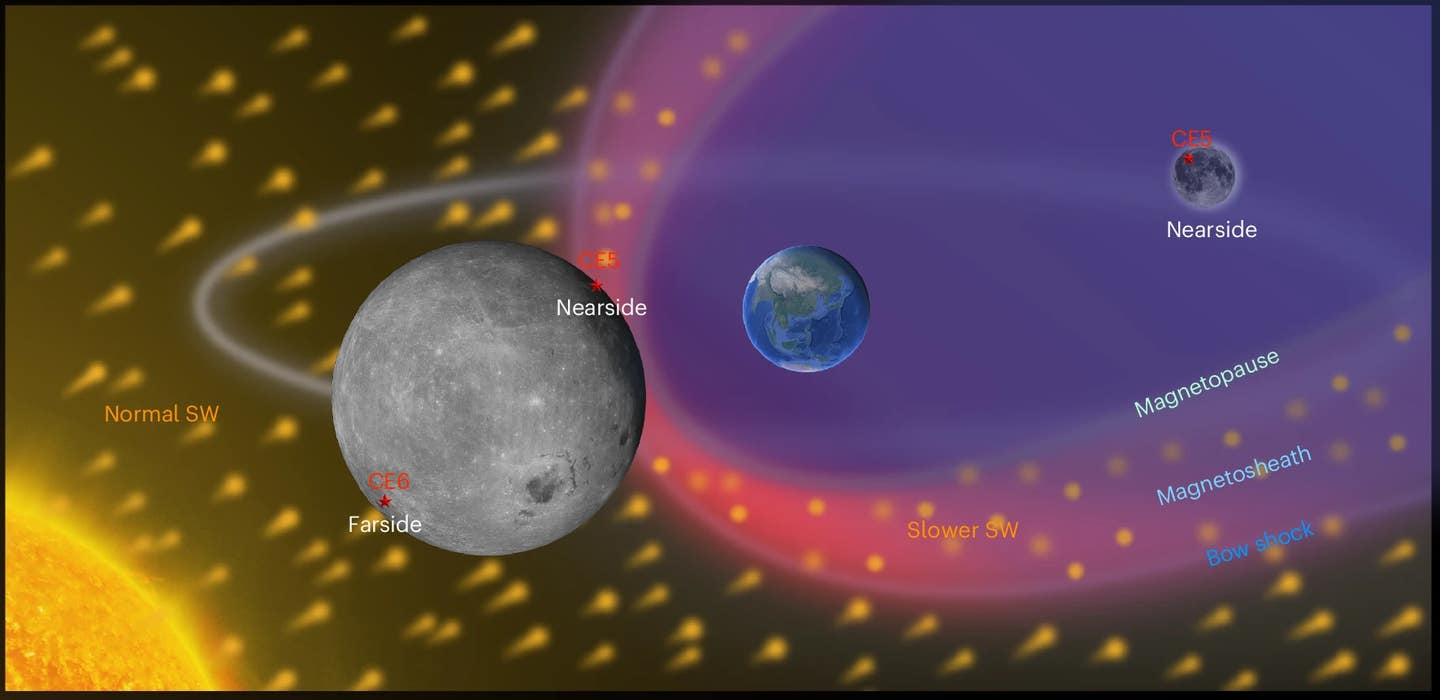
Hemispheric differences in SW the Moon receives as influenced by Earth’s magnetosphere. (CREDIT: Sun image, NASA/GSFC/SOHO; Moon images, NASA/GSFC/Arizona State University)
The Moon’s two hemispheres have spent billions of years facing very different surroundings. Its far side looks away from Earth, while the near side repeatedly passes through regions shaped by Earth’s magnetic field.
Samples returned by China’s Chang’e-6 mission now show that this difference reaches into the lunar soil. Noble gases trapped in far-side regolith carry signs of faster, higher-energy solar wind than material collected from the side facing Earth.
The study, published in Nature Geoscience, provides the first direct comparison between solar-wind implantation on the Moon’s near and far sides. It links the contrast to Earth’s magnetosphere, which slows some charged particles before they strike the lunar surface.
The work was led by researchers at the Institute of Geology and Geophysics of the Chinese Academy of Sciences. The team examined helium, neon, argon, krypton and xenon in Chang’e-6 soil from the South Pole-Aitken basin.
Chang’e-6 opened the far side for comparison
The solar wind is a continuous stream of charged particles flowing from the Sun. With almost no atmosphere or global magnetic field for protection, the Moon receives that stream directly.
Over time, solar-wind particles become implanted in grains of lunar regolith. Noble gases are especially useful records because they are chemically inert. Their concentrations, isotopic ratios and release temperatures can preserve physical details about how the particles arrived.
Until Chang’e-6, every returned lunar sample came from the near side. That prevented direct laboratory testing of whether Earth changes the solar wind reaching one hemisphere more than the other.
Chang’e-6 returned 1,935 grams of soil from the far side. The team analyzed seven small portions through stepwise heating and total-fusion laser extraction, measuring the isotopic composition of five noble gases.
The clearest anomaly appeared in neon. Chang’e-6 samples had an average ratio of neon-20 to neon-22 of 11.34, with an uncertainty of 0.22. That value is lower than ratios reported in all previously studied near-side soils.
It also sits close to the theoretical value of 11.2 expected for strongly fractionated solar-wind neon. The far-side material therefore contained a greater relative share of the heavier isotope, neon-22.
Heavy gases point to deeper implantation
Krypton and xenon revealed a second difference. When the Chang’e-6 soil was heated in stages, most solar-wind-derived xenon emerged only at higher temperatures.
Chang’e-5 samples from the near side behaved differently. They produced a double-peaked pattern, with substantial xenon released at both lower and higher temperatures.
Release temperature provides information about where gases sit within mineral grains. Gas released later, under stronger heating, is generally held more deeply. The Chang’e-6 pattern therefore points to deeper implantation on the far side.
The team ruled out several alternative explanations. The average krypton-to-xenon ratios were almost identical in Chang’e-5 and Chang’e-6 soils, arguing against extra meteorite or comet material as the source of the contrast.
Long-term changes in the solar wind also appeared unlikely. The Chang’e-6 soils recorded relatively recent solar-wind exposure, reducing the chance that the difference arose from ancient shifts in solar activity.
The researchers also found no noble-gas depletion large enough to support simple diffusion, erosion or preferential sputtering as a complete explanation for the unusual neon ratios. They concluded that more than one fractionation process may be involved.
Earth slows the wind on the near side
The strongest explanation centers on the magnetosheath, a turbulent buffer region surrounding Earth’s magnetosphere. Solar wind normally travels near 400 kilometers per second, but it slows to about 200 kilometers per second inside this region.
As the Moon orbits Earth, it passes through the magnetosheath twice during each orbit. The near side receives much of this decelerated flow because it faces Earth.
Lower-speed ions carry less energy and do not penetrate as deeply into lunar grains. That would produce the shallower implantation pattern preserved in Chang’e-5 material.
The far side remains oriented away from Earth because the Moon is tidally locked. During the same magnetosheath passages, the Chang’e-6 landing site avoids the slowed stream and continues to record normal solar-wind implantation.
The researchers estimated that about 25 percent of solar-wind exposure at the Chang’e-5 landing site involved decelerated particles. They found no comparable effect at the Chang’e-6 site.
Computer simulations supported the interpretation. At roughly 200 kilometers per second, implanted solar-wind gases would occupy shallower regions and mix more closely with meteorite and comet components, matching the Chang’e-5 release pattern.
Neon leaves a harder puzzle
The magnetosheath explains the depth difference, but the strongly fractionated neon on the far side remains more complicated.
Previously proposed processes do not fully reproduce the Chang’e-6 measurements. Preferential sputtering predicts a higher neon-20 to neon-22 ratio. Diffusion or erosion would require losing nearly all the neon, yet Chang’e-6 soils did not show such a loss.
The similar latitudes of the Chang’e-5 and Chang’e-6 sites also weaken temperature-based explanations. Both locations should experience broadly comparable surface heating.
The team suggested that multiple processes may have acted together. Another possibility is the addition of a neon component with an even lower isotope ratio than strongly fractionated solar-wind neon.
Practical implications of the research
The findings turn lunar soil into a possible record of Earth’s magnetic environment. Heavy noble gases may preserve where the magnetosheath once slowed the solar wind and how that interaction changed over time.
Combined with paleomagnetic evidence, those signatures could help reconstruct the long-term development of Earth’s magnetosphere. They may also improve estimates of how solar-wind-derived hydrogen, nitrogen, water and other volatiles became distributed across the Moon.
Future comparisons between near-side and far-side samples could test whether the neon anomaly appears elsewhere. They could also separate local geology from effects created by the Sun-Earth-Moon system.
Chang’e-6 has shown that the lunar far side is not merely a different landscape. Its regolith records a different history of particle bombardment, one shaped in part by Earth itself.
Research findings are available online in the journal Nature Geoscience.
The original story "Chang’e-6 samples reveal how Earth's magnetosphere changed the solar wind reaching the Moon" is published in The Brighter Side of News.
Related Stories
- New X-ray scans track violent solar winds threatening Earth’s satellites
- Astronomers discover why solar winds gradually slow down on their way out of the solar system
- Earth may not be swallowed by our dying sun after all, study finds
Like these kind of feel good stories? Get The Brighter Side of News' newsletter.
Joshua Shavit
Writer and Editor
Joshua Shavit is a NorCal-based science and technology writer with a passion for exploring the breakthroughs shaping the future. As a co-founder of The Brighter Side of News, he focuses on positive and transformative advancements in technology, physics, engineering, robotics, and astronomy. Having published articles on AOL.com, MSN, Yahoo News, and Ground News, Joshua's work highlights the innovators behind the ideas, bringing readers closer to the people driving progress.