CUNY physicists recreate black hole energy extraction in a historic lab experiment
A still device acted like an ultrafast rotator, letting waves draw energy and emerge amplified in a black hole-inspired experiment.
 Edited By: Joseph Shavit

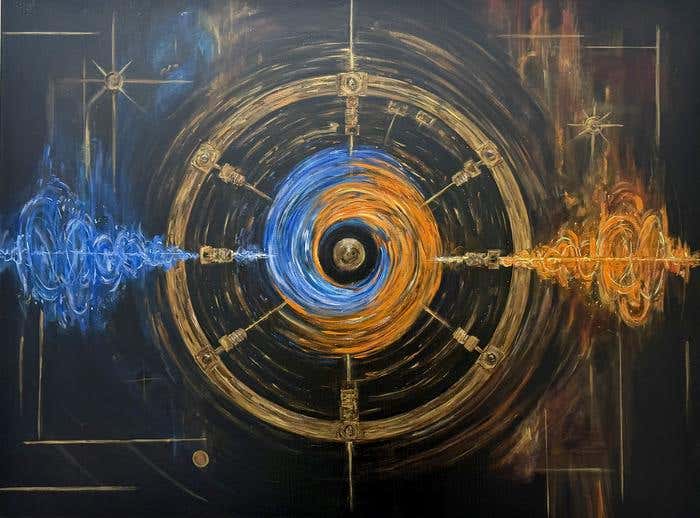
Artistic rendering of Penrose super-radiance: electromagnetic waves with selected rotation patterns are amplified as they interact with a system that appears to rotate at superluminal speeds. (CREDIT: Dalila Pasotti and Hadiseh Nasari
A black hole may be millions of light-years away, but some of its strangest physics has now been recreated in a Manhattan laboratory.
In the late 1960s, physicist Roger Penrose proposed that a rotating black hole could transfer some of its energy under the right conditions. Soon after, Yakov Zel'dovich predicted that waves striking a rapidly rotating object could emerge stronger by extracting energy from its motion.
Now researchers at the Advanced Science Research Center at the CUNY Graduate Center have demonstrated a new version of that phenomenon. Instead of spinning an object at extreme speeds, they built an electronic system that behaves as though it were rotating. Reported in Nature, the experiment transforms a decades-old theoretical prediction into a controllable device that amplifies selected waves by extracting energy from what the team calls synthetic rotation.
New method of wave–matter interaction
“Our approach facilitates a new method of wave–matter interaction in which waves with selected rotational properties extract energy from synthetic time-engineered rotation, producing a form of broadband selective amplification,” said Andrea Alù, the study’s principal investigator, Distinguished Professor and Einstein Professor of Physics at the CUNY Graduate Center, and founding director of the CUNY ASRC’s Photonics Initiative.
The central question was deceptively simple. Could electromagnetic waves sent into a device that never physically moves behave as though they were interacting with something rotating at ultrafast speed, and then extract energy from that apparent motion?
The team’s answer came in the form of a ring-shaped network of electronic resonators. Instead of spinning the ring, the researchers rapidly modulated the resonators’ properties in a carefully timed pattern that traveled around the circle. To incoming waves, that moving pattern looked like rotation.
A spinning effect without spinning matter
That distinction matters because ordinary mechanics quickly runs into limits. In earlier work on rotational wave amplification, extending the effect to electromagnetic waves and especially to optics has been difficult. Reaching the needed rotational speeds is hard, and larger rotating objects can create other problems, including poor overlap with the kinds of waves used in the experiments.
The CUNY device sidesteps those obstacles by replacing physical motion with engineered modulation in space and time. The system remains still, but its electromagnetic properties sweep around the ring in sequence, creating what the researchers describe as a synthetic form of ultrafast rotation.
Because that synthetic motion is not bound by the same practical limits as mechanically spinning matter, it can reach effective rotational speeds that would otherwise be out of reach in the lab. That, in turn, lets researchers probe a regime tied to extreme rotational Doppler shifts, the frequency changes that waves experience in rotating systems.
“Waves with the appropriate rotational characteristics extracted energy from the system and became amplified, reproducing the essential physics of the Penrose–Zel’dovich process,” said co-lead author Hady Moussa, a former PhD student with the CUNY ASRC Photonics Initiative. “Our approach relies on engineered metamaterials that are designed to control how waves propagate.”
The experiment used radio-frequency circuitry rather than an astronomical object or a rapidly spinning cylinder, but the underlying theme is similar. If a wave enters the right rotational regime, the theory says it can tap energy from the rotating system and emerge stronger.
When the wave flips into a different regime
In the team’s setup, the key signature appeared when the modulation rate became high enough to push a downconverted signal into what the researchers describe as a negative Doppler-shift regime. In that regime, the wave’s orbital angular momentum, or OAM, reversed sign, a marker of time-reversed dynamics in the fast-rotating frame.
That reversal was not just mathematical bookkeeping. It coincided with amplification.
The prototype itself was small, a loop of three resonators configured in a delta topology and modulated by varactor diodes. The researchers drove the system with an input signal at 100 megahertz and tracked what happened as they changed the modulation frequency. At lower modulation rates, the downconverted subharmonic weakened as expected. Once the modulation frequency rose past the input frequency, the behavior changed. The OAM order flipped, and the signal entered the amplification regime.
Experimentally, the maximum net gain reached about 7.8 decibels.
Lead author Hadiseh Nasari, a post-doctoral researcher with the CUNY ASRC’s Photonics Initiative, said the result moves a long-standing concept into an experimental setting with broader reach. “This successful experiment moves ideas about extreme rotational dynamics from theory to practice and creates a versatile experimental platform for exploring a broad range of phenomena at the intersection of astrophysics, wave physics, and quantum science,” she said. “The work has implications for advances in fundamental science and in communications, optics and photonics.”
The paper argues that the amplification in this system does not reproduce every detail of the original Penrose or Zel’dovich scenarios. The device is not a one-to-one mechanical analog. But the authors say it is driven by the same thermodynamic logic: when a mode effectively crosses into a negative-frequency regime in a rotating frame, dissipation can open a channel for net energy extraction from the external drive.
A new playground for wave control
One of the study’s more unusual conclusions is that loss, usually treated as an obstacle, can help here. The analysis showed that parasitic losses and modulation strength work together in enabling the amplification process. In fact, at a fixed output frequency in the synthetic superluminal regime, larger losses increased the effective amplification and broadened the gain response.
The broader framework behind the experiment involves what the authors call rotating space-time crystals and angular-momentum bandgaps. In this system, modulation patterns shift the device from a space-like regime, associated with frequency gaps, into a time-like regime, where gaps open in angular momentum instead. Inside those gaps, parametric coupling allows energy transfer that selectively amplifies certain rotational wave modes.
That selectivity could matter for technology. Because the platform can be tuned to favor waves with particular rotational properties, it points to possible uses in wave control and data encoding. The paper also suggests possible applications in wireless communications, classical optics and quantum optics.
The current experiment operated in a radio-frequency circuit, but the authors argue the same principles could be extended to higher frequencies, including photonic and possibly optical systems, through all-optical modulation schemes. They also say larger ring networks with more resonators could expand the range of accessible orbital angular momentum states.
For now, the deeper appeal may be conceptual. A phenomenon inspired by black hole energy extraction has been brought into a controlled lab device that never actually spins.
Practical implications of the research
The work offers researchers a new way to study extreme rotational wave behavior without relying on mechanically rotating objects, which are hard to push into the necessary speed range. That could make experiments on unusual Doppler effects, wave amplification and time-varying media far more practical.
It also points to devices that selectively amplify signals with specific rotational properties, which may prove useful in communications and photonics.
Longer term, the same approach could help scientists manipulate light in new ways, process information with greater control, and test wave effects linked to astrophysics and quantum systems in ordinary laboratory settings.
Research findings are available online in the journal Nature.
The original story "CUNY physicists recreate black hole energy extraction in a historic lab experiment" is published in The Brighter Side of News.
Related Stories
- Black hole collision lets scientists probe the event horizon for the first time
- Collapsing stars could form gravastars instead of black holes
- Milky Way’s central black hole wind finally detected ending 50-year search
Like these kind of feel good stories? Get The Brighter Side of News' newsletter.
Joseph Shavit
Writer, Editor-At-Large and Publisher
Joseph Shavit, based in Los Angeles, is a seasoned science journalist, editor and co-founder of The Brighter Side of News, where he transforms complex discoveries into clear, engaging stories for general readers. With vast experience at major media companies like The Los Angeles Times, Times Mirror and Tribune Publishing, he writes with both authority and curiosity. His writing focuses on space science, planetary science, quantum mechanics, geology. Known for linking breakthroughs to real-world markets, he highlights how research transitions into products and industries that shape daily life.