Scientists finally confirm the cause of Earth’s greatest mass extinction
Experiments reveal why warming, oxygen-poor seas favored clams and snails during Earth’s largest mass extinction.
 Edited By: Joshua Shavit

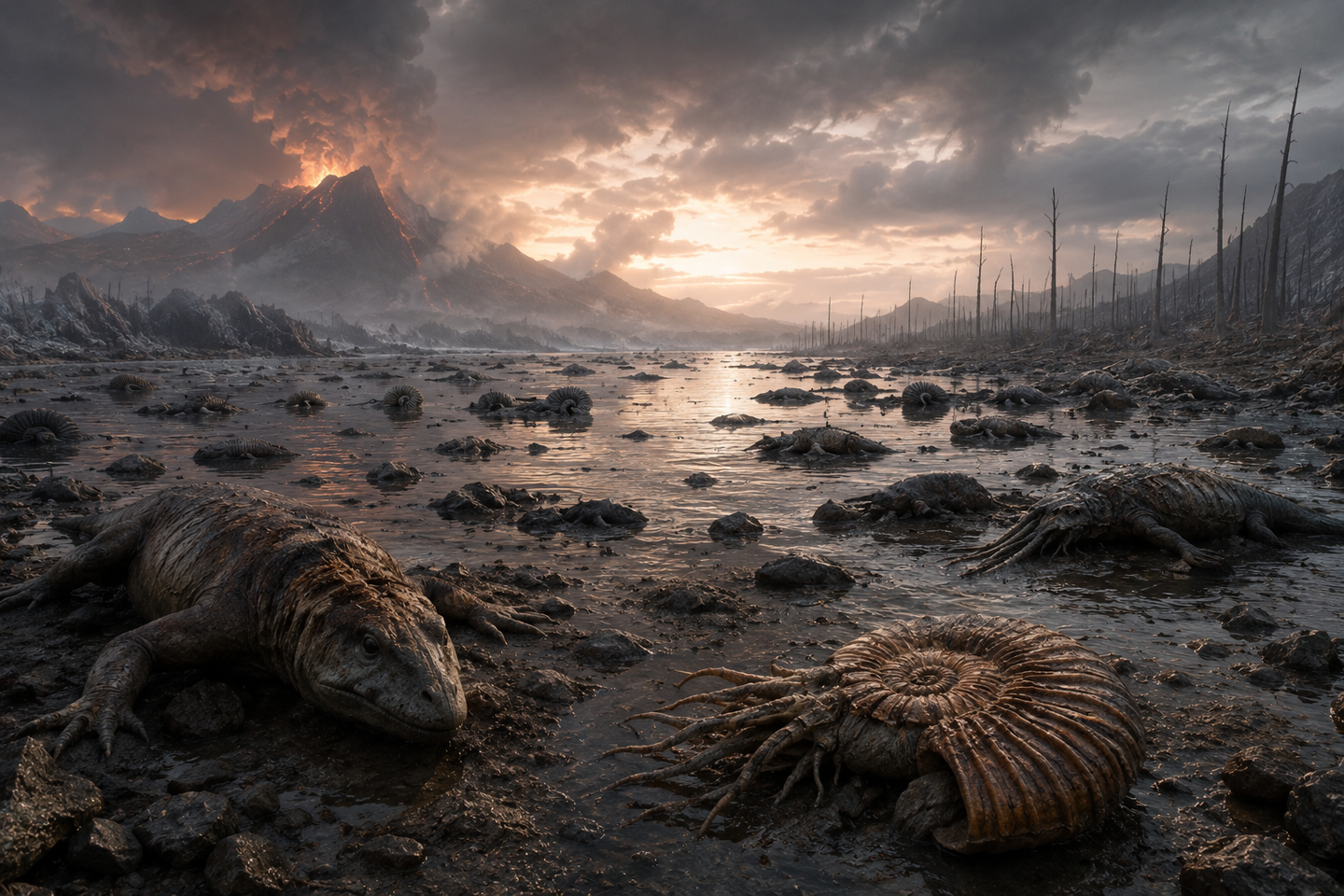
Metabolic differences may explain why clams survived the Great Dying while brachiopods and sea lilies suffered devastating losses. (CREDIT: Wikimedia / AI-Generated / CC BY-SA 4.0)
Around 252 million years ago, Earth’s oceans became a lethal test of animal physiology. Nearly every marine species vanished, yet some groups survived well enough to dominate the seas ever since. The difference may have come down to how bodies handled heat and oxygen.
The Permian–Triassic extinction, often called the Great Dying, eliminated about 96% of marine species and 70% of land animals. Its effects were not evenly spread across the evolutionary tree.
Brachiopods, which resemble clams, nearly disappeared. Sea lilies, or crinoids, and other slow-moving seafloor animals also suffered enormous losses. These groups had dominated marine ecosystems for roughly the first 280 million years of animal life.
Mollusks fared better. About half of clams, snails, and related groups survived. Their descendants, along with fish, starfish, and sea urchins, later became central players in modern oceans.
A metabolic divide beneath the waves
A Stanford-led study published in the Proceedings of the National Academy of Sciences argues that this turnover reflected a deep physiological divide. The animals hit hardest were especially vulnerable when warming water raised their oxygen needs while the ocean itself lost oxygen.
“With this study, we essentially wanted to solve the mystery of why, when you go to the beach, you collect the shells of clams and snails rather than those of brachiopods,” said lead author Jose Andres Marquez, a former doctoral student in Erik Anders Sperling’s Stanford laboratory.
The team found that extinction rates rose sharply among groups unable to cope with the combined pressure of high temperatures and low oxygen.
“Our findings show that, across different organism groups, extinctions happened at much higher rates for those more vulnerable to increases in water temperature and decreases in oxygen availability,” Marquez said.
The crisis began after massive eruptions in the Siberian Traps released carbon dioxide, methane, sulfur compounds, and other gases. Global temperatures climbed, oxygen levels fell across broad regions of the ocean, and seawater became more acidic.
Earlier work had already linked warming and oxygen loss to the Great Dying. The new analysis goes further by comparing the biology of animal groups that were devastated with those that survived more successfully.
Why brachiopods struggled as temperatures rose
Many animals that dominated Paleozoic seafloors had slow metabolisms and simple body plans. Brachiopods, crinoids, certain corals, and sea anemones often stayed fixed in place and filtered food from the water.
Their low energy demands allowed them to survive in water with little oxygen. At cooler temperatures, some brachiopods could maintain basic metabolism under conditions that would asphyxiate many modern marine animals.
That advantage disappeared as temperatures rose.
Warmer water speeds chemical reactions inside an animal’s body, increasing its metabolic demand. The experiments showed that the oxygen requirements of Paleozoic-style animals rose faster with warming than those of groups associated with modern oceans.
Brachiopods rely on relatively simple circulation and limited musculature. Bivalves such as clams and mussels have more developed respiratory structures, stronger circulation, and muscular feet that help them dig or move.
Those features require more oxygen under normal conditions. They also give bivalves greater capacity to pump water, circulate oxygen, and meet rising demand when temperatures increase.
“This is why we eat clam chowder and we don’t eat brachiopod chowder,” Sperling said. “Brachiopods have almost no meat.”
Before the extinction, brachiopods outnumbered bivalves. Today, only about 400 brachiopod species remain, compared with roughly 10,000 to 15,000 bivalve species.
Testing survivors of an ancient ocean
The researchers collected living representatives of both broad groups, including brachiopods and crinoids, during fieldwork in places such as Washington state’s San Juan Islands.
They placed animals in chambers and measured oxygen use as water temperatures changed. The experiments established the lowest oxygen level each animal could tolerate while maintaining its resting metabolism.
The team combined its measurements from 14 species with published data from 24 others. It also analyzed two large sets of species distribution records, including more than 21,000 physiological estimates derived from the Ocean Biodiversity Information System.
Across the independent datasets, the same pattern emerged. Paleozoic-style animals generally tolerated lower oxygen while resting, but their performance declined more sharply as temperatures climbed.
The researchers then placed those physiological differences into an Earth system model of the end-Permian climate transition. The simulated ocean warmed by about 11 degrees Celsius in the Paleo-Tethys Sea and lost oxygen as warmer water held less gas and ocean circulation weakened.
The model predicted greater extinction among Paleozoic groups at every latitude. Losses for both major groups increased toward the poles, matching broad patterns in the fossil record.
At the family level, the Paleozoic fauna lost 79% of its biodiversity. The Modern fauna lost 27%.
Warming carried the greatest blow
Ocean acidification likely added stress by making shell growth more difficult. Sulfide toxicity and other chemical changes may also have contributed.
Still, the new results place temperature-dependent oxygen stress at the center of the biological turnover.
“Warming and oxygen loss are the key drivers,” Sperling said.
The authors caution that living species cannot reveal the exact physiology of animals that died 252 million years ago. Entire groups, including trilobites, have no surviving representatives. Modern brachiopods also occupy a narrower range of habitats than their ancient relatives.
Even so, the comparison between living brachiopods and bivalves suggests that basic anatomical differences have preserved meaningful physiological traits across evolutionary time.
“This study is really the final nail in the coffin for what caused the Permian–Triassic mass extinction,” Sperling said.
The event began in a relatively cool, well-oxygenated ocean before a massive injection of carbon dioxide transformed the climate. That starting point carries an unsettling resemblance to present conditions.
Practical implications of the research
Temperatures rose by about 8 to 12 degrees Celsius over thousands of years during the Great Dying. Current projections place warming at 1.5 to 4 degrees above preindustrial levels by 2100, unfolding over only 100 to 200 years.
“The bad news is, we are on track for Permian-Triassic levels of warming in worst-case scenario projections,” Sperling said. “But the good news is, we’re still at the point where we can change things and do something about it.”
The findings may help scientists identify modern marine animals at greatest risk as oceans warm, lose oxygen, and become more acidic. Vulnerability may depend not only on where a species lives, but also on how its body moves oxygen and responds to heat.
The ancient extinction does not provide a precise forecast for today. It does show that rapid warming can reorganize marine life for hundreds of millions of years, favoring some body plans while pushing others toward disappearance.
Research findings are available online in the journal PNAS.
The original story "Scientists finally confirm the cause of Earth’s greatest mass extinction" is published in The Brighter Side of News.
Related Stories
- Ancient oceans started to suffocate 8 million years before the Triassic mass extinction
- Scientists discover how primitive plants survived Earth’s worst mass extinction
- Mass extinction helped jawed vertebrates rise, study finds
Like these kind of feel good stories? Get The Brighter Side of News' newsletter.
Joseph Shavit
Writer, Editor-At-Large and Publisher
Joseph Shavit, based in Los Angeles, is a seasoned science journalist, editor and co-founder of The Brighter Side of News, where he transforms complex discoveries into clear, engaging stories for general readers. With vast experience at major media companies like The Los Angeles Times, Times Mirror and Tribune Publishing, he writes with both authority and curiosity. His writing focuses on space science, planetary science, quantum mechanics, geology. Known for linking breakthroughs to real-world markets, he highlights how research transitions into products and industries that shape daily life.