Dante’s Inferno suggests Hell and Purgatory mirror the physics of a massive asteroid impact
A new reading of Dante suggests Hell and Purgatory mirror the physics of a massive impact crater.

 Edited By: Joseph Shavit

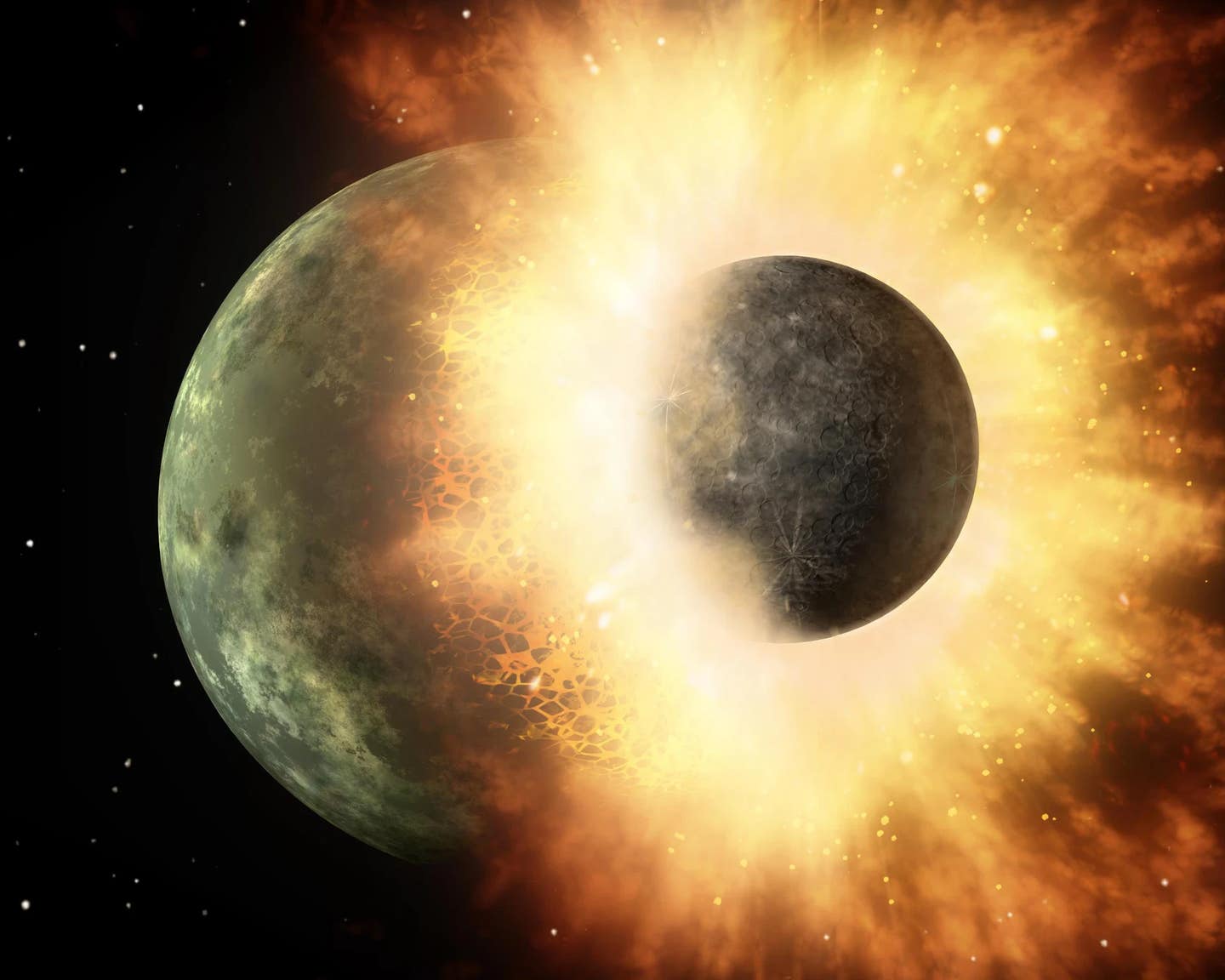
Artist’s depiction of a collision between two planetary bodies, similar to the hypothesized collision between Theia and the proto-Earth. (CREDIT: Wikimedia / CC BY-SA 4.0)
For centuries, Dante Alighieri’s Inferno has been read as a moral and spiritual descent, a journey into sin, punishment, and divine justice. Timothy Burbery of Marshall University now argues that the poem also carries something far more physical. In his reading, Dante did not simply imagine Satan falling from Heaven. He pictured that fall as a violent planetary impact.
That idea changes the scale of the story at once.
Instead of treating Satan’s plunge as a symbolic collapse, Burbery proposes that Dante envisioned him as a fast-moving body striking the Southern Hemisphere and boring all the way to Earth’s center. In that scenario, Hell is not just a spiritual realm beneath the surface. It is the crater left behind by the collision, formed from the ground up as matter is forced outward and downward.
The image is startling because it makes Dante sound less like a poet working in allegory and more like someone running a thought experiment about impact physics centuries before modern meteoritics existed.
Hell as a crater, Purgatory as a peak
Burbery’s interpretation gives new meaning to the geography of the Divine Comedy. In this account, Satan’s fall does not just open a pit. The impact pushes the Northern Hemisphere away, creating the hollow structure of Hell, while the displaced earth behind him rises into the mountain of Purgatory.
That would make Mount Purgatory the equivalent of a central peak, the uplifted mass that appears in the middle of major impact structures.
The comparison becomes even more striking when Burbery places Dante’s imagined event beside known examples from impact science. He suggests that the scale resembles the Chicxulub impact, the collision linked to the extinction event that ended the age of dinosaurs. In that framing, Satan becomes something like an asteroid-sized body whose arrival sets off a global chain reaction.
Burbery also describes Dante’s Satan as oblong, more like the interstellar object Oumuamua than a simple sphere. And unlike many objects that break apart or vaporize on impact, this one remains intact. That part of the comparison calls to mind the Hoba meteorite, a roughly 60-ton mass that still survives on Earth rather than having been destroyed in the atmosphere or at impact.
The circles of Hell take on a new shape
Seen this way, the nine circles of Hell stop looking like purely moral divisions and start resembling terrain.
Burbery argues that Dante’s descending rings echo the terraced, concentric structures seen in multi-ring impact basins across the solar system. Those features appear on worlds such as the Moon and Venus, where giant collisions left behind broad circular depressions with repeated structural bands.
That does not mean Dante was doing modern geology in a formal sense. But the resemblance, Burbery suggests, is too strong to ignore. The architecture of Hell begins to look like an intuitive description of crater morphology, translated into poetry long before anyone had the scientific language to describe such landforms.
His reading also touches on motion and force. Dante’s vision, in this interpretation, anticipates ideas tied to terminal velocity and crustal breach, imagining what would happen if an enormous body struck with enough power to drive itself to maximum compression at the planet’s core.
It is an audacious claim, but also a carefully framed one. Burbery is not saying Dante wrote a science text. He is saying the poem can be read as a geophysical thought experiment, one that overlaps in surprising ways with later scientific ideas about impacts, shock, and planetary restructuring.
A challenge to old ideas about the heavens
That matters because Dante wrote in a world shaped by older assumptions about the sky.
Under Aristotelian thinking, the heavens were often understood as perfect and unchanging. Meteors did not fit comfortably into that vision as world-altering physical agents. Burbery argues that Dante, by portraying Satan’s fall as a real collision with devastating material consequences, effectively pushed against that older worldview.
In this reading, celestial bodies are no longer distant ornaments or optical effects. They become forces that can alter the structure of the planet itself.
That gives the Divine Comedy a second life beyond literature. It remains a religious and poetic masterpiece, but it also starts to look like an early attempt to think through the mechanics of planetary catastrophe. The poem becomes a place where medieval imagination brushes against scientific reality.
Burbery sees value in that overlap today. He argues that literary geomythology can help people think about physical threats long before those threats are formally described by science. Ancient and medieval narratives, in other words, may preserve ways of imagining disaster that later become scientifically legible.
The original story "Dante’s Inferno suggests Hell and Purgatory mirror the physics of a massive asteroid impact" is published in The Brighter Side of News.
Related Stories
- Marine life evolved rapidly after the dinosaur killing asteroid impact 66 million years ago
- DART spacecraft's asteroid impact informs new planetary defense strategy
- Asteroid impact could trigger climate chaos, but oceans might thrive
Like these kind of feel good stories? Get The Brighter Side of News' newsletter.
Joshua Shavit
Writer and Editor
Joshua Shavit is a NorCal-based science and technology writer with a passion for exploring the breakthroughs shaping the future. As a co-founder of The Brighter Side of News, he focuses on positive and transformative advancements in technology, physics, engineering, robotics, and astronomy. Having published articles on AOL.com, MSN, Yahoo News, and Ground News, Joshua's work highlights the innovators behind the ideas, bringing readers closer to the people driving progress.