MIT releases first AI model built to make Alzheimer’s preventable
MIT-led FINGERS-7B combines multi-omic data to spot Alzheimer’s risk years before symptoms appear.

 Edited By: Joseph Shavit

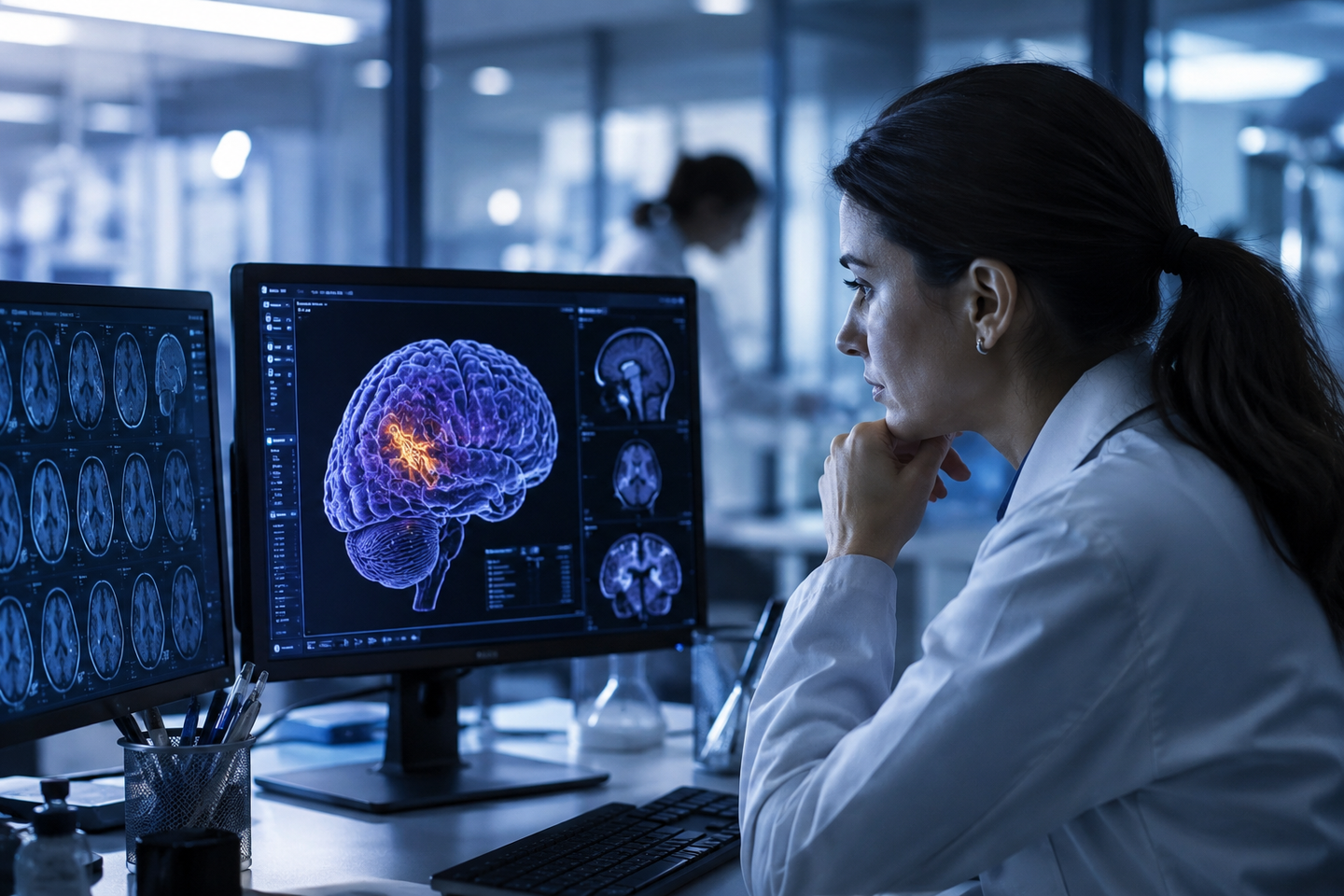
MIT-led FINGERS-7B uses multi-omic data to predict Alzheimer’s risk earlier and improve responder stratification. (CREDIT: AI-generated image / The Brighter Side of News)
Alzheimer’s disease often starts its work long before anyone notices a problem.
That gap, sometimes stretching a decade or more before memory symptoms appear, is where a research team centered at MIT says it wants to intervene. The group has released FINGERS-7B, which it describes as the first AI foundation model built specifically to help make Alzheimer’s preventable by identifying people at risk earlier and more accurately.
The model, developed by a team of AI researchers, physicians, and scientists, combines lifestyle, clinical, genomic, and proteomic data from tens of thousands of at-risk individuals. By reading those signals together, rather than one at a time, the system is designed to uncover what the team calls multi-omic biomarkers for preclinical Alzheimer’s disease.
Looking across many kinds of biological evidence
What makes the project unusual is not just the scale of the data, but the way the model handles it. FINGERS-7B was trained to learn jointly from lifestyle information, clinical records, biomarkers, genomic data, and proteomic signals. The broader platform around it is called FINGERPRINT, which pairs the model with AI agents that run automated multi-omic analyses.
The central idea is that disease risk may be easier to detect when many layers of biology and behavior are examined together. Instead of treating each omics domain as a separate puzzle, the model looks for patterns across them all at once. According to the team, that integrated view is what allows earlier and more accurate detection in cases where no single source of data can do the job alone.
"Each of us carries a biological fingerprint, basically a unique combination of signals that reveal disease risk and, if properly understood, could enable prevention and treatment of Alzheimer's disease," said Adrian Noriega, an MIT-Novo Nordisk AI Fellow and FINGERPRINT co-lead. "FINGERPRINT is a discovery acceleration engine composed of specialized agents and new foundation models that interpret these biological signals to help us find novel biomarkers, prevention interventions, and therapeutics."
Noriega co-leads the project with Arvid Gollwitzer, a Broad Institute research scholar who led the design and training of FINGERS-7B.
Accuracy claims and personalized predictions
On datasets from the WW-FINGERS network, the team says FINGERS-7B delivered four times more accurate preclinical diagnosis than prior methods. It also reported a 130 percent improvement in responder stratification, a measure that could help researchers sort out which people are more likely to benefit from specific interventions.
Those findings matter because preclinical Alzheimer’s is the stage before obvious cognitive symptoms set in. If risk can be identified there, researchers and clinicians may have a larger window to test prevention strategies, lifestyle changes, or therapies before significant decline begins.
The model is also designed to generate individualized analyses. Given a person’s data, the team says it can estimate risk, forecast the likely course of cognitive decline, and predict the effect of possible interventions, ranging from dietary changes to drug treatments.
Li-Huei Tsai, Picower Professor and director of the Picower Institute for Learning and Memory at MIT, said the need for this kind of integration has been growing for years as Alzheimer’s labs generate larger and larger datasets.
"Even as Alzheimer's research labs like ours have gained the capability to generate huge volumes of data, including genetic, epigenetic and proteomic profiles from human tissue samples, we've faced the challenge of truly integrating all of it to gain a comprehensive view of individuals' risk, prognosis and likely treatment response," Tsai said. "Early on it became clear that FINGERPRINT would be a remarkable example of how AI could help."
Built on a prevention study that went global
The work builds on Professor Miia Kivipelto’s FINGER study, a landmark effort focused on cognitively unimpaired but at-risk older adults. That study later inspired the global WW-FINGERS network, which now spans 40 countries and 30,000 participants.
Those studies focus on risk factors and lifestyle interventions that can help prevent disease onset. The new project layers additional biomarker, genomic, and proteomic datasets on top of the WW-FINGERS clinical and lifestyle information, drawing on collaborating laboratories and industry partners.
MIT’s Aging Brain Initiative, directed by Tsai, helped launch the effort with a $100,000 grant last June to Noriega and Giovanni Traverso, a professor of mechanical engineering. Within 10 months, the team said, it trained FINGERS-7B, deployed it in the AD Workbench, and made the model available for outside use.
That timeline is striking for a project trying to bridge medicine, biology, and large-scale AI.
Open access, shared tools, and global partners
The team has made the model open source. Its weights, training code, and evaluation pipelines are public, meaning other research groups can apply FINGERS-7B to their own patient cohorts and contribute their results back.
It is also deployed in the AD Workbench, a secure cloud environment operated by the Alzheimer’s Disease Data Initiative, or ADDI, and used by Alzheimer’s researchers around the world. That setup is meant to lower the barrier for adoption. Researchers and clinicians can use the system where they already work, without moving sensitive patient data or building new infrastructure from scratch.
Other members of the FINGERPRINT effort include Tsai, Traverso, and Kivipelto. Industry partners include Alamar Biosciences and Novo Nordisk. Additional institutional partners include the Broad Institute, Yale University, Imperial College London, and Brigham and Women’s Hospital.
Even before the public release, the project had begun attracting outside attention. In February, the Davos Alzheimer’s Collaborative and the FINGERS Brain Health Institute announced a partnership to use FINGERPRINT to support Alzheimer’s prevention research. One of the partnership’s stated goals is to make that work globally inclusive, capturing the diversity of populations around the world.
The team was also named a finalist from roughly 200 teams for last month’s AI Insights Data Prize competition in Copenhagen, sponsored by ADDI and Gates Ventures.
"Someone was going to build the foundation model stack for Alzheimer's prevention," Gollwitzer said. "It should be open, and it should be now."
Practical implications of the research
If the system performs as hoped in wider use, its biggest contribution may be practical rather than abstract. Earlier risk prediction could help researchers identify people for prevention studies before symptoms appear, when interventions may have a better chance of changing the course of disease.
The responder stratification results also point to a second use: sorting people into more precise groups for trials and treatment research. In a field where Alzheimer’s risk is shaped by biology, health history, and everyday life, that kind of sorting could make studies more targeted and less blunt.
The open-source release matters too. Because outside groups can test the model on their own cohorts through the AD Workbench, the project is set up not as a closed product, but as shared research infrastructure. That may speed validation, widen participation, and push Alzheimer’s prevention research toward a more integrated, data-rich approach.
The original story "MIT releases first AI model built to make Alzheimer's preventable" is published in The Brighter Side of News.
Related Stories
- Early cognitive training could protect memory against Alzheimer’s
- A lesser-known brain peptide may contribute to Alzheimer’s disease
- ‘Gatekeeper’ lining brain cells may guard against Alzheimer’s disease
Like these kind of feel good stories? Get The Brighter Side of News' newsletter.
Shy Cohen
Writer