Mercury has a 10-mile-thick layer of diamonds under its surface
Mercury’s dark crust may point to a deeper secret, a diamond-rich layer near the planet’s core-mantle boundary.

 Edited By: Joshua Shavit

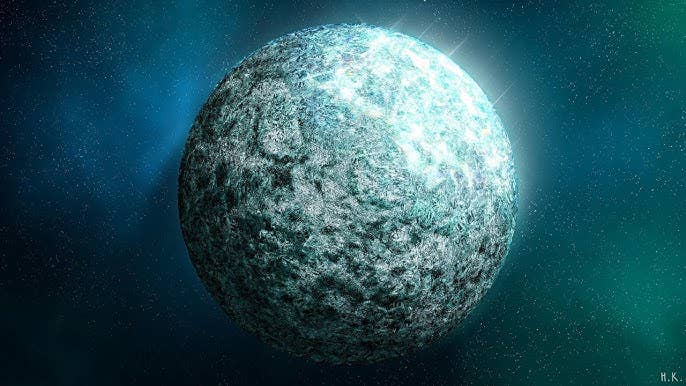
New analysis suggests Mercury may hold a deep diamond layer formed as its carbon-rich core slowly crystallized. (CREDIT: Wikimedia / CC BY-SA 4.0)
Mercury does not look like a world built for extravagance. It is small, battered, sun-scorched and gray. Yet far below that dark surface, the innermost planet may hold one of the stranger planetary treasures in the solar system: a layer of diamond formed under conditions unlike those on Earth.
That possibility emerges from a new analysis of Mercury’s interior, built on data from NASA’s MESSENGER mission and laboratory experiments designed to recreate the planet’s deep past. The work suggests that carbon inside Mercury may not be sitting only in the form of graphite, the soft mineral long tied to the planet’s unusually dark crust. Some of it may have ended up as diamond at the boundary between Mercury’s mantle and core.
“We calculate that, given the new estimate of the pressure at the mantle-core boundary, and knowing that Mercury is a carbon-rich planet, the carbon-bearing mineral that would form at the interface between mantle and core is diamond and not graphite,” said Olivier Namur, an associate professor at KU Leuven.
The proposed layer is not a scattering of gemstones. It is a deep, buried zone that the researchers estimate could average roughly 14.9 to 18.3 kilometers thick, with substantial uncertainty. That is about 9 to 11 miles.
The dark crust that started the mystery
Scientists have known for years that Mercury’s surface holds clues to an unusual carbon story. Spectral data from MESSENGER showed that the planet’s low reflectivity, its broad darkness, comes from widespread graphite. Neutron and gamma-ray measurements placed carbon in the crust at about 2 to 4 weight percent, although a more recent reanalysis suggested the concentration may be under 1 percent.
Either way, the carbon appears to be native to Mercury itself, not mainly delivered by outside impacts. The close link between graphite and lower crustal material exposed in deep craters points to an internal origin. That matters because it suggests Mercury once had a carbon-saturated magma ocean, and that carbon stayed important through the planet’s earliest differentiation.
For a long time, graphite seemed like the obvious outcome. Under earlier models, Mercury’s mantle and magma ocean were not thought to reach the pressure and temperature conditions needed to stabilize diamond. Graphite, being less dense than molten silicate, would have floated upward and helped form a primordial crust, much as light minerals helped build the Moon’s early crust.
The new work reopens that question because estimates of Mercury’s internal structure have shifted.
Using newer gravity-based models, the team recalculated the depth and pressure at Mercury’s core-mantle boundary. A deeper boundary means higher pressure, and higher pressure changes which form of carbon is favored. The researchers found that Mercury’s core-mantle boundary pressure likely falls around 5.38 to 5.77 gigapascals, with the highest possible estimate reaching 7 gigapascals.
That is enough to make the carbon problem more interesting.
Rebuilding Mercury in the lab
To test the idea, the team used a large-volume press to reproduce the extreme conditions expected deep inside early Mercury. They heated Mercury-like materials to temperatures up to about 3,950 degrees Fahrenheit and examined how those materials melted and crystallized under high pressure.
The experiments focused on mantle compositions resembling the silicate portion of enstatite chondrites, meteorites considered relevant analogs for Mercury’s primordial makeup. They also accounted for sulfur, which appears in significant amounts on Mercury and plays a major role under the planet’s chemically reduced conditions.
That sulfur turned out to matter a great deal.
By lowering the liquidus temperature, the temperature at which the magma ocean would begin to crystallize, sulfur nudged some models into the diamond stability field. In sulfur-free cases, graphite remained favored. But with 7 to 11 weight percent sulfur in the silicate melt, a small fraction of the pressure-temperature models supported diamond instead, especially as the magma ocean cooled.
Even so, the study found that diamond forming directly from Mercury’s magma ocean was probably limited.
“We believe that diamond could have been formed by two processes,” Namur said. “First is the crystallization of the magma ocean, but this process likely contributed to forming only a very thin diamond layer at the core/mantle interface. Secondly, and most importantly, the crystallization of the metal core of Mercury.”
That second mechanism is the heart of the new argument.
A diamond layer from a cooling core
When Mercury formed about 4.5 billion years ago, its core was fully molten. As the planet cooled, an inner solid core began to crystallize inside the liquid metal. Because the solid phase is poor in carbon, that process would have concentrated carbon in the remaining liquid outer core.
“The liquid core before crystallization contained some carbon; crystallization, therefore, leads to carbon enrichment in the residual melt,” Namur said.
Once the melt could no longer hold all that carbon, a carbon-rich phase would have to form. Under Mercury’s low-pressure core conditions, the study argues, diamond is more likely than iron carbides to be the stable product. Because diamond is far less dense than the surrounding liquid iron-rich alloy, it would float upward until it reached the core-mantle boundary.
There, over time, it could accumulate into a distinct layer.
The authors estimate that this process could have produced a present-day diamond layer averaging between about 14.9 and 18.3 kilometers thick, depending on which moment-of-inertia model is used. The uncertainty is large, about 10.6 kilometers, and the researchers stress that these numbers are upper-limit style estimates in some respects. Early-formed carbon may have shifted phase, and later convection could have redistributed some material.
Still, the work argues that most of the diamond layer, or its graphite precursor, likely formed after strong lower-mantle convection had already faded, which would limit major disruption.
Why Mercury is not just a smaller Earth
Mercury’s chemistry sets it apart from Venus, Earth and Mars. Namur said the planet likely formed closer to the Sun from a carbon-rich dust cloud, leaving it poorer in oxygen and richer in carbon than the other rocky planets. That difference shaped how carbon moved through the planet, from magma ocean to crust to metallic core.
Interestingly, the comparison does not stop there.
Namur noted that Earth’s core also contains carbon, and some researchers have suggested diamond formation there as well. But Mercury offers a more favorable natural case because of its strongly reduced composition, silicon-rich core, sulfur-rich silicate portion and evidence that the whole planet was saturated in carbon early on.
The findings also touch on Mercury’s magnetic field. A conductive diamond layer at the core-mantle boundary could change how heat escapes from the liquid outer core. The study suggests that, unlike a thick insulating FeS layer, a diamond-rich boundary could support heat transfer in ways that favor thermal stratification near the top of the core, with possible implications for how Mercury generates its magnetic field.
That does not mean the case is closed.
The researchers note that a diamond layer this thin could not yet be confirmed unambiguously by current interior models. They also point out that if an FeS layer exists at the core-mantle boundary, the diamond would need to be placed relative to that layer depending on whether the sulfide is solid or liquid.
Diamonds found elsewhere in the solar system
Diamonds have been speculated to exist in various locations within the solar system due to extreme pressure and temperature conditions. Here are some notable examples:
- Neptune and Uranus: The interiors of these ice giant planets are thought to have conditions that could form diamonds. The hypothesis is that methane in these planets' atmospheres could break down under high pressure and temperature, causing carbon atoms to crystallize into diamonds. These diamonds could then sink towards the planets' cores.
- Jupiter and Saturn: Similar to Neptune and Uranus, the high-pressure environments of Jupiter and Saturn might also be capable of forming diamonds. Researchers suggest that lightning storms on these gas giants could convert methane into soot, which hardens into graphite and then compresses into diamonds as it falls deeper into the planets' atmospheres.
- Meteorites: Some meteorites found on Earth contain microscopic diamonds. These diamonds are believed to have formed in the high-pressure environments of space, possibly during the violent impacts or within the parent bodies of the meteorites, such as asteroids.
- Exoplanets: Beyond our solar system, certain exoplanets have been speculated to have conditions conducive to diamond formation. For instance, 55 Cancri e, a rocky exoplanet, has been suggested to possibly contain a diamond-rich interior due to its high carbon content and extreme pressures.
These discoveries highlight the diverse and extreme environments in our solar system and beyond where diamonds could potentially form.
Research findings are available online in the journal Nature Communications.
The original story "Mercury has a 10-mile-thick layer of diamonds under its surface" is published in The Brighter Side of News.
Related Stories
- JWST finds a dark, airless exoplanet covered in rock like Mercury
- Mercury Is Not Dead: Bright Streaks Reveal Ongoing Activity
- Mercury has been slowly shrinking for billions of years, study finds
Like these kind of feel good stories? Get The Brighter Side of News' newsletter.
Joseph Shavit
Writer, Editor-At-Large and Publisher
Joseph Shavit, based in Los Angeles, is a seasoned science journalist, editor and co-founder of The Brighter Side of News, where he transforms complex discoveries into clear, engaging stories for general readers. With vast experience at major media companies like The Los Angeles Times, Times Mirror and Tribune Publishing, he writes with both authority and curiosity. His writing focuses on space science, planetary science, quantum mechanics, geology. Known for linking breakthroughs to real-world markets, he highlights how research transitions into products and industries that shape daily life.