Einstein Probe catches a neutron star merger glowing far longer than expected
Einstein Probe caught an ordinary short gamma-ray burst followed by an extraordinary X-ray glow lasting nearly 10 minutes.
 ERC BHianca Writer: Sabina Simeone

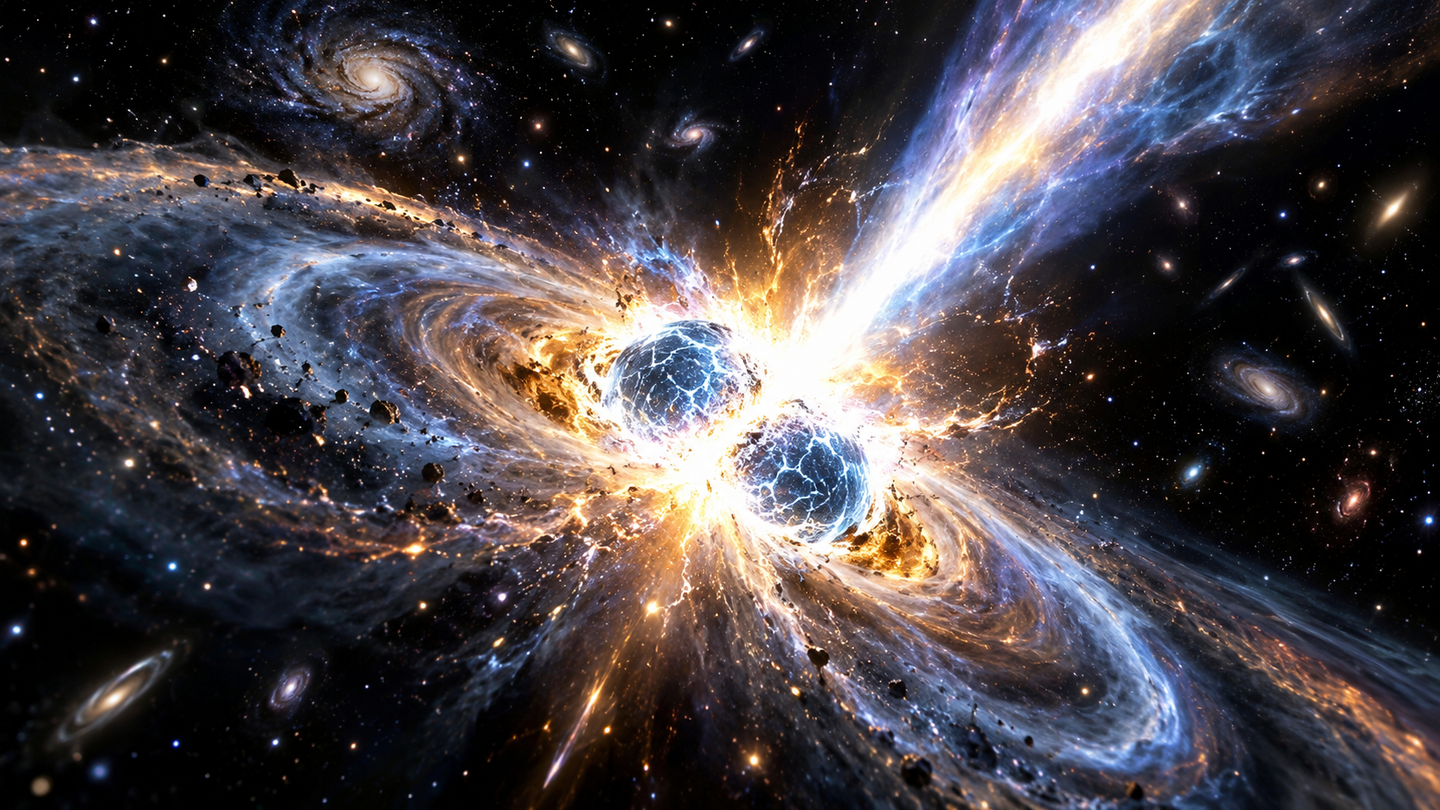
A short gamma-ray burst followed by 10 minutes of X-rays may reveal a long-lived magnetar born from a neutron star merger. (CREDIT: Shutterstock)
- A short gamma-ray burst lasting only about 0.4 seconds was followed by nearly 10 minutes of soft X-rays, providing unusually direct evidence that some neutron star mergers can remain active long after their gamma-ray flash ends.
- Follow-up observations measured a redshift of 0.661 and found no accompanying supernova, while the X-ray variability and spectral evolution pointed toward continued activity from the merger’s central engine.
- The researchers favor a rapidly spinning, strongly magnetized neutron star, or magnetar, as the remnant, raising the possibility that some unexplained fast X-ray transients are hidden signatures of compact-object mergers.
A cosmic explosion detected on July 4, 2025, looked ordinary for less than a second. Then it did something that challenged the usual picture of how neutron star mergers fade.
The event, GRB 250704B, produced a gamma-ray burst lasting only about 0.37 seconds, comfortably within the class of short bursts associated with compact-object mergers. At lower energies, however, the Einstein Probe satellite recorded soft X-rays for nearly 10 minutes.
An international team including researchers at the University of Rome Tor Vergata argues that the prolonged emission came from an engine that remained active after the merger. Their study, published in Science Bulletin, suggests the remnant was most likely a rapidly spinning, intensely magnetized neutron star known as a magnetar.
The result could connect some mysterious fast X-ray transients with neutron star mergers and provide astronomers with a new way to find these violent events beyond traditional gamma-ray searches.
A short burst followed by a long glow
Neutron stars are collapsed stellar cores containing more mass than the Sun inside an object roughly the size of a city. When two spiral together and merge, they can launch a short gamma-ray burst and send gravitational waves across the universe.
Gamma-ray observations traditionally dominate the first moments of these explosions. Short bursts generally last less than two seconds, encouraging models in which the central engine shuts down rapidly after the collision.
EP250704a, the X-ray counterpart of GRB 250704B, told a different story. Einstein Probe detected three phases of soft X-ray activity. An initial spike accompanied the gamma-ray burst, a short tail followed, and then a much longer X-ray bump continued for hundreds of seconds.
The total X-ray duration was about 562 seconds. During the prolonged phase, satellites detected no comparable gamma-ray emission, meaning an instrument watching only higher-energy radiation could have missed most of the event.
“This is the longest lasting prompt X-ray flash ever observed from a neutron star merger,” graduate student Niccolò Passaleva said.
Rapid changes pointed to a surviving engine
The prolonged radiation could not easily be explained as an ordinary afterglow created when merger debris slams into surrounding material.
Its brightness changed too quickly. The X-rays displayed rapid variability relative to the time since the explosion, behavior difficult to produce in a large external shock moving away from the merger.
The spectrum also changed with time. A later transition toward harder X-rays helped distinguish the prolonged prompt emission from the more conventional afterglow that followed.
Together, those observations suggest that something near the center of the explosion continued supplying energy for several minutes. Later X-ray and optical behavior also indicated prolonged energy injection into the expanding debris.
One possibility is continued accretion onto a compact object. The researchers instead favor a magnetar, a neutron star spinning extremely rapidly while carrying a magnetic field trillions of times stronger than Earth’s.
Such an object contains an enormous reservoir of rotational energy. As it slows, magnetized winds can carry energy outward and produce radiation long after the brief gamma-ray burst has ended.
A distant spectrum revealed the explosion’s origin
Connecting the X-ray transient to a merger required more than its unusual light curve.
After Einstein Probe issued its alert, Passaleva and colleagues rapidly secured observations with the European Southern Observatory’s Very Large Telescope in Chile. Its X-Shooter instrument separated the fading light into a spectrum containing absorption features from elements including magnesium and iron.
Those features yielded a redshift of 0.66102, establishing the distance scale of the explosion. Its light had traveled for more than 6 billion years before reaching Earth.
Knowing the distance allowed researchers to calculate the burst’s intrinsic energy and compare it with known gamma-ray burst populations. Its gamma-ray properties fell within those of merger-driven short bursts rather than the long bursts normally produced when massive stars collapse.
The team also searched deeply for a supernova. None appeared.
That absence matters because a long-lasting high-energy transient could otherwise point toward the collapse of a massive star. At this distance, the observations ruled out a broad range of supernovae similar to those typically accompanying long gamma-ray bursts.
The magnetar remains the leading interpretation
The evidence strongly favors a compact binary merger, but it does not directly prove that two neutron stars collided or that the remnant was a magnetar.
At a redshift of 0.661, any gravitational waves from the merger were beyond the sensitivity of current ground-based detectors. A kilonova, the radioactive glow from neutron-rich merger debris, would also have been too faint to detect reliably at that distance.
The magnetar interpretation instead comes from the prolonged engine activity, X-ray variability and subsequent energy injection. Independent modeling of the same event has also found its multiwavelength behavior consistent with a long-lived millisecond magnetar undergoing continued accretion.
Previous observations have hinted that neutron star mergers can create magnetars. X-ray plateaus following some short gamma-ray bursts have been interpreted as energy from rapidly spinning remnants, while other fast X-ray transients have shown properties compatible with the same idea.
EP250704a is unusual because astronomers directly observed the soft X-ray activity beginning alongside an otherwise ordinary short gamma-ray burst.
Einstein Probe may be uncovering a missing population
Einstein Probe was launched in 2024 with a wide-field telescope designed to monitor the soft X-ray sky. Its sensitivity has already uncovered transients that older gamma-ray instruments could easily overlook.
The new event suggests that some mergers may appear brief in gamma rays while remaining bright much longer at lower energies. If so, the known population of merger-driven explosions may be incomplete because astronomers have traditionally classified them mainly from their gamma-ray behavior.
That possibility matters for gravitational-wave astronomy. Future detectors could identify a neutron star merger through ripples in spacetime while Einstein Probe or another X-ray telescope simultaneously catches its extended radiation.
Such a pairing would offer a direct test of whether a magnetar survived the collision. It could also help determine how often neutron star mergers collapse immediately into black holes and how often they leave behind neutron stars capable of surviving for seconds, minutes or longer.
The next major advance may therefore come from observing the same merger in two fundamentally different ways: through the vibration of spacetime and through a lingering flash of soft X-rays.
Dig deeper into neutron star mergers and magnetars
These studies provide important context on long-lived merger remnants, magnetar signatures and the emerging population of fast X-ray transients.
Evidence for a brief appearance of gamma-ray periodicity after a compact star merger: Researchers reported evidence for a 909-hertz periodic signal in GRB 230307A that could represent the rotation of a newly formed millisecond magnetar. (Nature Astronomy, 2025)
Discovery of high-frequency quasi-periodic oscillation in short-duration gamma-ray bursts: An analysis of 605 short gamma-ray bursts identified high-frequency oscillations in three events that may carry signatures of hypermassive magnetar engines. (Monthly Notices of the Royal Astronomical Society, 2025)
A large-scale magnetic field produced by a solar-like dynamo in binary neutron star mergers: Numerical simulations showed how neutron star mergers could generate powerful organized magnetic fields capable of supporting magnetar-driven relativistic outflows. (Nature Astronomy, 2024)
Late-time accretion in neutron star mergers: Implications for short gamma-ray bursts and kilonovae: This study examined how post-merger accretion can persist for hundreds of seconds and influence extended X-ray emission after short gamma-ray bursts. (Monthly Notices of the Royal Astronomical Society, 2023)
A magnetar-powered X-ray transient as the aftermath of a binary neutron-star merger: An earlier fast X-ray transient was interpreted as evidence that some neutron star mergers can leave behind long-lived magnetars even without a detected gamma-ray burst. (Nature, 2019)
Research findings are available online in the journal Science Bulletin.
The original story "Einstein Probe catches a neutron star merger glowing far longer than expected" is published in The Brighter Side of News.
Related Stories
- Extreme X-rays from a magnetar exposes that empty space may not be empty
- Newborn magnetar offers rare evidence of Einstein’s relativity in a stellar explosion
- NASA's Juno reveals how Jupiter’s giant magnetic shield absorbs the solar wind
Like these kind of feel good stories? Get The Brighter Side of News' newsletter.
Joshua Shavit
Writer and Editor
Joshua Shavit is a NorCal-based science and technology writer with a passion for exploring the breakthroughs shaping the future. As a co-founder of The Brighter Side of News, he focuses on positive and transformative advancements in technology, physics, engineering, robotics, and astronomy. Having published articles on AOL.com, MSN, Yahoo News, and Ground News, Joshua's work highlights the innovators behind the ideas, bringing readers closer to the people driving progress.