New evidence challenges the idea that Earth and Mars formed the same way
Earth and Mars began side by side, but their volatile elements reveal sharply different paths from dust and rock to finished planets.
 University of Copenhagen Writer: William Brøns Petersen

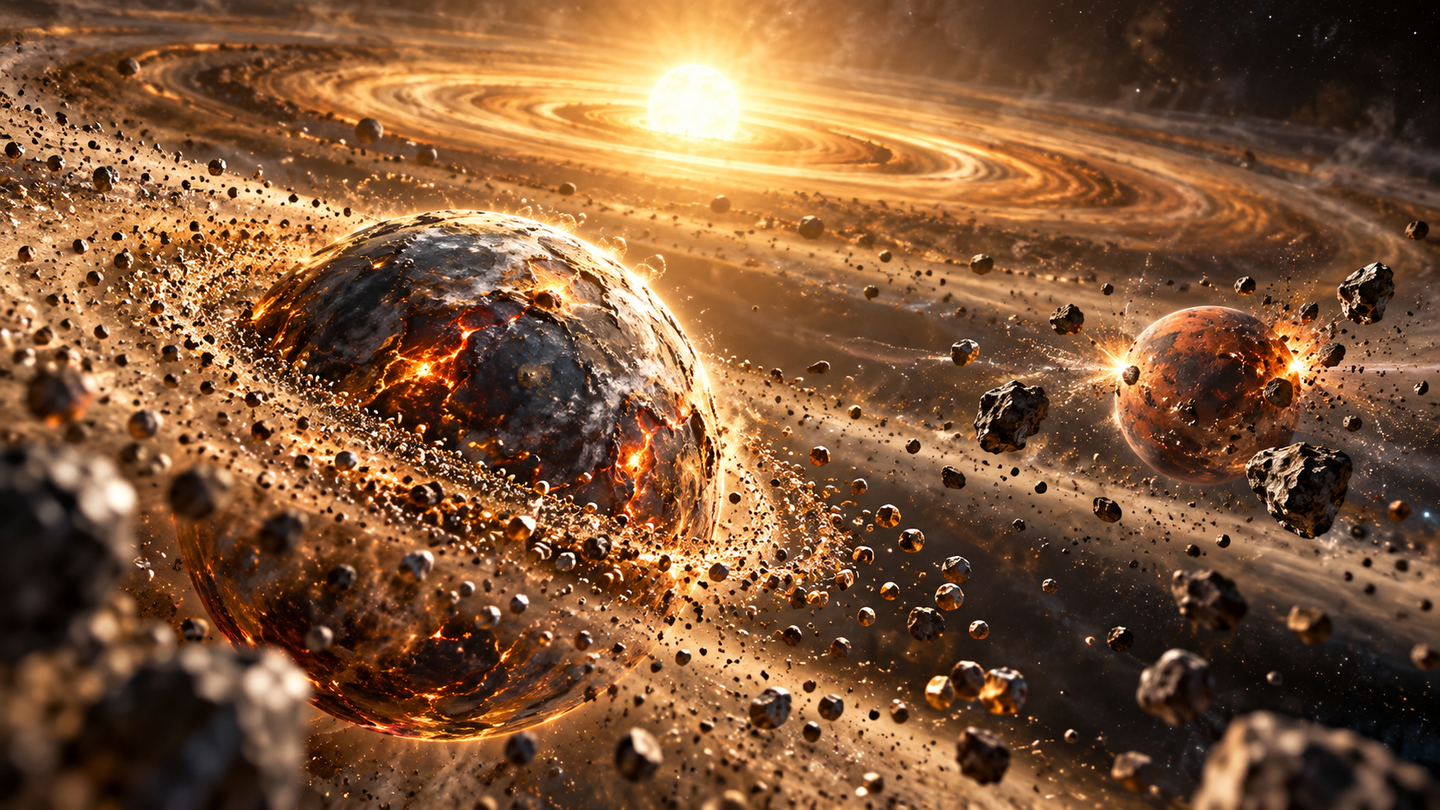
Planetary chemistry suggests Earth grew mostly from pebble-built protoplanets, while Mars formed mainly from larger planetesimals. (CREDIT: The Brighter Side of News)
- Earth and Mars may have formed through surprisingly different mixtures of pebble accretion, planetesimal collisions and giant impacts, despite growing beside each other in the same young Solar System.
- Chemical modeling suggests at least 75% of Earth’s mass came from two protoplanets that grew mainly by capturing pebbles, while roughly 73% of Mars came from volatile-depleted planetesimals.
- The study uses the loss of moderately volatile elements as a record of planetary growth, providing a possible new way to reconstruct the formation and habitability of rocky worlds around other stars.
Earth and Mars emerged from the same swirling disk of gas and dust, separated today by less than 80 million kilometers at their closest approach. Their common birthplace might suggest that the two rocky planets were assembled through broadly similar processes.
Their chemistry tells a different story.
A University of Copenhagen-led study finds that Earth appears to have been built primarily from large protoplanets that themselves grew by sweeping up millimeter- to centimeter-sized pebbles. Mars, by contrast, acquired most of its mass from collisions with much larger building blocks called planetesimals.
Published in Nature Astronomy, the research supports a hybrid picture of rocky planet formation in which pebble accretion and collisions both matter. Crucially, their relative importance may vary dramatically from one planet to another.
“The most surprising result was that Earth and Mars appear to have formed in different ways,” Professor Anders Johansen told The Brighter Side of News. “You might have expected that two planets formed side by side in the same solar system would share a more similar formation history.”
Volatile elements preserve an ancient fingerprint
Scientists cannot watch Earth or Mars being assembled 4.5 billion years ago, so they must reconstruct that history from chemical traces surviving inside the planets.
Haiyang Wang, Johansen and colleagues focused on moderately volatile lithophile elements, including sodium, potassium, zinc and lithium. These elements readily enter rocky mantles but evaporate more easily than highly refractory materials such as aluminum and calcium.
Both Earth and Mars have less of these moderately volatile elements than the primitive material from which the Solar System formed. The pattern of depletion varies with each element’s volatility.
That matters because different growth mechanisms remove volatile elements in different ways. A planet's final chemical inventory can therefore retain information about how its ingredients were assembled and heated.
The researchers modeled 13 major and moderately volatile lithophile elements and compared different combinations of pebble accretion, planetesimal accumulation and giant impacts. They used both statistical fitting and Bayesian inference to identify which scenarios best reproduced the present-day compositions of Earth’s and Mars’ silicate mantles.
“It is a major detective job to figure out what happened back then when most of the evidence disappeared long ago,” Johansen said. “But even after 4.5 billion years, the compositions of Earth’s and Mars’ mantles remain the same.”
Growing planets can cook incoming pebbles
The study also proposes a mechanism for creating the chemical fingerprint associated with pebble accretion.
As a young protoplanet grows, it develops a hot envelope of hydrogen and helium drawn from the surrounding disk. Pebbles falling through that atmosphere encounter progressively higher temperatures as they descend.
The researchers modeled what happens to their chemical ingredients. Once temperatures exceed an element’s sublimation threshold, volatile material leaves the pebble and becomes vapor.
Three-dimensional simulations then showed how convection can carry that vapor outward. Large-scale gas flows connecting the protoplanet's envelope with the surrounding disk can remove much of the material before it ever reaches the growing planet.
The effect becomes efficient on remarkably short timescales. In the simulations, only about 30% of released volatile material remained inside the envelope after one year. After five years, no more than roughly 3% remained.
More refractory materials behave differently. They can survive deeper into the atmosphere or remain trapped close to a molten planetary surface, producing a characteristic chemical pattern.
Earth grew mostly from pebble-built protoplanets
For Earth, the favored models require at least about 75% of the planet's final mass to come from two bodies that had grown primarily through pebble accretion.
One was the proto-Earth. The other was a large impactor, broadly compatible with the type of body thought to have struck the young Earth during the Moon-forming collision.
The researchers' reference solution attributed about 64% of Earth's mass to the proto-Earth, 22% to a pebble-grown impactor and 14% to volatile-depleted planetesimals. Other statistically acceptable solutions changed those exact fractions, but the overall conclusion remained similar.
Pebble-grown material had to dominate, while Vesta-like planetesimals could provide up to roughly one-quarter of Earth's mass in the favored scenarios.
That does not mean Earth formed solely through smooth accumulation of dust and pebbles. Large impacts still played an important role, and the researchers found that including an impactor produced a better explanation for Earth's volatile-element pattern than models without one.
The work therefore bridges two previously competing pictures of terrestrial planet formation rather than selecting only one.
Mars followed a different route
Mars produced almost the reverse result.
The reference model found that about 73% of the planet's mass came from volatile-depleted planetesimals similar in chemical character to the asteroid Vesta. Pebble accretion supplied about 27%.
Changing assumptions about the exact chemistry of the planetesimals altered the percentages, but not the broader pattern. Across the tested models, planetesimals consistently supplied more than about 65% of Mars' mass, while pebbles still contributed a meaningful minority.
One possible reason involves the gravitational influence of neighboring protoplanets. Mars may have occupied an environment where its ability to capture drifting pebbles was reduced, leaving collisions with planetesimals as its dominant growth mechanism.
The result also fits Mars' rapid early development. Geological evidence indicates that the planet grew and differentiated quickly, effectively becoming a stranded planetary embryo while Earth continued accumulating material and undergoing major impacts.
What this could mean for habitable worlds
Important uncertainties remain. The researchers had to assume compositions for ancient planetary building blocks that no longer exist in recognizable form, including a Vesta-like population of early planetesimals.
They also assumed that giant impacts did not substantially remove the moderately volatile lithophile elements used in their main models. Impact-driven volatile loss remains poorly constrained, particularly while gas still surrounded the young Solar System.
Yet the central result survived multiple alternative assumptions: Earth and Mars are best explained by hybrid growth pathways with very different proportions of pebbles and planetesimals.
That conclusion could eventually matter far beyond the Solar System. Volatile loss influences how much carbon, hydrogen, nitrogen, oxygen, phosphorus, sulfur and water a rocky planet ultimately retains. Those ingredients help determine whether a world can develop an atmosphere, oceans and conditions compatible with life.
If volatile depletion can reveal how a planet formed, astronomers may eventually use stellar and planetary compositions to infer the histories of rocky worlds they cannot visit.
Two neighboring planets already demonstrate why that could be necessary. Earth and Mars began in the same disk, but their chemistry suggests that proximity did not guarantee the same path from dust to planet.
Dig deeper into rocky planet formation
These recent studies and reviews explore competing models of terrestrial planet growth, volatile delivery and how pebble accretion could influence the chemistry of habitable worlds.
Experimental simulation of water formation on Earth from dry pebble rain: Laboratory experiments show that pebbles descending through a hydrogen-rich protoplanetary atmosphere can lose volatiles while simultaneously producing water, with implications for the origin of oceans on Earth-like planets. (Nature Geoscience, 2026)
The shaping of terrestrial planets by late accretions: This review examines how the final fraction of material added to Earth, Mars and other rocky planets could strongly influence their chemistry, interiors and potential for prebiotic environments. (Nature, 2025)
Did the terrestrial planets of the solar system form by pebble accretion?: This study evaluates chemical, dynamical and chronological constraints and argues that collisions among planetesimals and embryos remain important, highlighting the active debate over pebble-dominated formation. (Earth and Planetary Science Letters, 2025)
Building Earth with pebbles made of chondritic components: Researchers show that mixtures of meteorite components delivered through pebble accretion can reproduce important aspects of Earth’s elemental and isotopic composition. (Geochimica et Cosmochimica Acta, 2025)
Origin of moderately volatile elements in Earth inferred from mass-dependent Ge isotope variations among chondrites: Germanium isotopes indicate that Earth incorporated both volatile-poor and volatile-rich material, including a later contribution from outer Solar System sources. (Earth and Planetary Science Letters, 2025)
Research findings are available online in the journal Nature Astronomy.
The original story "New evidence challenges the idea that Earth and Mars formed the same way" is published in The Brighter Side of News.
Related Stories
- Breakthrough in determining life's origin on Earth — and maybe Mars
- Mars's mantle may be hundreds of degrees hotter beneath one hemisphere
- New analysis finds signs of life on Mars actually came from Earth
Like these kind of feel good stories? Get The Brighter Side of News' newsletter.
Joseph Shavit
Writer, Editor-At-Large and Publisher
Joseph Shavit, based in Los Angeles, is a seasoned science journalist, editor and co-founder of The Brighter Side of News, where he transforms complex discoveries into clear, engaging stories for general readers. With vast experience at major media companies like The Los Angeles Times, Times Mirror and Tribune Publishing, he writes with both authority and curiosity. His writing focuses on space science, planetary science, quantum mechanics, geology. Known for linking breakthroughs to real-world markets, he highlights how research transitions into products and industries that shape daily life.