Enormous, Earth-like magma systems once existed inside Mars
Mars may have recycled deep crustal magma in Earth-like ways, despite lacking the plate tectonics once thought necessary.

 Edited By: Joshua Shavit

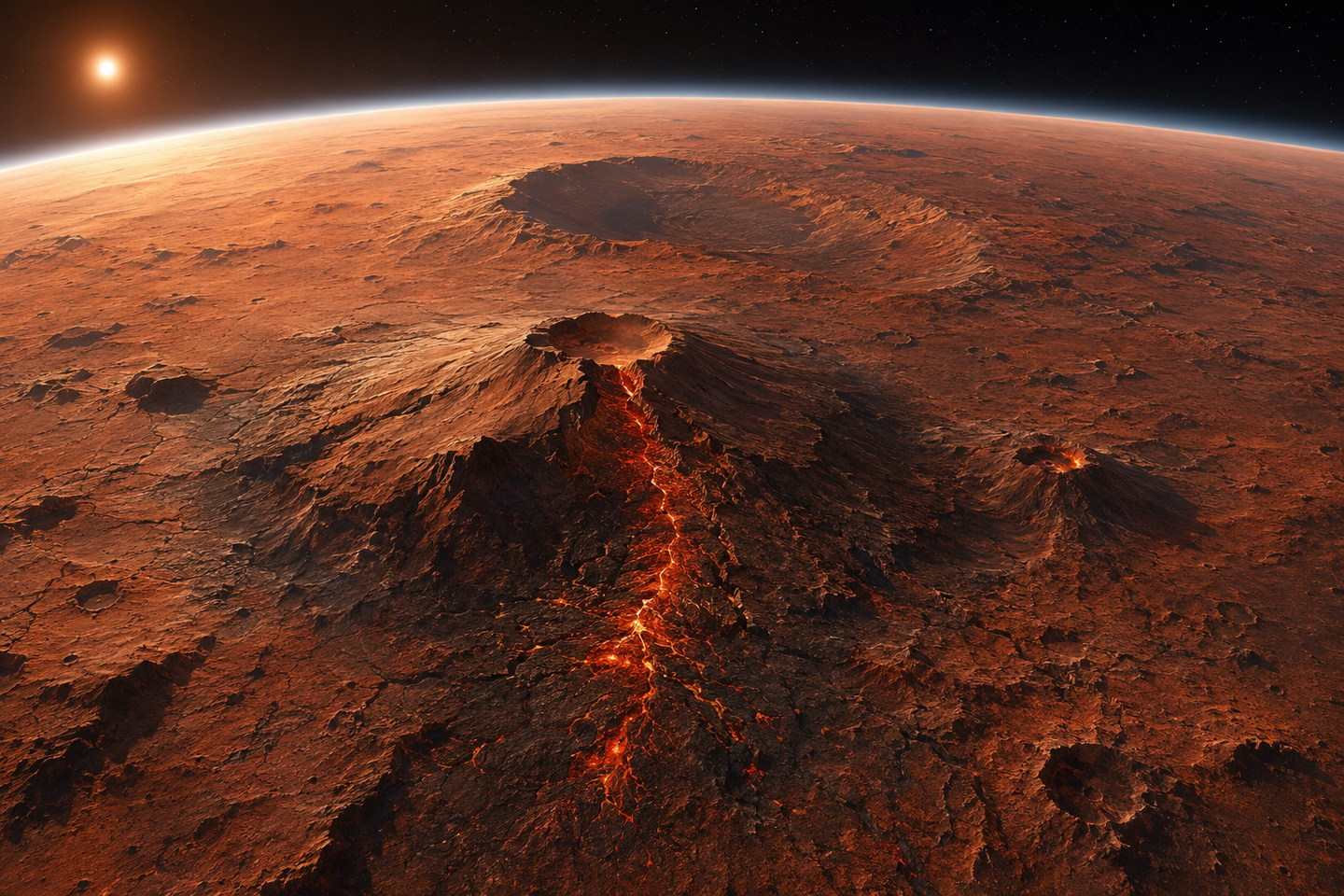
Seismic data suggest Mars built complex magma systems deep underground without plate tectonics, reshaping ideas about habitable worlds. (CREDIT: AI-generated image / The Brighter Side of News)
For years, Mars has sat in an awkward middle ground, too geologically quiet to look like Earth. At the same time, it is too complex to be written off as a dead world of simple basalt. Now a new look beneath the planet’s surface suggests that picture was far too neat.
A study in Nature Astronomy argues that Mars once hosted vast, long-lived magmatic systems deep in its crust. These systems look strikingly similar to ones on Earth that help build complex continental material. That matters because Mars does not have plate tectonics, the churning surface process long treated as a near-requirement for this kind of geological sophistication.
Instead, the new work suggests the Red Planet may have been able to recycle and rework molten rock through much of its crust anyway.
The case rests on a buried boundary about 24 kilometers below the Martian surface, detected through seismic data gathered by NASA’s InSight mission. Scientists had already identified the boundary. However, what it actually marked remained unsettled. Was it just another layer in a basalt-rich crust, or something more important?
Researchers from the University of Oxford’s Departments of Earth Sciences and Statistics worked with collaborators at the University of Bristol. They tested that question by comparing seismic observations with hundreds of possible rock compositions. They combined thermodynamic modeling, mineral physics calculations and statistical analysis to see which rock types best matched the waves recorded from marsquakes and meteoroid impacts.
What they found was a sharp compositional divide. The rock above the boundary was most consistent with mafic material, the kind of silica-richer basaltic crust expected on Mars. Below it, the best match was ultramafic rock, richer in iron and magnesium and poorer in silica.
A buried layer with a very different history
That distinction is more than technical geology. It points to a thick lower-crustal layer made of dense, melt-depleted ultramafic cumulates. These are essentially the leftover crystals produced when magma cools, separates and evolves over time.
Under the study’s preferred model, Mars was not simply erupting straightforward mantle melts to the surface. Instead, molten rock appears to have pooled deep underground. It then differentiated into different materials, and left behind dense residues at the base of the crust, while lighter, more evolved melts rose upward.
On Earth, comparable processes are linked to volcanic arcs and the production of continental crust. The surprise is not that this happens somewhere in the solar system. It is that it may have happened on a stagnant-lid planet once assumed too tectonically simple to manage it.
The analysis places this ultramafic zone beneath the InSight landing site between the 24.5-kilometer intracrustal boundary and the deeper crust-mantle boundary near 38 kilometers. In other words, the lower crust there seems to contain roughly 14 kilometers of this dense cumulate material.
The statistical case was strong. Under uniform priors, layer 3 had an 85.9% probability of being mafic, while layer 4 had a 90.8% probability of being ultramafic. Even when the team excluded the less certain P-wave model and used a broader likelihood function, the overall conclusion held.
Lead author Dr. Tobermory Mackay-Champion, who was at the University of Oxford during the study and is now at the University of Bristol, said: “We’ve traditionally assumed that volcanism on Mars was relatively simple compared to that on Earth. But this discovery suggests Mars could sustain large, long-lived systems where molten rock evolved and reprocessed itself throughout the entire crust. It raises exciting possibilities for how common such systems might be on rocky planets beyond our solar system.”
Why simple heat alone does not explain it
The researchers then asked how such a lower crust could have formed. One possibility was partial melting of older mafic crust. Another was the intrusion and fractionation of large volumes of mantle-derived magma. In reality, the paper argues, the two may have worked together.
Thermal modeling made one point clear. Under typical Martian heat flow, the crust beneath the InSight site should not have gotten hot enough for lower-crustal rocks to melt on their own. The ambient areotherm did not cross even the water-saturated solidus within the relevant depth range, except under unusually high heat flow.
That means some extra energy source was needed.
The most likely driver was a major magmatic event tied to mantle upwelling. Rising mantle would have produced mafic magma and also supplied the heat needed to warm surrounding crust, trigger local melting and set off the sort of vertically connected magmatic system seen in terrestrial deep crustal hot zones.
In that picture, repeated injections of basaltic magma built a mushy, melt-depleted lower crust while generating more evolved melts that could move into shallower reservoirs or reach the surface. The study describes this as transcrustal magmatism, a vertically integrated system linking lower-crustal intrusion, melt storage, fractionation and upper-crustal evolution.
That process has long been associated with Earth. The new work suggests it may not be Earth’s alone.
The idea also fits a wider spread of Martian evidence. Seismic observations are compatible with evolved crustal material in the upper 10 kilometers beneath InSight. Moreover, orbital spectroscopy has revealed feldspar-rich, silica-enhanced lithologies in Terra Cimmeria. Martian meteorites, including nakhlites and chassignites, record multi-level petrogenesis from lower to upper crust. And the broad detection of a 20 to 24 kilometer seismic discontinuity across the northern hemisphere hints that the structure seen under InSight may not be a local oddity.
A different route to planetary complexity
If that interpretation is right, Mars once hosted enormous interconnected magmatic systems. These may have extended for hundreds or even thousands of kilometers across parts of the northern hemisphere.
That changes the terms of a much bigger planetary debate. Plate tectonics has often been treated as the key geological engine behind the crustal recycling, volatile movement and long-term climate regulation that help make Earth habitable. But Mars may have developed at least some of the same crust-building complexity without breaking its surface into moving plates.
Co-author Professor Jon Wade of the University of Oxford said: “One of the big questions in planetary science is whether Earth is unique. If Mars could develop this kind of complex crust without plate tectonics, then maybe the conditions needed for habitability can emerge on more planets than we realised, including those previously dismissed based on size or their apparent lack of tectonic activity.”
That does not mean Mars was Earth-like in every important sense, or that transcrustal magmatism automatically makes a planet habitable. The study does not claim either. What it does suggest is that one of the field’s standard filters may be too strict.
Mars, in this view, was not geologically primitive so much as geologically different.
Practical implications of the research
The findings widen the menu of planetary environments scientists may need to take seriously when assessing habitability. If complex crust can form without plate tectonics, then rocky planets once dismissed as too stagnant or too small may deserve a closer look.
The work also gives researchers a new framework for interpreting seismic and geochemical data from Mars. This is especially useful as future missions try to link crustal structure, volcanic history, water inventory and atmospheric evolution.
More broadly, it suggests that Earth’s route to geological complexity may be only one version of a more common planetary story.
Research findings are available online in the journal Nature Astronomy.
The original story "Enormous, Earth-like magma systems once existed inside Mars" is published in The Brighter Side of News.
Related Stories
- Astronomers discover first evidence of hot water on the surface of Mars
- Hidden Martian deltas point to an ancient ocean covering half of Mars
- Marsquakes help scientists decode the ancient Martian Dichotomy
Like these kind of feel good stories? Get The Brighter Side of News' newsletter.
Joseph Shavit
Writer, Editor-At-Large and Publisher
Joseph Shavit, based in Los Angeles, is a seasoned science journalist, editor and co-founder of The Brighter Side of News, where he transforms complex discoveries into clear, engaging stories for general readers. With vast experience at major media companies like The Los Angeles Times, Times Mirror and Tribune Publishing, he writes with both authority and curiosity. His writing focuses on space science, planetary science, quantum mechanics, geology. Known for linking breakthroughs to real-world markets, he highlights how research transitions into products and industries that shape daily life.