First-ever synthetic cell grows, divides, replicates and could revolutionize biology
SpudCell fed, grew, copied DNA and divided, showing how far scientists can build life-like behavior from chemistry alone.

 Edited By: Joseph Shavit

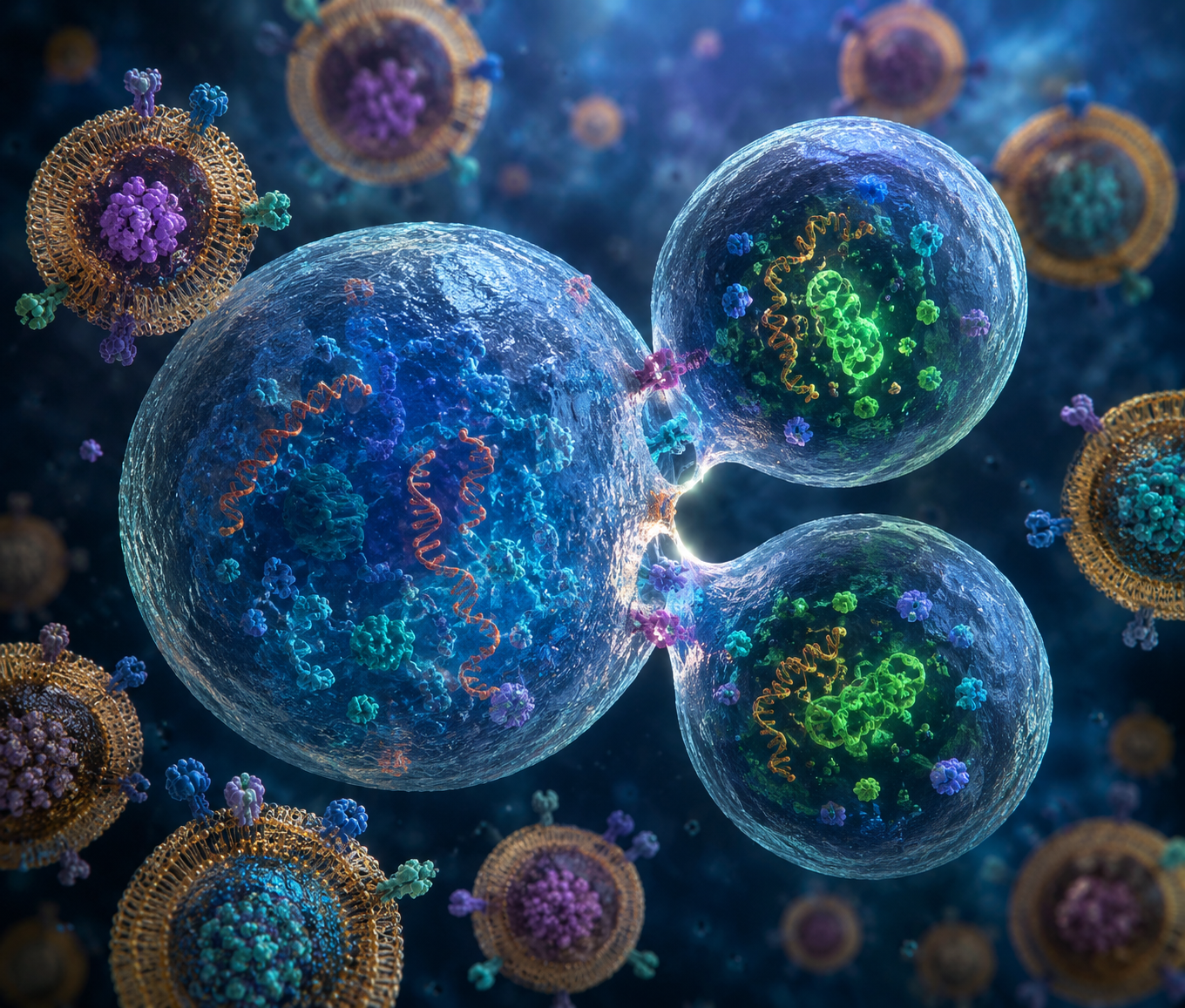
SpudCell, built from nonliving components, grew, copied genes, divided and competed across generations in a major synthetic biology advance. (CREDIT: AI-generated image / The Brighter Side of News)
A tiny bubble of lipids, enzymes and DNA has done something biologists have chased for years: it carried out a full cycle of life-like behavior without starting from a living cell. The system, called SpudCell, fed, grew, copied its genes, divided and, under pressure, let a better-adapted version take over.
That does not make it alive in the ordinary sense. It still needs carefully staged help from the outside, and it cannot yet run on its own for long. But the work moves synthetic biology across an important line. Instead of trimming down an existing organism, the team built this cell-like system from chemically defined, nonliving parts.
Associate Professors Kate Adamala and Aaron Engelhart, working with colleagues at the University of Minnesota, describe SpudCell as the first synthetic cell made entirely from such components to complete a cell cycle across multiple generations. The system also showed selection and competition, two behaviors that sit near the heart of biology.
“This is likely the most exciting project I've ever worked on,” Adamala said. “We’ve replicated in chemistry what only used to be possible in biology: the complete set of behaviors of a cell. It proves that the most fundamental functions of life, like growth and replication, do not need a mysterious magical spark.”
Built from parts, not borrowed life
SpudCell is a liposome, a hollow sphere made from fatty molecules like those in natural cell membranes. Inside sits a defined protein-making system, purified enzymes, ribosomes and a 90,000-base-pair genome spread across several DNA plasmids. Unlike earlier “minimal cell” efforts that began with living cells and pared them down, this one was assembled bottom-up.
That distinction matters because every major ingredient is known. The researchers used the PURE system, a protein expression mix made from purified components, rather than a crude cell extract, for most of the key results. That gave them tighter control over what was happening inside the synthetic cells.
The genome is strikingly small. Earlier analyses had suggested a living cell might need at least 113 kilobase pairs. SpudCell came in at 90 kilobase pairs, though its DNA was split across multiple plasmids rather than carried on a single chromosome. That modular setup let the team assign different jobs to different pieces of DNA.
The tradeoff is that the cell does not do everything a natural one does. Instead of making all of its own supplies through metabolism, it takes in help from “feeder liposomes,” smaller vesicles loaded with lipids, enzymes, ribosomes and small molecules.
Feeding, growth and division without the usual machinery
Feeding depends on a protein called alpha-hemolysin, or αHL. SpudCell makes that protein from its own DNA, inserts it into its membrane, and uses an exposed chemical tag to latch onto feeder liposomes. When the two fuse, the synthetic cell gets fresh membrane material and internal cargo, allowing it to grow.
That shortcut solves a major engineering problem. A truly self-sufficient metabolism would require many more genes. By outsourcing some of the supply chain to feeder liposomes, the researchers were able to keep the genome smaller while still making the whole cycle work.
Division posed another hurdle. Natural cells rely on a cytoskeleton, a scaffold that helps pull them apart. Rebuilding that from scratch has been one of the field’s toughest problems. SpudCell avoids it. Instead, proteins crowd on the membrane surface until the stress is enough to pinch the membrane into daughter cells.
The team first used mechanical division in some multigeneration experiments, then added a genetically encoded division system. In that version, membrane-bound proteins and external linker molecules helped trigger splitting. The result was a direct connection between what the genome encoded and how many offspring a synthetic cell could produce.
When a synthetic cell starts to compete
The most intriguing results came when the researchers introduced variation. They altered the promoter controlling αHL, swapping in a stronger version called T7Max. Cells carrying that change made more of the fusion protein, fused with feeder liposomes more efficiently, grew faster and ended up producing more offspring.
After five generations, the stronger variant had outcompeted the original. Sequencing confirmed that the T7Max version rose in abundance even when it started as the minority. In one test, it began as only 10 percent of the population and climbed to 38 percent after five generations.
The advantage became even clearer when food was scarce. As feeder liposomes were reduced, the faster-growing cells pulled further ahead. The system does not yet generate spontaneous beneficial mutations on its own, so this is not full Darwinian evolution. Still, it is selection tied directly to growth and reproduction in a synthetic chemical system.
There are limits everywhere you look. The cell currently depends on ribosomes taken from E. coli. Its multipart genome does not always distribute cleanly, and after five generations only about 30 percent of daughter cells carried the full set of plasmids measured in the single-cell analysis. The machinery also degrades over time, which caps the run length.
Adamala said those weaknesses point to the next engineering problems. The genome needs to become more stable, division needs higher yields, and labs need shared standards so the work can be reproduced without hand-carried demonstrations and tacit know-how.
Practical implications of the research
For now, SpudCell is less a product than a platform. The researchers argue that cells built from scratch could one day carry out molecular tasks that natural cells handle poorly and industrial chemistry handles harshly. That could matter for drugmaking, especially for compounds containing amino acids biology never adopted, and for manufacturing materials under gentler, more energy-efficient conditions.
The work also gives scientists a cleaner way to ask what the minimum requirements for life-like behavior really are. Because the parts are specified, SpudCell could become a chassis for testing how growth, replication, inheritance and selection interact when stripped to essentials.
Adamala and collaborators are launching a public-benefit institution called Biotic to build shared infrastructure for that effort. The idea is to keep the platform open, modular and easier for other labs to extend. SpudCell is not a finished artificial organism. But it is a concrete step toward one, and a sign that some of life’s most basic behaviors may be built, not just inherited.
Research findings are available online in the journal bioRxiv.
The original story "First-ever synthetic cell grows, divides, replicates and could revolutionize biology" is published in The Brighter Side of News.
Related Stories
- Printed artificial neurons can communicate with living brain cells
- Major artificial cell research offers compelling evidence that "life finds a way"
- Scientists build synthetic cells with programmable DNA pores
Like these kind of feel good stories? Get The Brighter Side of News' newsletter.
Mac Oliveau
Writer
Mac Oliveau is a Los Angeles–based science and technology journalist for The Brighter Side of News, an online publication focused on uplifting, transformative stories from around the globe. Having published articles on MSN, and Yahoo News, Mac covers a broad spectrum of topics including medical breakthroughs, health and green tech. With a talent for making complex science clear and compelling, they connect readers to the advancements shaping a brighter, more hopeful future.