Hubble and JWST reveal thousands of young star clusters emerging from their birth clouds
Massive young star clusters emerge faster than smaller ones, helping more ionizing radiation escape into their galaxies.

 Edited By: Joseph Shavit

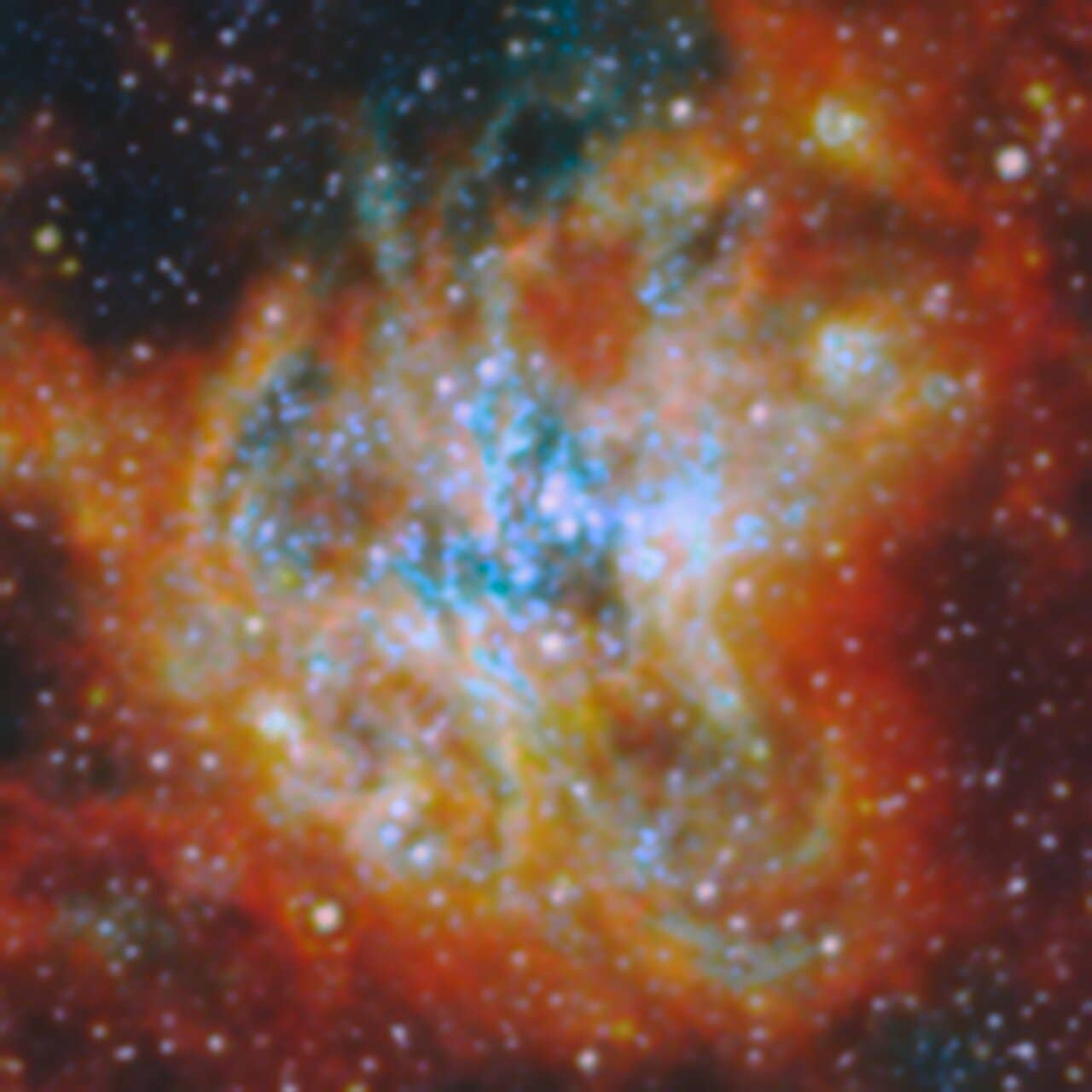
Webb and Hubble show massive young star clusters clear natal gas faster, shaping galaxy radiation and planet-forming environments. (CREDIT: ESA)
A young star cluster does not begin life in the open. It starts buried inside thick clouds of gas and dust, hidden from ordinary view while newborn stars heat, ionize, and push against the material around them. Now, observations from the Hubble and James Webb space telescopes suggest that the biggest clusters do not stay hidden for long.
In four nearby galaxies, astronomers found that more massive young star clusters clear away their birth clouds faster than smaller ones do. That means the brightest, most energetic clusters can begin flooding their host galaxies with radiation sooner, with consequences that reach from galaxy evolution to planet formation.
“I was excited to see that the emerging timescale of a star cluster is related to its mass in stars. This has implications on a range of research fields, from planet formation to galaxy evolution”, said Alex Pedrini, a PhD student at Stockholm University’s Department of Astronomy and the first and corresponding author of the study.
The work, published in Nature Astronomy, draws on a large census of roughly 8,900 young star clusters in M51, M83, NGC 628, and NGC 4449, all within about 30 million light-years of the Milky Way. By combining infrared observations from Webb with optical and ultraviolet data from Hubble, the team was able to sort clusters into different stages of emergence, from deeply shrouded objects to clusters whose surrounding gas had largely dispersed.
Reading a cluster’s life through light
Different wavelengths exposed different moments in the same story.
Infrared light let the researchers spot clusters still wrapped in warm dust. Visible light, by contrast, highlighted clusters after much of that obscuring material had been pushed away. The team also tracked specific signatures tied to ionized hydrogen and to polycyclic aromatic hydrocarbons, molecules linked to the photodissociation regions that mark the boundary between intense stellar radiation and nearby molecular gas.
That let the researchers define three stages. The earliest group still showed compact ionized gas and compact photodissociation regions. A second group had lost the compact photodissociation signature but still displayed compact ionized gas. The last group consisted of optically visible young star clusters younger than 10 million years.
“By comparing how many clusters we see in each stage, we can estimate how long it takes for young star clusters to emerge and how this depends on their mass in stars,” Pedrini said.
Rather than relying mainly on absolute ages from spectral energy distribution fitting, which the authors say carry systematic uncertainties, the team used the relative numbers of clusters in each stage to estimate how long the emergence process lasts.
Above a mass threshold where the sample was complete, the pattern was clear. The most massive clusters completed their emergence in about 5 million years. Lower-mass clusters took closer to 7 to 8 million years, making them about 1.5 times slower to finish the process.
The same basic trend appeared across the full combined sample and remained in place when the researchers tested it in different ways, including removing galaxies one by one and replacing stellar mass estimates with near-infrared luminosity.
Faster clearing, earlier escape
The contrast was not just in total emergence time. It also appeared in how long clusters stayed linked to compact photodissociation regions.
High-mass clusters spent about 75 percent of their emergence phase, roughly 4 million years, in that compact gas-rich stage. Lower-mass clusters stayed in that state for about 65 percent of a longer total timescale, around 5 million years out of 7 to 8 million. In other words, once low-mass clusters lost those compact surrounding regions, they still needed relatively more time to fully emerge than their massive counterparts.
That difference matters because the most massive clusters also host the stars that produce most of the ionizing radiation in galaxies. If those clusters break out sooner, more of that radiation can escape into the wider galactic environment.
“Because massive star clusters disperse their birth gas more quickly, more of their energetic and ionizing radiation can escape into the galaxy, making them important sources of ionizing radiation in galaxies”, Pedrini said.
The findings also strengthen the case that pre-supernova feedback plays a central role early in a cluster’s life. Before the first supernova explosions arrive, radiation pressure, photoionization, and stellar winds appear to be doing major work in dispersing the natal cloud.
Four galaxies, one broad pattern
The four galaxies did not behave in exactly the same way.
M51 showed the longest emergence timescales, with low-mass clusters reaching about 9 million years. The authors suggest that may be tied to the galaxy’s complicated dynamics, including tidal interaction with a satellite galaxy. M83 and NGC 628 tracked the broader trend more closely, although NGC 628 showed a weaker contrast between lower- and higher-mass bins.
NGC 4449 stood out for a different reason. This lower-metallicity galaxy had especially short timescales associated with photodissociation regions, which the analysis links to a shortage or destruction of PAH molecules in such environments.
The team argues that the broader result may point to something basic about where massive clusters form. If cluster size stays fairly similar across masses, then more massive clusters are denser. That would mean they likely formed in denser gas clumps, where star formation was more efficient and cloud clearing happened faster.
Still, the work includes important caveats. The analysis assumes that cluster stellar mass does not increase much during emergence, since the sample already consists of clusters associated with compact ionized regions. Simulations, however, suggest that 5 to 20 percent of stellar mass could be lost during these early stages. The authors tested even stronger mass-loss scenarios, up to 50 percent, and reported that the mass trend held up. They also note that the earliest, deeply embedded phase, before ionized hydrogen becomes detectable, cannot be measured here and is expected to be short, about 1 to 2 million years or less.
What this means for stars, planets, and galaxies
The results feed into a bigger question in astronomy: how galaxies regulate star formation.
Stars do not convert all available gas into more stars. Feedback interrupts the process. By tying emergence timescales to cluster mass, the new study offers a more detailed picture of how that interruption works, and which clusters matter most in shaping a galaxy’s radiation field.
“This study is a team effort enabled by the unique synergy between HST and JWST observations. Understanding how star clusters form and affect their environment is one of the main goals of the FEAST team”, said Angela Adamo, an associate professor at Stockholm University’s Department of Astronomy and leader of the FEAST program.
The work may also matter much closer to home, at the scale of young planetary systems. In dense regions dominated by massive clusters, faster gas dispersal could cut short the supply of surrounding material that helps feed planet-forming disks. At the same time, earlier exposure to ultraviolet radiation may increase photoevaporation, stripping those disks more quickly.
That combination could reduce the time available for planets to form.
“With upcoming JWST observations, we will be able to study a wider variety of galaxies and more extreme cosmic environments, helping us uncover how young star clusters emerge and how stars and planets begin their lives across the Universe”, Pedrini said.
Practical implications of the research
This research gives astronomers a clearer timetable for how young star clusters push away the gas around them, and it shows that mass is a key part of that timeline.
That improves models of stellar feedback, helps explain which clusters are most likely to leak ionizing radiation into their galaxies, and offers a broader statistical framework for thinking about how harsh cluster environments may affect planet-forming disks.
It also gives future Webb observations a sharper target: testing whether the same pattern holds in more extreme galaxies and in conditions that better resemble the early universe.
Research findings are available online in the journal Nature Astronomy.
The original story "Hubble and JWST reveal thousands of young star clusters emerging from their birth clouds" is published in The Brighter Side of News.
Related Stories
- Orion, Pleiades, and Hyades are snapshots of the same star cluster across 800 million years
- Richard Feynman explains why our night sky is dark despite trillions of stars
- Sound waves unlock hidden secrets inside stars
Like these kind of feel good stories? Get The Brighter Side of News' newsletter.
Joshua Shavit
Writer and Editor
Joshua Shavit is a NorCal-based science and technology writer with a passion for exploring the breakthroughs shaping the future. As a co-founder of The Brighter Side of News, he focuses on positive and transformative advancements in technology, physics, engineering, robotics, and astronomy. Having published articles on AOL.com, MSN, Yahoo News, and Ground News, Joshua's work highlights the innovators behind the ideas, bringing readers closer to the people driving progress.