Ice Age spears reveal how America’s earliest hunters learned to survive
Clovis spear points were repaired longer than later Cumberland tools, revealing how knowledge may have changed decisions about risk.
 Ole Miss Writer: Clara Turnage

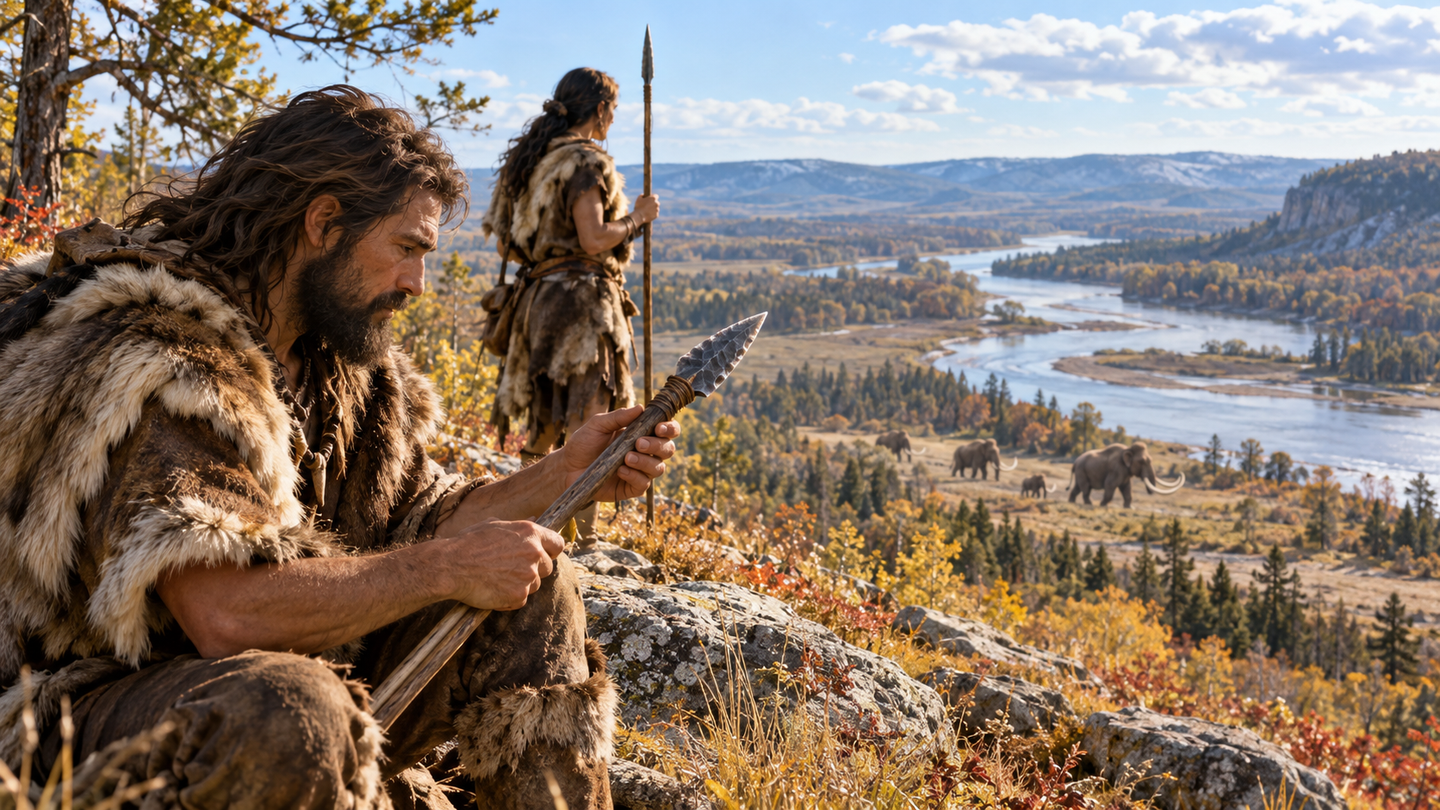
A study of 489 Ice Age spear points suggests early Clovis groups conserved tools more carefully as they learned a new landscape. (CREDIT: Shutterstock)
- A study of 489 Clovis and Cumberland projectile points from the Tennessee River Valley found that Clovis groups generally resharpened their weapons more extensively before discarding them.
- Later Cumberland groups more often threw away broken points while useful stone remained, a pattern researchers interpret as evidence that inherited landscape knowledge reduced the risks associated with replacing tools.
- The findings do not show how quickly people learned where resources were located, but they suggest stone-tool use can preserve evidence of how knowledge changed decisions about risk and resource conservation.
At the end of the last Ice Age, people moving through the Tennessee River Valley faced a familiar problem in unfamiliar country: what should be saved, and what could safely be replaced?
Archaeologists now argue that stone spear points preserve part of that calculation. A study of 489 Clovis and Cumberland projectile points suggests the earliest groups in the region maintained their weapons more conservatively, while later groups discarded damaged points with more useful material still remaining.
The study, published in the Journal of Archaeological Method and Theory by Jesse Tune of the University of Mississippi and Shane Miller of the University of Alabama, uses a model from behavioral ecology called the Marginal Value Theorem. Rather than treating spear points only as stylistic markers, the researchers examined them as finite packages of usefulness that hunters could keep repairing or replace.
Stone points preserve decisions about risk
Clovis and Cumberland points date to the Late Pleistocene and represent closely spaced technological traditions in the Tennessee River Valley. The researchers worked with 326 Clovis points and 163 Cumberland points drawn from the Paleoindian Database of the Americas.
Their argument depends on an important regional feature. High-quality chert, a stone well suited to chipped tools, is abundant across the Tennessee River Valley. Once sources were known, people did not face the same raw-material shortages found in some other landscapes.
That allowed the team to focus on knowledge rather than simple physical scarcity. The question was whether people who knew less about where reliable stone could be found would conserve finished tools more carefully than later populations with better inherited knowledge of the landscape.
Projectile points cannot reveal exactly when people discovered a quarry or how quickly knowledge spread. Instead, their use-lives may record how knowledge became incorporated into mobility and tool-maintenance strategies.
Clovis hunters squeezed more life from their points
A stone point loses material every time its edge is resharpened. Eventually, enough of the blade disappears that another repair no longer produces a weapon worth keeping.
Tune and Miller quantified that process by comparing measurements of the blade, haft and total point length. They used those proportions to estimate a discard threshold, the stage when continued repair should provide less value than making a replacement.
Clovis and Cumberland points had almost identical estimated discard thresholds. Their behavior around those thresholds, however, differed.
About 70% of broken Clovis bases were discarded only after falling below the calculated threshold, indicating that many points had already lost much of their potential utility before abandonment. Complete Clovis points also usually showed evidence of resharpening before being left behind.
Cumberland bases appeared across a broader range of remaining utility. More were discarded while enough stone remained that another repair might have been possible.
The researchers interpret that contrast as evidence that Clovis groups managed their stone technology more conservatively. Cumberland groups, by comparison, seem to have replaced broken points more freely.
Landscape knowledge may explain the difference
The explanation centers on what archaeologists call landscape learning.
The study treats Clovis as the first well-documented population to colonize this particular region because no pre-Clovis sites are currently known in the Tennessee River Valley. That does not establish that Clovis people were the first humans anywhere in the Americas.
For a newly arrived population, simply finding a chert source would not provide complete knowledge of the landscape. Hunters also needed to learn which deposits produced the best stone, when different areas were accessible, and how those sources fit with water, prey movements and travel routes.
Later Cumberland groups could have inherited much of that accumulated information through social transmission. In that setting, replacing a damaged point would carry less risk because people had a better idea where suitable raw material could be obtained again.
“We can't interview these people, so we have to look at the things they left behind,” Miller said.
The researchers are not arguing that Clovis hunters lacked skill or simply wandered until finding stone. Their model instead proposes that uncertainty increased the replacement cost of a point, encouraging longer use and more repair.
A behavioral model gives artifacts a new role
The framework comes from the Marginal Value Theorem, originally developed to model decisions about how long an animal should continue exploiting a food patch before moving elsewhere.
Applied to stone tools, a projectile point becomes a patch of finite utility. Resharpening restores some function but removes material, so each repair leaves less potential for the next one.
A hunter should continue investing effort until the return from another repair falls below the expected value of replacement. If replacement is risky because future stone sources are uncertain, that threshold shifts toward heavier curation.
The archaeological record fits that prediction. Clovis points were maintained in a more consistent way, while Cumberland points showed more variable discard behavior and more residual utility.
Other factors could also influence point form, including weapon-system changes and how often points were removed from their hafts for repair. Projectile points also represent only one part of a much larger toolkit.
Ancient decisions echo modern exploration
The study uses repeated decisions preserved across hundreds of artifacts to identify patterns that would be difficult to see from a single campsite.
Those patterns point toward a gradual reduction in uncertainty as generations learned the Tennessee River Valley. Knowledge turned an unfamiliar environment into a structured landscape containing known stone, water, travel routes and hunting opportunities.
Tune sees a modern parallel in space exploration. Missions to the Moon or Mars face the same general problem of deciding what equipment to carry, which resources can be found locally and how knowledge from one expedition should guide the next.
The technology could hardly be more different. The underlying challenge remains recognizable: humans entering unfamiliar environments survive partly by learning which resources are dependable and deciding how cautiously to use what they already have.
Dig deeper into Paleoindian technology and landscape learning
These studies provide recent and directly relevant context on projectile points, mobility, hunting strategies and how early populations adapted to unfamiliar landscapes.
Hemisphere-wide evidence of Early Paleoindian megaherbivore specialization: This broad synthesis examines how Clovis and related early populations organized mobility, technology and hunting around very large prey across the Americas. (Science Advances, 2026)
Evaluating Kill-Camp Organization in a Terminal Pleistocene Lithic Scatter: Computational Spatial Analysis of the Reddin Folsom Site, San Luis Valley, USA: Projectile point fragments and spatial analysis are used to reconstruct hunting, butchery and residential behavior at a Paleoindian site. (Journal of Archaeological Method and Theory, 2026)
Toward a synthesis of Paleoamerican fluted point cultures in the Carolinas: Researchers analyze hundreds of fluted points to explore resharpening, technological change and regional differences among early Paleoamerican traditions. (Scientific Reports, 2025)
Addressing a gap in the late Pleistocene record of the Midwest: fluted points in Northwest Missouri and Southwest Iowa: A study of 235 fluted points links raw-material transport and artifact distributions with high Clovis mobility and later shifts toward more localized land use. (Plains Anthropologist, 2025)
Questioning the visibility of the landscape learning process during the Paleoindian colonization of northeastern North America: This study provides an important contrasting interpretation, arguing that early fluted-point groups already possessed substantial landscape knowledge and organized raw-material procurement. (Journal of Archaeological Science: Reports, 2017)
Research findings are available online in the Journal of Archaeological Method and Theory.
The original story "Ice Age spears reveal how America’s earliest hunters learned to survive" is published in The Brighter Side of News.
Related Stories
- Ancient land bridge discovery: How humans migrated to Europe during the last Ice Age
- 146,000-year-old tools suggest human ingenuity thrived during the ice age
- Ancient stone tools in China reveal an unexpectedly early start to human technology
Like these kind of feel good stories? Get The Brighter Side of News' newsletter.
Joseph Shavit
Writer, Editor-At-Large and Publisher
Joseph Shavit, based in Los Angeles, is a seasoned science journalist, editor and co-founder of The Brighter Side of News, where he transforms complex discoveries into clear, engaging stories for general readers. With vast experience at major media companies like The Los Angeles Times, Times Mirror and Tribune Publishing, he writes with both authority and curiosity. His writing focuses on space science, planetary science, quantum mechanics, geology. Known for linking breakthroughs to real-world markets, he highlights how research transitions into products and industries that shape daily life.