Squirrel colors spotlight local evolutionary changes in urban species
A survey of 1,734 squirrels found dramatic coat-color differences across Montreal linked with trees, winter cold and geographic barriers.
 McGill University Writer: Kay Pettigrew

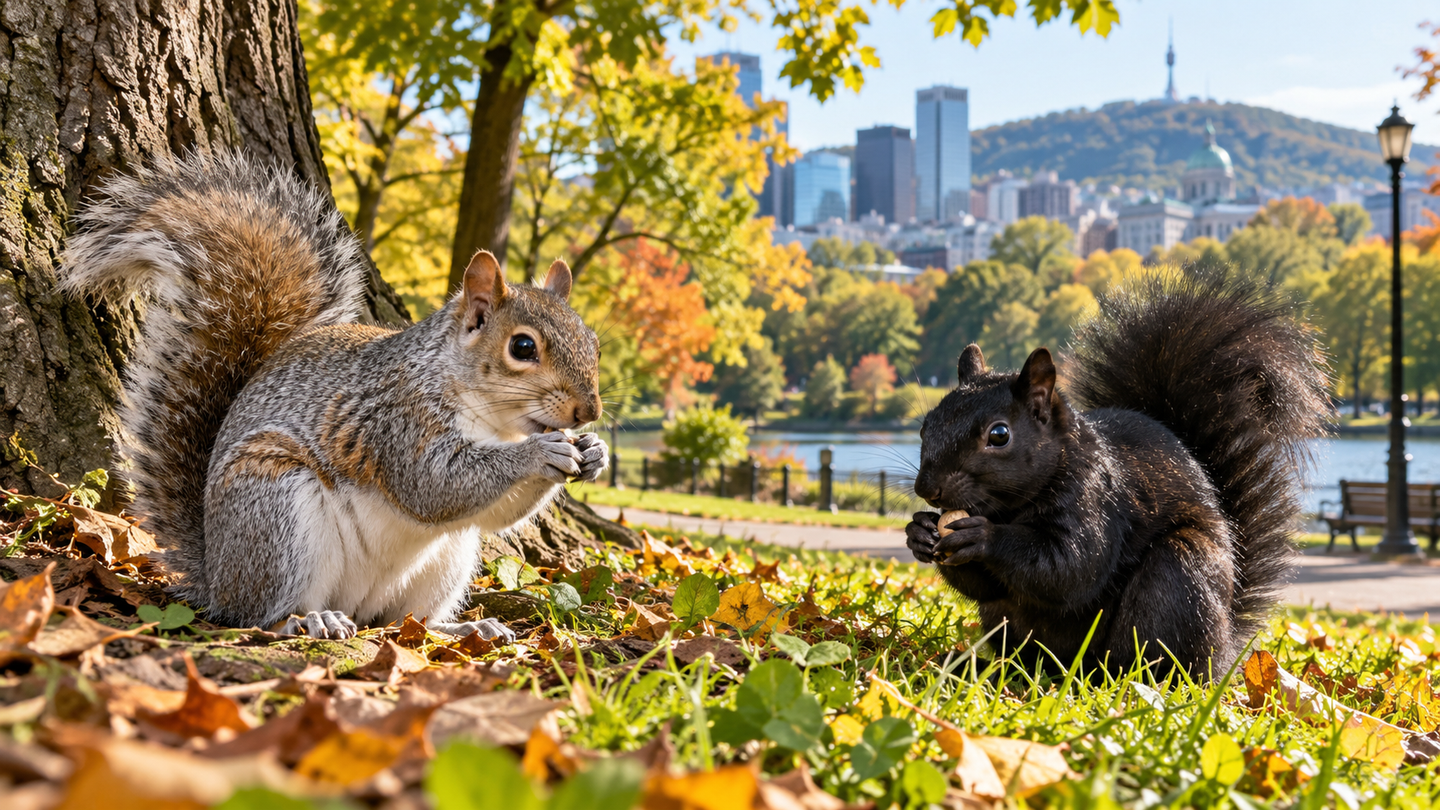
Black squirrels in Montreal are more common in colder, forested areas, revealing how local climate and rivers may shape urban wildlife. (CREDIT: Shutterstock)
- A Montreal-wide study of 1,734 eastern grey squirrel observations found that black-coated squirrels were most common in colder, more heavily forested areas rather than in the most intensely urbanized neighborhoods.
- Rivers appear to help divide the metropolitan population into distinct geographic clusters, with black squirrels reaching much higher frequencies to the north and west than to the south and east.
- The findings show that urban wildlife traits can vary dramatically within a single city, but the observational study cannot yet prove that local conditions are causing evolutionary change.
The color of a squirrel’s coat can change dramatically depending on which side of Montreal you visit.
An analysis of eastern grey squirrels across the metropolitan area found that black-coated animals were disproportionately common in colder neighborhoods with greater tree canopy. Their prevalence also shifted sharply across waterways, suggesting that rivers may restrict movement enough to help maintain distinct populations.
Researchers at McGill University combined standardized surveys across 197 parks with observations from iNaturalist and the SquirrelMapper project. Altogether, their analysis included 1,734 squirrel records collected across a metropolitan landscape divided by the St. Lawrence River and its tributaries.
The study, published in the Journal of Animal Ecology, challenges a common approach to urban evolution that treats cities as relatively uniform environments. Conditions within a few kilometers can differ enough to produce very different patterns in wildlife.
“People often think of cities as a single type of environment, but our findings show that the conditions animals experience can vary dramatically from one neighbourhood to another,” senior author Allison Roth said.
Black squirrels are the same species
Eastern grey squirrels, Sciurus carolinensis, usually have grey fur, but a genetic variation can produce a dark brown or almost entirely black coat known as melanism. A deletion involving the melanocortin 1 receptor gene, or Mc1R, contributes to this inherited color difference.
Black squirrels are particularly common in parts of the northern species range. Dark fur has been proposed to provide a thermal advantage in cold conditions because it can absorb more solar radiation, although camouflage, predators, roads and other environmental pressures may also influence which coat colors persist.
Previous research across North American cities has often found more melanic squirrels in heavily urbanized areas. That raised the possibility that cities repeatedly favor dark coloration through similar combinations of habitat modification, altered predators and road networks.
Montreal did not follow that simple pattern. Black squirrels were generally less common in its heavily urbanized center and more prevalent in certain colder, forested areas farther away.
Hundreds of parks exposed a complicated pattern
First author Francis Quang-Hai Dinh collected a major portion of the field data while he was an undergraduate at McGill. During the summer of 2022, researchers surveyed 197 metropolitan parks using standardized 20-minute searches.
“I visited almost 200 parks around the city on my bicycle during my free time the first summer that I was at McGill,” Dinh said. Those surveys were combined with independently gathered citizen-science observations, allowing researchers to examine patterns across a much wider geographic area.
Black squirrels accounted for 12.8% of the 1,734 observations in the combined dataset. Yet that average concealed striking geographic differences.
Melanism was only around 5% near Montreal’s urban center. Frequencies became much higher toward the northwest, reaching particularly high levels in northern and western rural areas while remaining low toward the south and east.
On the West Shore, black squirrels became significantly more common with increasing distance from the city. The pattern was different on the South Shore, Laval and North Shore, demonstrating that a single urban-to-rural line could not explain the entire metropolitan area.
Trees and winter cold mattered more than urbanization
The researchers examined environmental variables including winter temperature, forest canopy, impervious surfaces, building density, road area and park size.
Canopy cover and winter temperature consistently emerged as the strongest predictors of black-squirrel frequency. Across surveyed locations, winter surface temperatures ranged from about minus 9 to minus 2.3 degrees Celsius, while canopy cover ranged from roughly 1% to almost 98%.
Parks with more canopy tended to contain more black squirrels, while warmer winter conditions were associated with fewer. Statistical modeling suggested that urbanization affected coat color primarily indirectly because highly urbanized locations tended to have warmer winters and less tree cover.
That result turns the usual urban-squirrel story partly on its head. Instead of urban conditions directly favoring melanism, Montreal’s warmer and less forested urban core may reduce environmental conditions associated with the black morph.
Greater tree cover could influence camouflage as well as temperature. Historically, melanism declined across portions of North America following widespread deforestation, suggesting the visual background of forests could also affect survival.
Rivers may divide squirrels into local populations
Temperature and trees still could not explain everything.
Large regional differences remained after the researchers accounted for environmental conditions. One likely contributor is Montreal’s unusual geography, where the St. Lawrence River and several tributaries divide the metropolitan landscape into islands and separated shorelines.
Squirrels can disperse through parks, neighborhoods and wooded corridors, but broad rivers represent much more substantial obstacles. Restricted movement can reduce gene flow and allow differences between populations to persist.
The researchers observed abrupt changes in coat-color frequencies across some regional boundaries. They propose that the St. Lawrence system could partly separate squirrels connected to the Great Lakes population, where melanism is common, from populations farther east where black squirrels occur less frequently.
That interpretation remains a hypothesis. Genetic sampling from opposite sides of Montreal’s rivers will be needed to determine whether waterways actually produce the population structure suggested by the color patterns.
Coat color does not yet prove rapid evolution
The results offer a snapshot of phenotype distribution rather than direct evidence that Montreal squirrels are currently evolving in response to neighborhood conditions.
The study was observational, so associations between coat color, temperature and vegetation cannot establish cause and effect. Researchers also lacked direct measurements showing that black or grey squirrels survive and reproduce differently across Montreal’s various environments.
Detection could introduce another complication. Dark squirrels may be easier to see against pavement but harder to spot in shaded vegetation, while unusual black animals may attract disproportionate attention from citizen scientists.
Despite those limitations, three independently assembled datasets produced broadly similar geographic patterns. The findings therefore strengthen the case for treating urban landscapes as mosaics rather than single ecological environments.
“This project shows how discoveries can be accessible and that you can do science in your backyard,” Dinh said.
That backyard may differ substantially from one several neighborhoods away. For urban wildlife, a river, a patch of forest or a few degrees of winter temperature could help shape which traits become common and which remain rare.
Dig deeper into urban evolution and squirrel coat color
These studies provide recent and directly relevant context on the genetics, natural selection and environmental pressures behind eastern grey squirrel melanism.
Cities as genetic refugia: rural selection maintains Mc1R pigmentation cline in squirrels despite an urban bottleneck: Whole-genome sequencing and evolutionary simulations show that strong rural selection can maintain grey-versus-black coat differences even after urban populations undergo major demographic changes. (Proceedings of the Royal Society B, 2026)
Road Mortality Contributes to the Evolution of an Urban–Rural Cline in Squirrel Coat Color: This study tests whether road mortality acts as a selective force on grey and melanic eastern grey squirrels across urban landscapes. (Evolutionary Applications, 2025)
Crypsis in a polymorphic mammal along an urbanization gradient: Researchers examine how effectively grey and black squirrels blend into different urban and rural backgrounds, testing camouflage as a mechanism shaping coat-color distributions. (Urban Ecosystems, 2025)
Population genomic structure of a widespread, urban-dwelling mammal: The eastern grey squirrel (Sciurus carolinensis): Genome-wide data reveal broad geographic population structure across eastern grey squirrels and provide context for the regional genetic divisions discussed in the Montreal study. (Molecular Ecology, 2024)
Parallel evolution of urban–rural clines in melanism in a widespread mammal: More than 60,000 observations across 43 North American cities show how urbanization, climate and forest cover interact to shape black-squirrel frequencies. (Scientific Reports, 2022)
Research findings are available online in the Journal of Animal Ecology.
The original story "Squirrel colors spotlight local evolutionary changes in urban species" is published in The Brighter Side of News.
Related Stories
- Ancient squirrel droppings reveal 700,000 years of lost ecosystems
- Researchers discover prehistoric giant flying squirrel
- Leaping squirrels could help scientists develop more agile robots
Like these kind of feel good stories? Get The Brighter Side of News' newsletter.
Rebecca Shavit
Writer
Based in Los Angeles, Rebecca Shavit is a dedicated science and technology journalist who writes for The Brighter Side of News, an online publication committed to highlighting positive and transformative stories from around the world. Having published articles on MSN, AOL News, and Yahoo News, Rebecca's reporting spans a wide range of topics, from cutting-edge medical breakthroughs to historical discoveries and innovations. With a keen ability to translate complex concepts into engaging and accessible stories, she makes science and innovation relatable to a broad audience.