Iron meteorites unlock secrets of the early solar system and Earth’s origin
A meteorite study suggests Earth’s life-linked nitrogen and phosphorus may have originated closer to the young sun.
Provided By: Rachel Leeson, Rice University/Edited By: Joseph Shavit

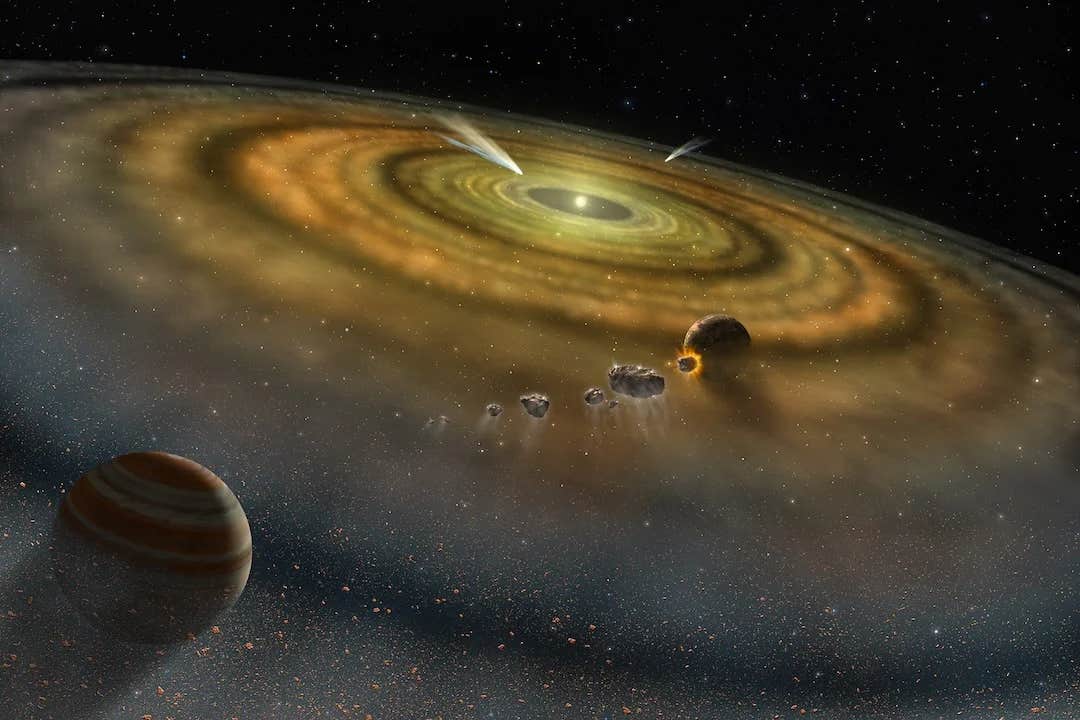
Iron meteorites suggest Earth’s nitrogen and phosphorus may have come from early inner solar system planetesimals. (CREDIT: NASA/FUSE/Lynette Cook)
The ingredients that help make a planet livable did not necessarily come from where many scientists once thought.
A new analysis of iron meteorites suggests that nitrogen and phosphorus, two elements tied to life, may have been available in the inner solar system very early, long before later waves of asteroid material reshaped the region. That matters because Earth formed there.
The work traces those elements back to some of the solar system’s earliest planetesimals, small bodies that formed more than 4.5 billion years ago and later broke apart. Their metallic cores survive today as iron meteorites, offering a rare record of conditions during the solar system’s first million years.
By reconstructing the chemistry of those lost bodies, researchers found a pattern that differs from the one seen in later-formed chondrites, a more familiar class of stony meteorites. The contrast points to a changing solar system, one in which the flow of material shifted quickly as Jupiter grew and the disk of gas and dust cooled.
“We recreated the crystallization of iron meteorites in the lab and used the known chemical composition of iron meteorites available to us,” said Debjeet Pathak, a graduate student and the corresponding author on the paper. “That allowed us to determine the chemical composition of the small planetary bodies, called planetesimals, from which the iron meteorites came from.”
Reading the chemistry of broken worlds
Iron meteorites are not whole planets in miniature. They are fragments of metallic cores left behind after early planetesimals differentiated, separated into layers, and were later stripped apart by collisions. That makes them useful, but not simple. To infer the chemistry of the original parent bodies, the team had to reverse the effects of crystallization and core formation.
The researchers, led by Rice University professor Rajdeep Dasgupta, recreated those conditions in the lab using high-pressure, high-temperature experiments. They heated mixtures containing iron, nickel, phosphorus, sulfur, and nitrogen at 2 gigapascals and temperatures ranging from 1050 to 1600 degrees Celsius.
Those experiments helped the team estimate how phosphorus and nitrogen would divide between solid and liquid metal as a planetesimal core cooled. From there, they modeled the likely elemental budgets of the original parent bodies.
The result was a clear divide. Iron meteorite parent bodies from the inner solar system had lower phosphorus-to-nitrogen ratios than those from the outer solar system. But that pattern did not survive into the next generation of planetesimals.
Later chondrites showed the opposite trend. Inner solar system chondrites had higher phosphorus-to-nitrogen ratios, and those ratios gradually declined farther from the sun.
That reversal is one of the study’s central clues.
A record of a solar system in motion
The authors argue that the early disk around the young sun was not chemically static. In the first stage, strong turbulence and higher temperatures may have pushed phosphorus-bearing refractory material outward from the hot inner disk into the cooler outer regions. That could help explain why the earliest outer solar system planetesimals ended up with higher phosphorus-to-nitrogen ratios than their inner counterparts.
Later, the picture changed.
“As Jupiter grew in size,” Pathak said, “it slowly began to block the transport of phosphorus and nitrogen, resulting in a gradual decrease in the observed ratios found in chondrites, which formed as much as 2-3 million years after the iron meteorite bodies.”
In the team’s interpretation, the growth of Jupiter, combined with the gradual cooling of the protoplanetary disk, altered what materials could move and where they could survive. That would have changed the chemistry of planetesimals forming just a few million years apart.
The paper argues that this temporal shift helps explain why first-generation planetesimals and later chondrites record opposite phosphorus-to-nitrogen patterns across the solar system.
“We think this finding tells us how the dust and consequently the planetesimal compositions in the inner versus outer solar system evolved within the first few million years, affected by Jupiter’s growth and gradual cooling of the gas-dust medium,” said Dasgupta, the W. Maurice Ewing Professor of Earth Systems Science and the director of the Rice Space Institute Center for Planetary Origins to Habitability.
Rethinking where Earth’s essential elements came from
That changing pattern matters because Earth’s chemistry does not neatly match a simple late delivery from outer solar system chondrites.
Traditional models have often emphasized volatile-rich material arriving later from farther out in the solar system. But the new study tested whether that idea can explain the phosphorus-to-nitrogen ratio of Earth’s bulk silicate portion, the mantle and crust left outside the core.
The answer, the authors argue, is no, at least not by itself.
Their forward models show that enstatite chondrites, long considered important analogs for Earth’s building material, produce phosphorus-to-nitrogen ratios that are too low. Outer solar system iron meteorite parent bodies produce ratios that are too high. Inner solar system iron meteorite parent bodies come closer, falling only about a factor of two below the present-day bulk silicate Earth.
The nitrogen budget tells a similar story. No single end-member perfectly reproduces Earth’s composition, but the inner solar system iron meteorite parent bodies provide the closest match among the options tested.
That does not mean Earth was built from one source alone. The paper notes that a more realistic scenario likely involved contributions from both generations of inner solar system planetesimals, including enstatite chondrites and the parent bodies sampled by noncarbonaceous iron meteorites.
Still, the broader point is striking. Earth may not have needed a late rescue shipment of life-essential elements from the outer solar system. Some of those ingredients may have been present much closer to home, carried by the earliest bodies forming near the young sun.
Practical implications of the research
The study changes the way scientists can think about chemical habitability in rocky planets. Instead of focusing mainly on late delivery from volatile-rich outer solar system material, it points to the possibility that key life-essential elements were built into inner solar system building blocks from the start.
That has consequences for models of Earth’s formation and for how researchers interpret other rocky worlds. If nitrogen and phosphorus budgets depend strongly on when and where planetesimals formed, then habitability is tied not just to what a planet accretes, but to how the protoplanetary disk evolves over time.
The work also gives researchers a new way to use iron meteorites, not just as samples of metal cores, but as records of shifting chemical traffic in the young solar system.
Research findings are available online in the journal Science Advances.
The original story "Iron meteorites unlock secrets of the early solar system and Earth's origin" is published in The Brighter Side of News.
Related Stories
- Scientists use microbes on ISS to extract valuable metals from meteorites
- Where do meteorites of different types come from?
- Mysterious dust ring beyond Jupiter formed many of our Solar System’s earliest worlds
Like these kind of feel good stories? Get The Brighter Side of News' newsletter.