Kissing may be millions of years older than its earliest written records
New historical and evolutionary research places kissing in earlier manuscripts and models its possible roots in ancient ape ancestors.

 Edited By: Joshua Shavit

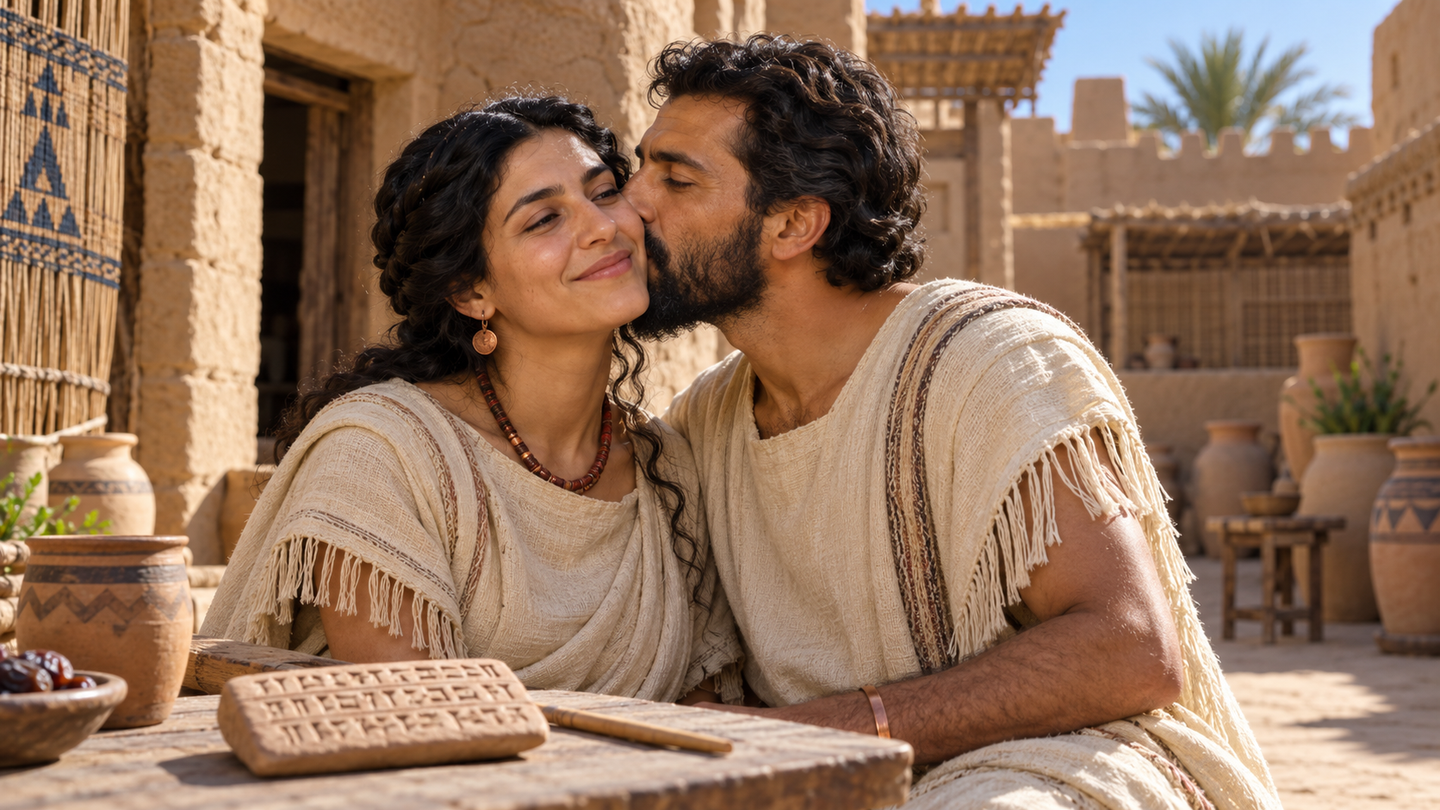
Recent research links ancient kissing records with primate evolution, grooming and microbial exchange, while leaving its origins uncertain. (CREDIT: The Brighter Side of News)
- A 2025 historical review identifies romantic kissing in Sumerian manuscripts dated to approximately 2600–2500 BCE.
- A comparative primate study suggests broader kissing behavior existed in ape ancestors 21.5–16.9 million years ago, based on evolutionary modeling.
- New grooming and microbiome hypotheses broaden the discussion, but neither kissing's original function nor its specific role in ancient disease spread is settled.
Clay tablets preserve kisses between ancient deities, while living apes offer clues to a much deeper history. New research has expanded the question from when people first recorded kissing to how the behavior might have evolved.
A 2025 historical review identifies romantic kissing in Sumerian manuscripts dated to approximately 2600–2500 BCE. Separately, a comparative study suggests mouth-to-mouth kissing may have existed in the ancestors of large apes 21.5–16.9 million years ago.
The two findings measure different things. One concerns surviving written evidence. The other reconstructs ancestral behavior statistically, using a broader definition than human romantic kissing.
Both appeared in Evolution and Human Behavior. Together with newer proposals about grooming and microbial exchange, they extend a debate reopened by University of Copenhagen and University of Oxford researchers in 2023.
An earlier written kiss emerges from an old manuscript
The 2023 Science Perspective, by Troels Pank Arbøll and Sophie Lund Rasmussen, challenged claims that romantic kissing was first documented in South Asia around 1500 BCE. Mesopotamian texts placed it roughly a millennium earlier.
Arbøll's 2025 follow-up reports an additional source identified in a 2024 scholarly publication by Manfred Krebernik and Jan J. W. Lisman. It concerns a Sumerian myth about the grain goddess Ezinan and her seven children.
Manuscripts containing the myth date to approximately 2600–2500 BCE and come from Abū Ṣalābīḫ in present-day Iraq. The passage describes the god An having intercourse with Ezinan and then kissing her.
That is earlier than the Barton Cylinder discussed in the 2023 paper, dated approximately 2500–2350 BCE. The advance came through interpreting difficult texts known for decades, rather than discovering a newly excavated kiss.
The review also examines kissing vocabulary and evidence across neighboring ancient societies. Its chronology strengthens the case for a broad history, but cannot identify the behavior's birthplace. A surviving manuscript dates documentation, not invention.
Ancient intimacy came with social rules
Mesopotamia's clay tablets show that kissing could signify more than sexual desire. Sumerian and Akkadian sources describe affection, family relationships, respect and submission, including kisses directed toward feet or the ground.
Romantic kisses could also create trouble. Two texts from around 1800 BCE describe a married woman nearly tempted by another man's kiss and an unmarried woman's promise to avoid a particular man.
Other passages indicate restrictions on public intimacy or contact with people expected to abstain from sex. These examples suggest a recognized, regulated behavior, although romantic descriptions remain relatively sparse among surviving texts.
Written evidence is also socially selective. Literate societies left records that other communities could not. An absence of surviving documentation therefore cannot establish that a population never kissed.
Nor does ancient evidence make romantic kissing universal. Affectionate mouth contact, sexual kissing and gestures of respect must be distinguished before comparing cultures or tracing origins.
A primate family tree reaches back millions of years
A different approach came from Matilda Brindle, Catherine Talbot and Stuart West. Their comparative study was released in November 2025 and appears in the journal's January 2026 issue. The team included researchers at Oxford and Florida Institute of Technology.
They defined kissing as non-aggressive, directed mouth-to-mouth contact within a species, involving movement of the mouth and no food transfer. That definition allowed comparisons beyond specifically human romantic behavior.
The researchers gathered observations of living primates and mapped kissing onto their evolutionary relationships. Bayesian models then estimated whether ancestral species likely displayed the behavior. The analysis supported its presence in the ancestor of large apes 21.5–16.9 million years ago.
It also suggested that Neanderthals likely kissed. These are inferred ancestral states, not fossil evidence of particular encounters.
Oxford reports that the model ran for ten million iterations. That extensive computation does not compensate for missing behavioral observations, which the researchers acknowledge, particularly outside large apes.
The proposed date therefore applies to broadly defined kissing behavior. It does not establish when human romantic kissing emerged, whether ancestral kisses were sexual, or whether people everywhere inherited the same kissing customs.
Could kissing preserve the final step of grooming?
In October 2024, University of Warwick researcher Adriano Lameira proposed another explanation in Evolutionary Anthropology. His “groomer's final kiss” hypothesis connects human kissing with primate grooming.
The idea starts with lips making contact and applying suction to remove debris or parasites from another animal's coat. As human ancestors lost fur, grooming might have shortened while retaining this final mouth-contact gesture.
A practical cleaning action could thus have persisted as a signal of trust or affiliation. The proposal concerns an evolutionary pathway, rather than reporting an experiment that demonstrated it.
The later comparative paper challenges parts of that account. It notes that defining kissing only through protruded lips and suction is too narrowly human-centered for cross-species analysis. It also calls for evidence that living apes consistently finish grooming with a kiss.
The disagreement leaves clear observational questions for future research: what movements occur, in which contexts, and whether grooming predicts them.
Microbial exchange adds possibilities, not proof
Newer work also broadens the discussion beyond pathogens. A paper by Remco Kort, published online in October 2025 and in a January 2026 issue, proposes a feedback loop involving partners' oral microbial communities.
Repeated intimate kissing could encourage sustained microbial sharing, while biological responses might reinforce the behavior. The article synthesizes existing evidence and proposes research designs. It does not demonstrate that such a loop exists or that exchanging microbes necessarily improves health.
That distinction also applies to the older herpes debate. A 2022 study recovered ancient HSV-1 genomes and proposed that cultural changes, potentially including romantic kissing, might explain changes in viral ancestry.
The 2023 historians argued that earlier kissing records weaken a simple story of sudden introduction. Neither the newer evolutionary reconstruction nor the microbiome hypothesis proves kissing caused a Bronze Age viral expansion.
Ancient medical texts remain ambiguous too. The Mesopotamian condition bušānu affected the mouth and throat, but comparisons with herpes depend partly on disputed symptom translations. Such descriptions cannot securely identify a virus or its transmission route.
The first kiss remains beyond the evidence
The research now spans ancient language, living primate behavior and microbial biology. Each provides a different kind of evidence, with different uncertainties.
Texts can establish that people described kissing at a particular time. Evolutionary models can estimate ancestral behavior, while microbial studies can investigate exchange between partners. None observes the first kiss or settles why the behavior persisted.
The useful advance is a more testable set of questions. Detailed primate observations, careful translations and longitudinal microbial experiments can evaluate competing explanations without treating an attractive origin story as an established result.
Dig deeper into kissing, culture and microbial exchange
These supporting studies provide context for interpreting the newer historical and evolutionary research.
Ancient herpes simplex 1 genomes reveal recent viral structure in Eurasia: Presents ancient viral genomes and the hypotheses about transmission that helped prompt the historical debate. (Science Advances, 2022)
Is the Romantic–Sexual Kiss a Near Human Universal?: Examines cross-cultural variation and challenges assumptions that romantic kissing occurs in every society. (American Anthropologist, 2015)
Shaping the oral microbiota through intimate kissing: Investigates bacterial exchange and similarities between partners' oral microbial communities. (Microbiome, 2014)
Neanderthal behaviour, diet, and disease inferred from ancient DNA in dental calculus: Demonstrates what ancient plaque can reveal about oral microorganisms, diet and health. (Nature, 2017)
Ezinan’s Seven Children: Presents the scholarly edition of the Sumerian myth used in the newer discussion of early written kissing. (Altorientalische Forschungen, 2024)
Research findings are available online in the journal Science.
The original story "Kissing may be millions of years older than its earliest written records" is published in The Brighter Side of News.
Related Stories
- The law of kissing has changed dramatically across 4,500 years
- Humans are not the only animals that kiss
- Scientists trace the origins of kissing back more than 21 million years
Like these kind of feel good stories? Get The Brighter Side of News' newsletter.
Joseph Shavit
Writer, Editor-At-Large and Publisher
Joseph Shavit, based in Los Angeles, is a seasoned science journalist, editor and co-founder of The Brighter Side of News, where he transforms complex discoveries into clear, engaging stories for general readers. With vast experience at major media companies like The Los Angeles Times, Times Mirror and Tribune Publishing, he writes with both authority and curiosity. His writing focuses on space science, planetary science, quantum mechanics, geology. Known for linking breakthroughs to real-world markets, he highlights how research transitions into products and industries that shape daily life.