Mars’s mantle may be hundreds of degrees hotter beneath one hemisphere
Tiny changes in spacecraft orbits suggest Mars’s famous north-south divide reaches deep into its mantle.

 Edited By: Rebecca Shavit

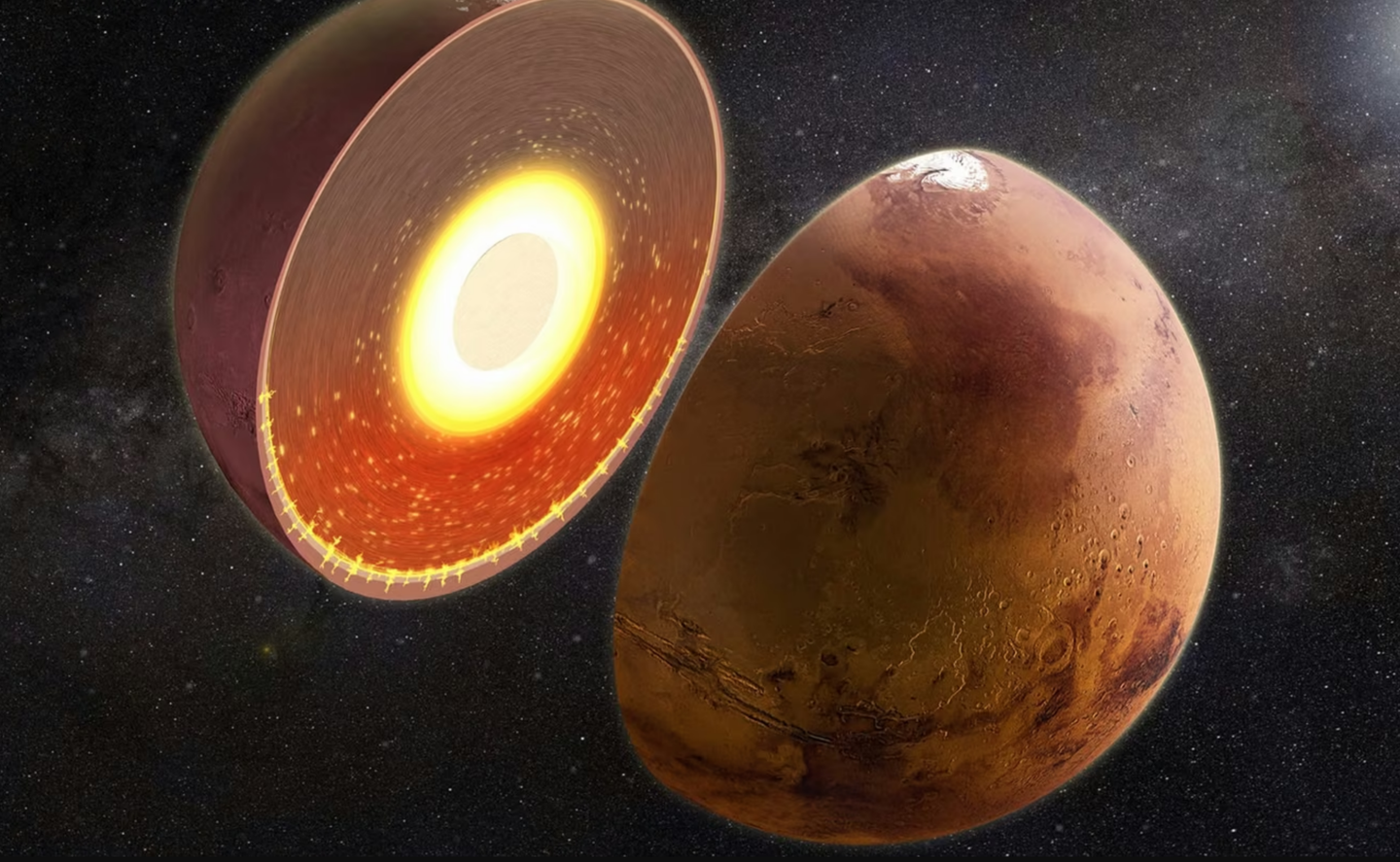
Artist concept of Mars’s warm southern interior. Mars’s southern mantle may be 200 to 400°C hotter than the north, revealing a deep divide beneath the planet’s surface. (CREDIT: Artist concept: NASA / Theophilus Britt Griswold)
- Mars’s mantle beneath the southern highlands appears to be about 200 to 400 degrees Celsius warmer than the mantle beneath the northern lowlands.
- Nearly two decades of spacecraft tracking data revealed gravity changes that suggest the planet’s deep interior is far less uniform than scientists often assume.
- The thermal divide could help explain differences in Mars’s crust, ancient magnetism and seismic behavior, but its origin remains uncertain.
Mars has long looked like a planet divided in two. Its southern hemisphere rises into rugged, heavily cratered highlands, while broad, relatively flat lowlands dominate the north.
That contrast may extend much farther beneath the surface than scientists realized.
An analysis of subtle changes in Mars’s gravitational field indicates that the mantle beneath the southern highlands is roughly 200 to 400 degrees Celsius warmer than the mantle beneath the northern lowlands. The finding suggests one of the planet’s defining surface differences may have roots deep inside Mars that have survived for billions of years.
The research, published in Nature was led by Caltech alumnus Alexander Berne, now a postdoctoral associate at the University of Arizona. The paper, titled “Tidal tomography reveals a thermal anomaly beneath Mars’s crustal dichotomy,” describes the first application of the technique to reveal large-scale variations within the Martian mantle.
The result challenges a common simplifying assumption in planetary science: that a planet’s interior can generally be treated as a series of spherical layers.
“Scientists usually assume that the interiors of planetary bodies are generally spherically symmetric, but this is not necessarily true,” Berne said.
Reading Mars through tiny orbital changes
Scientists did not detect the warmer region with a thermometer, seismic network or drilling equipment. Instead, they watched how Mars pulled on spacecraft orbiting the planet.
The team analyzed radio tracking observations from NASA’s Mars Global Surveyor, Mars Odyssey and Mars Reconnaissance Orbiter. Together, the data cover about 16 years of observations.
As spacecraft travel around Mars, tiny variations in the planet’s gravitational field slightly alter their velocities. Earth-based antennas in NASA’s Deep Space Network can detect those changes through precise Doppler measurements.
Berne and his collaborators used a technique called tidal tomography to translate the changing gravitational signals into information about Mars’s interior.
Mars follows a somewhat elliptical orbit and has a tilted rotational axis. As a result, the gravitational influence of the Sun varies through the planet’s 687-Earth-day year. Mars responds to those changing forces by deforming slightly, and the way it deforms depends on the physical properties of material deep inside the planet.
If Mars were internally uniform from one side to another, the resulting gravity variations should follow predictable patterns. They did not.
Some measured components differed by as much as 300 percent from predictions for a spherically symmetric Mars. The researchers found that the unexpected signals could be explained by substantial variations in the stiffness, or effective shear modulus, of the mantle.
A hotter mantle beneath the southern highlands
The inferred mantle differences broadly follow Mars’s surface geography.
The researchers identified higher mantle stiffness beneath the northern lowlands and lower stiffness beneath the southern highlands. Temperature offers a particularly strong explanation because hot mantle rock becomes mechanically weaker.
Their models indicate the southern mantle could be 200 to 400 degrees Celsius hotter. The analysis also permits an iron enrichment of up to 5 percent in the southern highlands mantle.
That does not mean scientists have found a vast underground ocean of magma.
A warmer southern mantle could experience localized melting, and some thermal models predict increased magma production there. However, the Nature paper explicitly states that melt is not required to explain the gravity measurements. Seismic observations also do not currently support widespread partial melting throughout the southern mantle.
If small amounts of melt do exist, the researchers suggest Mars’s thick southern crust could prevent much of it from reaching the surface. Magma might instead stall within the crust, creating buried intrusions that would be difficult to detect in ordinary surface images.
Clues to an ancient Martian puzzle
The thermal anomaly could provide another piece of evidence in a long-running debate over why Mars became so different between north and south.
Several explanations remain possible.
One proposes that a colossal impact reshaped the young planet, producing the northern lowlands. Another attributes the dichotomy to large-scale convection inside the mantle. A third possibility involves the thick southern crust itself, which could act as insulation and trap more heat beneath the highlands.
The authors also consider combinations of those processes. A giant impact early in Martian history, for example, could have altered the mantle and crust before later thermal insulation or mantle circulation helped preserve the north-south difference.
The hotter southern interior may also fit an independent clue from NASA’s InSight lander. Previous analysis of marsquakes found that seismic waves traveling through portions of the southern highlands dissipated energy more rapidly than waves associated with the northern lowlands. A temperature difference of several hundred degrees could contribute to that contrast.
Mars’s unusual crustal magnetism may provide another connection. Large regions of the southern highlands retain strong ancient magnetic signatures, unlike much of the north. The researchers suggest differences in mantle temperature and heat flow could have influenced how the crust acquired those magnetic records while Mars’s early dynamo was operating.
A new way to look inside other worlds
The implications extend beyond Mars.
Tidal tomography uses changes in a planetary body’s gravitational response rather than relying entirely on instruments placed on its surface. A related approach recently revealed a thermal asymmetry in the Moon’s mantle.
“As we get more gravity data, we can determine the three-dimensional intricacies of a planet’s interior structure,” Berne said. “These inferences in turn give us a blueprint for designing future missions and scientific exploration of these worlds.”
Dedicated gravity missions could eventually map Martian interior variations at much finer scales. The same approach might also help scientists investigate worlds such as Mercury, Ganymede, Io and Enceladus.
For Mars, the immediate result is striking enough. The dramatic boundary between northern plains and southern highlands may not simply mark two different landscapes. Deep below them, Mars itself appears to remain divided.
Dig deeper into Mars’s mantle, crustal dichotomy and internal heat
These five studies explore the seismic, thermal, volcanic and gravitational evidence scientists are using to reconstruct the structure and evolution of the Martian interior.
Thermal asymmetry in the Moon’s mantle inferred from monthly tidal response: This study demonstrated how time-variable tidal gravity can reveal lateral temperature differences inside another planetary body, providing an important methodological foundation for applying tidal tomography to Mars. (Nature, 2025)
Constraints on the Origin of the Martian Dichotomy From Southern Highlands Marsquakes: InSight seismic observations revealed substantially stronger attenuation beneath the southern highlands than in the northern lowlands, a difference that may reflect higher mantle temperatures and more vigorous convection in the south. (Geophysical Research Letters, 2025)
Mars's Crustal and Volcanic Structure Explained by Southern Giant Impact and Resulting Mantle Depletion: Numerical models examine how an enormous ancient impact and the mantle depletion that followed could help explain both Mars’s crustal dichotomy and the planet’s later pattern of volcanic activity. (Geophysical Research Letters, 2024)
Geophysical evidence for an enriched molten silicate layer above Mars’s core: Seismic and geophysical evidence supports a molten silicate layer above Mars’s core, demonstrating that the planet’s deep mantle may contain important thermal and compositional layering. (Nature, 2023)
The Thermal State and Interior Structure of Mars: Three-dimensional thermal evolution models examine how crustal thickness, heat-producing elements and mantle rheology shape the present-day temperature and internal structure of Mars. (Geophysical Research Letters, 2018)
Research findings are available online in the journal Nature.
The original story "Mars's mantle may be hundreds of degrees hotter beneath one hemisphere" is published in The Brighter Side of News.
Related Stories
- Enormous, Earth-like magma systems once existed inside Mars
- White rocks on Mars point to ancient rainfall and a wetter planet
- Scientists find significant amounts of water hidden beneath Mars' surface
Like these kind of feel good stories? Get The Brighter Side of News' newsletter.
Joseph Shavit
Writer, Editor-At-Large and Publisher
Joseph Shavit, based in Los Angeles, is a seasoned science journalist, editor and co-founder of The Brighter Side of News, where he transforms complex discoveries into clear, engaging stories for general readers. With vast experience at major media companies like The Los Angeles Times, Times Mirror and Tribune Publishing, he writes with both authority and curiosity. His writing focuses on space science, planetary science, quantum mechanics, geology. Known for linking breakthroughs to real-world markets, he highlights how research transitions into products and industries that shape daily life.