Scientists created a ‘mini universe’ that measures time without a clock
A 24,000-atom experiment constructs an internal clock from entropy exchange, offering a laboratory test of how time might emerge within a quantum system.

 Edited By: Joshua Shavit

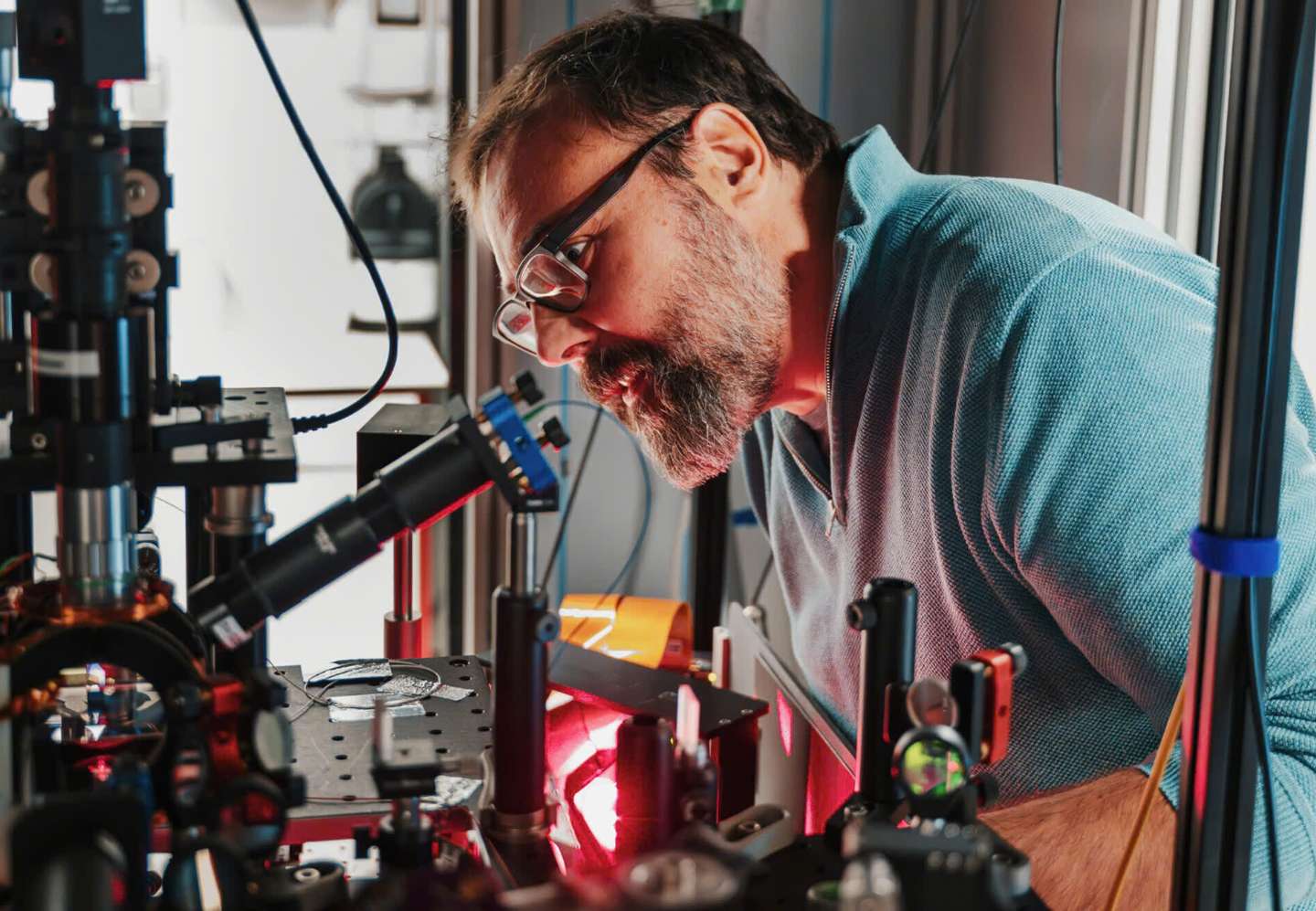
University of Birmingham physicist Giovanni Barontini operates equipment designed to trap and cool rubidium atoms. (CREDIT: University of Birmingham)
- A 24,000-atom experiment constructed an internal measure of time from entropy exchange between observed and unobserved regions.
- This “entropic time” broadly reproduced the sequence of laboratory measurements and supported a quantum equation describing the observed dynamics.
- The work provides a testbed for ideas about emergent time, but does not prove that time is unreal or recreate our universe.
A cloud of 24,000 atoms can expand, contract and begin another cycle while keeping track of its evolution through changes within itself. In a University of Birmingham experiment, those changes supplied an internal measure called entropic time. The result gives physicists a controlled way to investigate whether time can emerge from relationships inside a physical system.
Giovanni Barontini, a professor of physics at Birmingham, reported the work in Physical Review Research. He used ultracold rubidium atoms to construct a simplified laboratory analogue of an isolated universe. Its observed region exchanged particles and entropy with an unobserved region, providing the ingredients for an internal time variable.
The experiment still used laboratory clocks to collect and check measurements. Its achievement was showing that an internally constructed variable could organize those measurements and support a description of the system’s behavior. That distinction matters when assessing claims that scientists created time or demonstrated that it does not fundamentally exist.
Why physics has a problem with time
In everyday physics, time often enters equations as a parameter supplied from outside the system. A clock tells researchers when to compare measurements. That usually works well for an atom or machine whose surroundings provide a separate reference. But a theory describing the entire universe cannot simply assume another clock sitting beyond it.
The Wheeler-DeWitt equation captures that difficulty in one approach to quantum gravity, which seeks to reconcile quantum physics with gravity. It describes a quantum state without the familiar external time parameter. Physicists must then ask how changes and sequences could appear to observers within that description.
Relational approaches propose using one internal variable to track another. However, a variable that increases and then decreases can assign the same reading to different stages. An expanding and recollapsing system therefore poses a useful challenge: Can an internal clock preserve the sequence across both parts of its evolution?
Building the atomic mini-universe
Barontini began with approximately 24,000 rubidium-87 atoms in a Bose-Einstein condensate. In this ultracold state, atoms behave collectively according to quantum mechanics. Cooling the gas to a few billionths of a degree above absolute zero made this collective quantum behavior accessible. Crossed laser beams at wavelengths of 1,070 and 1,550 nanometers held the cloud in an optical trap.
A separate laser, operating at 675 nanometers, created a barrier approximately 8 micrometers wide. That barrier divided the trap into an observed “bright” region and an unobserved “dark” region. Those names describe the experimental partition, not cosmological dark matter or dark energy.
Atoms oscillated through the trap and could cross the barrier. As they entered the bright region, that region grew; as they departed, it contracted. Barontini called these stages analogues of a Big Bang and Big Crunch, while defining the “mini-universe” simply as an effectively closed system of many particles.
Over the relevant experimental interval, the whole cloud showed no measurable particle loss or dissipation. Its confinement remained fixed during evolution. These conditions made it possible to examine internal changes without continuously driving the system through an externally changing trap.
Entropy supplies an internal measure
Entropy describes how a system’s microscopic possibilities relate to its measured state. Here, Barontini used an experimentally defined, coarse-grained entropy, a description that retains selected measurable information. It was not simply another name for the cloud’s size or the distance its atoms traveled.
For the bright region, he estimated entropy per atom and multiplied it by the number of atoms present. He combined its entropy changes with an internal coordinate describing the cloud’s center of mass. This construction produced entropic time from the region’s own evolving properties.
The important process was entropy exchange between the two regions. Entropic time could advance as entropy entered or left the bright region, rather than requiring its entropy always to increase. Across the complete cloud, measured entropy remained constant within experimental uncertainty.
This connects the work to the wider relationship between entropy and timekeeping. A subsystem can gain or lose entropy while the isolated whole remains unchanged in that respect. Treating the two levels separately helps explain how an internal sequence can coexist with an effectively closed overall system.
Checking the order against laboratory time
Barontini followed the cloud for 120 milliseconds, taking absorption images at 2-millisecond intervals. From those images, he extracted particle numbers, positions and cloud widths. Repeating the experiment with different barrier heights changed the exchange between the bright and dark regions. Each image therefore contributed both a conventional time label and the internal measurements used to construct the alternative ordering.
He then compared entropic time with conventional laboratory time. The internal variable increased almost everywhere and broadly preserved the measured event sequence. Small “wiggles” appeared where signs changed in the sampled quantities, which the paper attributes to coarse sampling of the internal coordinate.
The result therefore supports a useful arrow of time, with stated experimental qualifications. Successive internal readings generally distinguished earlier events from later ones through expansion and contraction. They did not need to remain evenly spaced against the laboratory clock.
What happens when this clock stops
Higher barriers progressively reduced entropy exchange and slowed the internal measure. Under some conditions, the bright region approached a stationary state and entropic time stopped advancing. At low barriers, no entropic interval accumulated between a collapse and the next expansion when no entropy was exchanged.
These pauses belonged to the constructed variable, not to every physical process in the laboratory. The experiment could still record elapsed laboratory time during them. Different ways to measure time need not assign identical intervals to the same observed evolution.
The expansion-collapse analogy also has limits. The bright region did not encounter a genuine cosmological singularity, where a mathematical description breaks down. Nor did the experiment reproduce gravity’s full equations: its reduced mathematical structure resembles simplified cosmological models without being identical to them.
Giving the internal clock predictive work
Barontini also derived an effective Schrödinger equation using entropic time. This equation describes the evolution of the observed region’s quantum state. Numerical solutions reproduced the measured cloud-width evolution for a selected low-barrier case, with the entropy-dependent behavior inferred from experimental data.
That agreement gives the construction more substance than simply relabeling photographs. It shows that an internal time variable can support a quantitative account of observed dynamics. However, the resulting equation is not well defined when the entropy flow underlying that time variable vanishes.
Future experiments could compare alternative internal clocks or test reversibility by attempting to undo the system’s evolution. Barontini also proposes studying bounce scenarios and engineering analogue black holes. These remain suggested extensions rather than results of this experiment.
The broader opportunity lies in quantum simulation, using controllable systems to investigate difficult theoretical questions. This platform does not establish that cosmic time emerges through the same mechanism. Its next test is whether the internal ordering remains consistent when interactions, clock choices and the system’s dynamics become more complicated.
Dig deeper into entropy, quantum clocks and emergent time
These studies connect modern laboratory timekeeping with foundational ideas about internal clocks and quantum models of cosmology.
Entropic Costs of Extracting Classical Ticks from a Quantum Clock
Experiments distinguish the entropy cost of microscopic clockwork from the larger cost of recording readable ticks. (Physical Review Letters, November 2025)
Magnetic clock for a harmonic oscillator
This theoretical model investigates how familiar time and dynamics arise when an entangled clock approaches classical behavior. (Physical Review A, May 2024)
Quantum field simulator for dynamics in curved spacetime
An ultracold quantum gas simulates aspects of fields in curved and expanding spacetime, illustrating the possibilities of laboratory cosmology. (Nature, November 2022)
A Rapidly Expanding Bose-Einstein Condensate: An Expanding Universe in the Lab
An expanding atomic ring reproduces phenomena analogous to cosmological redshifting and energy redistribution after expansion. (Physical Review X, April 2018)
Von Neumann Algebra Automorphisms and Time-Thermodynamics Relation in General Covariant Quantum Theories
The foundational thermal time proposal relates time flow to a system’s thermodynamic state, offering context for comparison with entropic time. (arXiv preprint, June 1994)
Research findings are available online in the journal Physical Review Research.
The original story "Scientists created a ‘Mini Universe’ that measures time without a clock" is published in The Brighter Side of News.
Related Stories
- How did the first-ever clockmaker know what time to set?
- Atomic clocks may be powerful enough to detect the quantum fabric of time
- Breakthrough ion clock experiments reveal that time can go quantum
Like these kind of feel good stories? Get The Brighter Side of News' newsletter.
Joseph Shavit
Writer, Editor-At-Large and Publisher
Joseph Shavit, based in Los Angeles, is a seasoned science journalist, editor and co-founder of The Brighter Side of News, where he transforms complex discoveries into clear, engaging stories for general readers. With vast experience at major media companies like The Los Angeles Times, Times Mirror and Tribune Publishing, he writes with both authority and curiosity. His writing focuses on space science, planetary science, quantum mechanics, geology. Known for linking breakthroughs to real-world markets, he highlights how research transitions into products and industries that shape daily life.