4.1-billion-year-old meteorite offers a rare look into Mars’ wetter past
A rare Martian meteorite preserves 4.1-billion-year-old clues to water and magma, revealing an ancient crust and mantle unlike those in most available samples.
 University of New Mexico Writer: Steve Carr

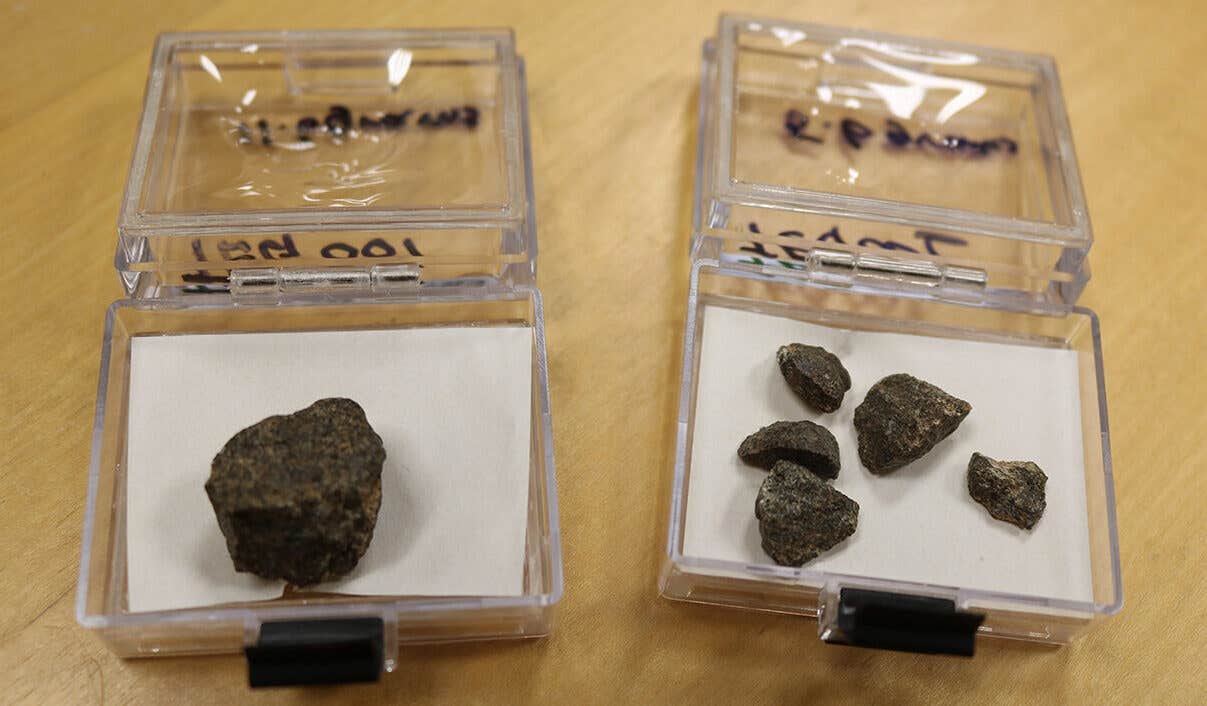
Samples of Teghaza 001, an ancient Martian meteorite dating back 4.1 billion years. (CREDIT: University of New Mexico)
- Teghaza 001 preserves a Martian rock that formed at least 4.1 billion years ago, offering a rare sample of the planet’s earliest crust.
- Mineral changes and oxygen isotopes point to water-related alteration, while trace elements reveal a previously unrecognized mantle source.
- The meteorite may come from Mars’ southern highlands, but its exact origin remains unknown and the findings do not demonstrate life.
A rock recovered from the Sahara has preserved something Mars rarely sends to Earth: a detailed record of its earliest crust. Known as Teghaza 001, it formed at least 4.1 billion years ago. Its minerals retain evidence of ancient magma and interactions with water, opening another window onto Mars’ watery past.
The findings appear in Science, in a study led by Yang Liu of NASA’s Jet Propulsion Laboratory. University of New Mexico scientists Carl Agee and Karen Ziegler helped recognize and investigate the unusual sample. Researchers at Caltech, UCLA and the University of Maine also contributed to the analysis. Ziegler, an Institute of Meteoritics scientist and research professor, contributed oxygen isotope analyses that helped characterize the rock.
The meteorite matters because much of the available Martian collection comes from younger geological settings. Ancient samples can reveal conditions those rocks never experienced. Teghaza 001 provides evidence about both the planet’s deep interior and water-related processes, although it cannot establish that early Mars resembled Earth in every important respect.
A desert find with an unusual history
Teghaza 001 was found in Mali’s Sahara Desert in 2022. Eight recovered stones together weigh 798.5 grams, with the largest weighing 442 grams. Oxygen isotope measurements, which compare forms of oxygen with different masses, confirmed the material’s Martian origin.
Agee, director and curator of UNM’s Institute of Meteoritics, noticed features unlike those in typical Martian meteorites. Some resembled Black Beauty, another unusual specimen he had studied. However, Black Beauty contains a mixture of rock fragments, while Teghaza 001 represents one coherent igneous rock type.
The team also separated Martian features from changes acquired after arrival. Weathering on Earth deposited carbonate and barium sulfate in fractures and altered iron-bearing material. Distinguishing those additions from the original rock is essential because terrestrial contamination can complicate the interpretation of meteorites.
Tiny crystals preserve a 4.1-billion-year record
Teghaza 001 is a leuco-gabbro, an igneous rock rich in the mineral plagioclase feldspar. Its texture indicates slow cooling underground, rather than rapid cooling as lava at the surface. Thin structures inside its pyroxene crystals suggest cooling of roughly 0.01 degrees Celsius per year.
To determine its age, researchers examined zircon crystals containing uranium and lead. Uranium decays into lead at known rates, allowing their proportions to function as geological clocks. The team made 10 measurements across six zircon grains, then compared the results with other dating methods.
Six consistent uranium-lead measurements produced an average age of 4.114 billion years, with an uncertainty of 17 million years. Lead-isotope measurements gave a closely matching result. A separate rubidium-strontium clock and previously measured phosphate ages were also consistent with an ancient origin. The researchers interpret these dates as recording hydrothermal alteration, involving heated fluids, shortly after the rock originally crystallized.
That distinction means the rock formed no later than about 4.1 billion years ago. It belongs among the oldest known Martian meteorites, rather than holding an uncontested age record. Allan Hills 84001 also dates to roughly 4.1 billion years ago, and Black Beauty contains still older fragments. Teghaza 001 adds a different mineral assemblage and chemical history to that small collection, rather than simply extending a single age ranking.
What the minerals reveal about water
The evidence for water-rock interactions appears at several scales. Plagioclase grains carry sodium-rich rims that formed after their interiors crystallized. Sodium enrichment also appears in zircon, while some pyroxene interiors show strong alteration associated with a fluid phase.
Oxygen provides another clue. Teghaza 001 contains a higher proportion of heavy oxygen than most familiar Martian igneous meteorites. The researchers found that ordinary crystallization of dry magma, or gases escaping from it, could not explain the measured difference.
Instead, magma may have incorporated crustal material previously altered by surface fluids. Direct interaction between magma and isotopically distinctive fluids offers another explanation. Together, the mineral textures and chemical measurements support a history involving water, while leaving details of that history unresolved. The authors also distinguish this ancient alteration from the later desert weathering identified in fractures.
Those findings concern environmental conditions, not a detection of organisms. Assessing possible evidence of life requires additional tests beyond identifying water-related chemistry. This sample does not demonstrate a global ocean, a continuously warm climate or biological activity on ancient Mars.
A chemical clue from deep inside Mars
The meteorite also preserves information about the Martian mantle, the rocky region beneath the crust. Certain trace-element ratios differ from those in previously studied meteorites. Because those elements resist some later changes, their relative abundances help identify the material from which magma originally formed.
The team compared the measurements with calculations of mantle melting. The closest match involved melting about 5% of a mantle source containing garnet. Because garnet remains stable under particular pressures inside Mars, that model suggests the melt originated at least about 160 kilometers beneath the surface.
These are model-based inferences, not direct measurements of a buried location. They nevertheless point to a chemically distinct mantle reservoir existing more than 4.1 billion years ago. Different source regions can produce different magma compositions, making it difficult to explain all Martian rocks through changes over time alone. That adds complexity to reconstructions of Mars’ formation, showing that its early interior cannot be represented by a single, uniform source.
Searching for the missing Martian address
The researchers compared the meteorite’s chemistry with measurements from orbit. Potassium, thorium, silicon and iron helped narrow the possible source regions. Its mineral composition provides another constraint, connecting detailed laboratory measurements with broader observations of the planet.
The strongest matches lie in the ancient southern highlands, particularly northwest of the Hellas impact basin. Plagioclase-rich rocks have been observed there, consistent with the meteorite’s dominant mineral. However, similarities in orbital mineral maps do not identify a unique outcrop or prove an exact launch site.
At some unknown later time, an impact ejected the rock into space. Shock transformed some minerals into forms that require high pressure, preserving evidence of that violent event. The study does not establish when the ejection occurred or how long the rock traveled before reaching Earth.
What one sample can guide next
Knowing the likely source region could help researchers prioritize ancient terrain for future investigation. A rover examining comparable rocks could place their chemistry within a visible landscape. Such context would complement the detailed analyses possible in Earth laboratories, including work relevant to Martian sample studies.
Meteorites and planned sample-return missions offer different routes to studying planetary material. A recovered meteorite provides physical evidence without a spacecraft collecting it, but usually lacks a known geological address. Teghaza 001 illustrates both the scientific value and the limits of that natural delivery system.
“That is why it's such a valuable sample. We've never found one like this before,” Agee said. For this specimen, the next questions concern the source of its water-related signatures, its original setting and whether comparable rocks survive elsewhere on Mars.
Dig deeper into ancient Mars and its meteorites
These studies explain how meteorites preserve records of water, planetary interiors and ancient Martian landscapes.
A Noachian hydrosphere component in the 4.1-Ga Martian meteorite Teghaza 001
An earlier analysis of the same meteorite uses hydrogen isotopes to investigate interactions between magma and ancient crustal water. (Science Advances, June 2026)
Zircon trace element evidence for early hydrothermal activity on Mars
A zircon grain in Black Beauty preserves evidence interpreted as hydrothermal activity about 4.45 billion years ago. (Science Advances, November 2024)
Early crustal processes revealed by the ejection site of the oldest martian meteorite
This study combines crater mapping and geological evidence to identify a likely source for Black Beauty and its paired meteorites. (Nature Communications, July 2022)
What Martian Meteorites Reveal About the Interior and Surface of Mars
This review explains what meteorite chemistry, mineralogy and ages reveal, including the biases and missing context in the available collection. (Journal of Geophysical Research: Planets, November 2020)
Unique Meteorite from Early Amazonian Mars: Water-Rich Basaltic Breccia Northwest Africa 7034
The foundational Black Beauty study established the specimen’s unusual water content and chemistry, opening investigations of a distinct Martian meteorite group. (Science, January 2013)
Research findings are available online in the journal Science.
The original story "4.1-billion-year-old meteorite offers a rare look into Mars’ wetter past" is published in The Brighter Side of News.
Related Stories
- New evidence challenges the idea that Earth and Mars formed the same way
- NASA’s Curiosity rover finds a vast field of honeycomb fractures on Mars
- Enormous, Earth-like magma systems once existed inside Mars
Like these kind of feel good stories? Get The Brighter Side of News' newsletter.
Joseph Shavit
Writer, Editor-At-Large and Publisher
Joseph Shavit, based in Los Angeles, is a seasoned science journalist, editor and co-founder of The Brighter Side of News, where he transforms complex discoveries into clear, engaging stories for general readers. With vast experience at major media companies like The Los Angeles Times, Times Mirror and Tribune Publishing, he writes with both authority and curiosity. His writing focuses on space science, planetary science, quantum mechanics, geology. Known for linking breakthroughs to real-world markets, he highlights how research transitions into products and industries that shape daily life.