Mosasaur tooth fossil reveals giant sea reptiles lived in freshwater rivers
A mosasaur tooth from North Dakota shows giant sea reptiles lived in freshwater rivers near the end of the dinosaur age.

 Edited By: Joseph Shavit

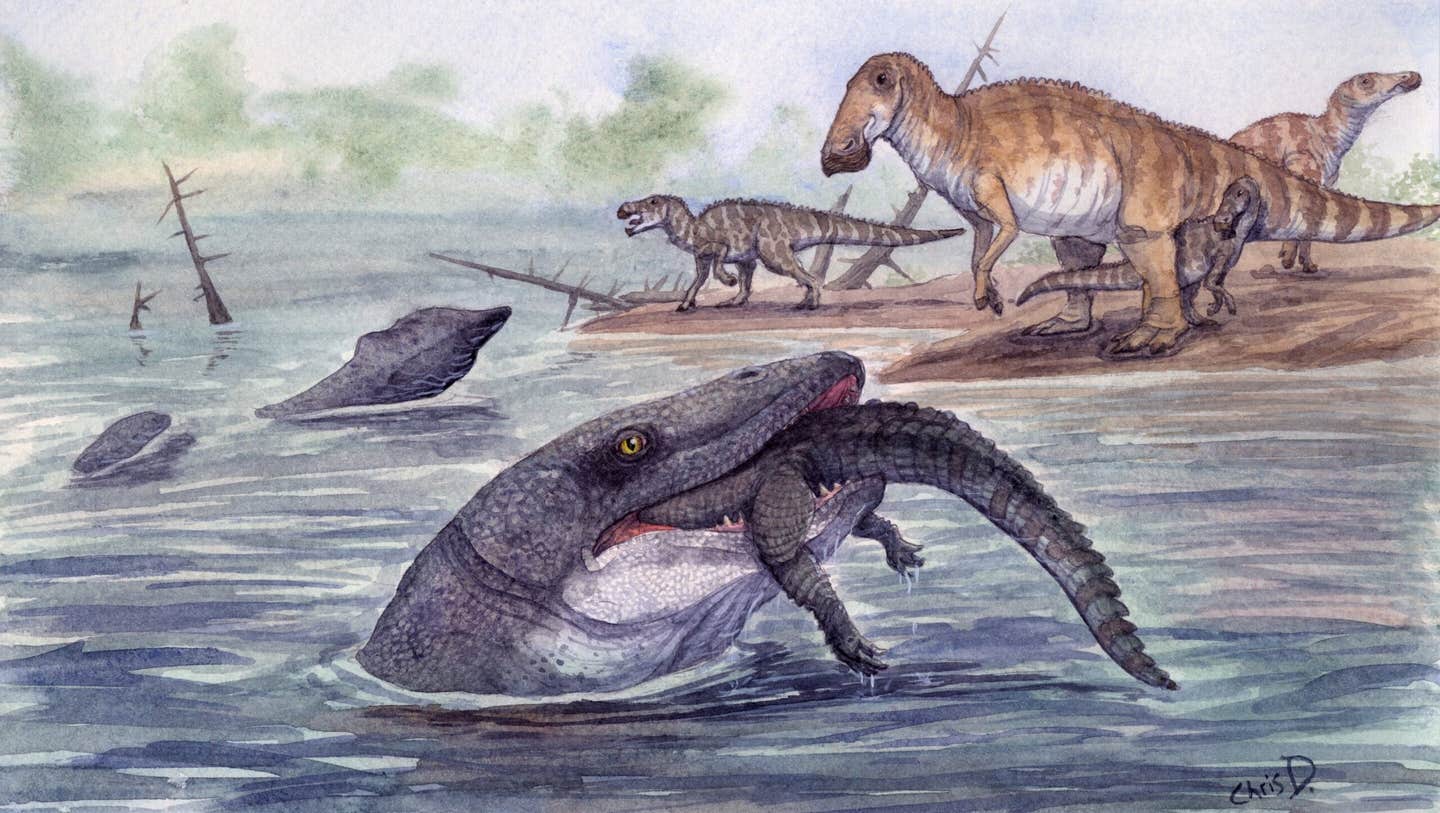
A single tooth found among dinosaur bones in North Dakota reveals that some of the largest sea reptiles also ruled ancient rivers. (CREDIT: Christopher DiPiazza)
At the end of the Cretaceous Period, a type of giant reptile called mosasaurs occupied and dominated oceanic food webs. Mosasaurs had long bodies and were related to both snakes and monitor lizards. They mostly roamed in the warm, shallow waters of the global ocean. In North America, mosasaurs flourished in what is known as the Western Interior Seaway, an inland ocean that dissected the continent. Because mosasaurs are represented primarily in the fossil record by marine deposits, we tend to think of them as animals that live only in saltwater environments.
All of these assumptions were thrown into confusion when, in 2022, the discovery was made in North Dakota when an oversized tooth belonging to a mosasaur in the Hell Creek Formation. The fossil (NDGS 12217) had not been recovered from marine sediment, but rather from sediments associated with river and floodplains, which were mixed in with dinosaur bones and freshwater animals.
Furthermore, there were no marine fossils associated with this discovery. These findings have led researchers to question whether mosasaurs had the ability to survive in freshwater environments throughout their life cycles, or perhaps migrate from saltwater to freshwater environments.
The Hell Creek Formation
The Hell Creek Formation is best known for containing many dinosaur species, such as Tyrannosaurus rex and Edmontosaurus, which had many different habitats in the low elevation landscape of the Hell Creek Formation, including rivers, soils and forests, as we see in today's environment, up until the time of the mass extinction event, approximately one million years before the extinction of the dinosaurs.
At the site of discovery, referred to as NDGS L4327, the rocks show overwhelming evidence that the rocks were deposited through a river versus deposited during coastal conditions. The mosasaur fossil tooth had been deposited at a carbon-rich mudstone layer, which would have been deposited and compacted as soil material was created and then subsequently buried again with the deposition of sand particles.
The sediments and rocks at this site (NDGS L4327), while located near the present-day location of the former shoreline of the Western Interior Seaway, are missing many other indicators of marine organisms (such as marine shell fossils). This detail plays a significant role in confirming the conclusion reached by researchers. The tooth could not simply have washed in from the ocean. Rather, the data may indicate a mosasaur that spent an appreciable time living in freshwater — contradicting long-held assumptions regarding where the animals may inhabit.
A Floodplain Filled with Predators and Prey
The fossil strata in which NDGS 12217 was located contain a mixture of disarticulated and fragmented bones, many of which appear disorganized. This implies that carcasses deteriorated and were consumed by scavengers prior to their being entombed. Bite marks and scratches indicate that carnivores fed on the remains. Therefore, this was not a peaceful burial ground, but rather a bustling floodplain habitat.
Among the fossil samples recovered were shed teeth from crocodilians such as Borealosuchus and Brachychampsa, collectively with teeth from theropod dinosaurs, including Tyrannosaurus rex. The mosasaur tooth was recovered from close proximity to a T. rex tooth, a crocodilian jaw fragment, and bones from Edmontosaurus. Collectively, these finds represent a river ecosystem capable of supporting large predators as well as large prey.
The condition of the mosasaur tooth is a pivotal aspect of this overall collection. The texture of its surface displays fine detail with very little surface rounding, therefore indicating that it was not transported a long distance by water. It also lacks any evidence indicating that it came from older, marine deposit layers below. Therefore, the most logical assumption is that this tooth was shed while the animal was still alive, within a freshwater environment.
This raises an important question. Was the mosasaur a rare visitor from the ocean or did it inhabit rivers as a regular occurrence? In order to ascertain this, scientists undertook an in-depth study of the mosasaur tooth and compared it to known reptiles of the same time period.
Determine the Animal Behind the Tooth
This specimen is a tooth crown with an overall height of just over 29 mm, with a slight curve and flattened nature. The entire crown region of this tooth has sharp front and back edges, but the tips have worn so much that they are rounded. The tooth enamel shows a distinct vined pattern due to the multiple fine ridges and wrinkles covering the entire enamel surface. Dinosaur teeth usually have obvious serrated teeth and have vastly different surface patterns than those present here.
Crocodilian teeth are similar to those of the tooth in that they are generally conical in shape, but their enamel is very smooth. For this tooth to be a crocodilian tooth, the dentist would have to have encountered a significantly larger-than-average individual whose anatomy was out of alignment with the typical growth patterns.
As a result, this tooth is most comparable to the teeth of the Prognathodontini group of mosasaurs. The teeth of the members of this group are strong and designed to crush and slice through large prey. Because there is only one tooth, the researchers refrained from naming a specific species. They classified the specimen as a prognathodontin mosasaur of undetermined species.
Using fossil comparisons with related species, the researchers estimated that the individual who lost this tooth might have been approximately 11 meters (35 feet) long, similar in size to modern killer whales and far greater than the other mosasaur species previously linked to freshwater habitats.
“Carbon isotopes in teeth generally reflect what the animal ate. Many mosasaurs have low ¹³C values because they dive deep. The mosasaur tooth found with the T. rex tooth, on the other hand, has a higher ¹³C value than all known mosasaurs, dinosaurs and crocodiles, suggesting that it did not dive deep and may sometimes have fed on drowned dinosaurs,” says Melanie During, PhD, at Uppsala University.
The Geochemistry to Establish the Habitat
Anatomy is not sufficient for determining the habitat of the creators of this tooth; thus, the research team employed geochemistry. Animal tooth enamel encodes chemical information not only from the water that supplied its body but also from its diet. The prehistoric tooth enamel was chemically analyzed for stable isotopes of oxygen, carbon and strontium. Researchers were able to use those isotopes to establish whether the animal lived primarily in bodies of salt or freshwater.
The isotopes indicated that the North Dakota mosasaur's tooth enamel values were closer in value to isotopes from dinosaur and crocodilian remains from the same site than they were to marine mosasaurs. Marine mosasaurs' oxygen and carbon isotope values tend to be much lower due to their behavior of feeding below the surface; however, the ND mosasaur's tooth enamel had much higher values and supports the hypothesis of a different lifestyle than that of marine mosasaurs.
Oxygen isotope values from the tooth enamel are closely associated with those from freshwater animals collected at the same location. The values of the ND mosasaur were significantly different than those associated with fossils found in marine or brackish deposits. The strontium isotope values from the ND mosasaur tooth provided another avenue of proof to support a freshwater lifestyle. The ocean water present during the late Cretaceous had a very narrow and easily distinguished strontium signature; the ND mosasaur tooth enamel strontium isotope values fell well outside that marine strontium signature range.
The combination of the provided data points pointing to a freshwater or estuarine environment and the idea that these two types of aquatic environments are layered (the surface layer is freshwater, while the bottom layer contains marine or saltwater) provides an excellent model for how the mosasaurs used to live and feed. Mosasaurs, like other land-dwelling mammals, would have been occupying the upper layer of the layered aquatic system.
What The Research Reveals
The research shows that mosasaurs were able to move from the ocean to a freshwater environment with relatively little change in their biology, as opposed to how difficult it can be for a species that has adapted to occupy a marine environment to make the switch to a freshwater one (e.g., river dolphins and saltwater crocodiles).
The new insights gleaned from the research will affect scientists' understanding of ancient ecosystems. Mohammed, and other top predators like mosasaurs, were able to move between the two types of systems more easily than previously thought.
As the climate continues to fluctuate in modern times, the ability of species to expand into new types of environments will be important for understanding how those animals will respond to a changing environment. The study will also help identify which species will be better able to adapt to changing environments in the future.
Research findings are available online in the journal BMC Zoology.
Related Stories
- Rare Antarctic fossil discovery has rocked scientific understanding of ancient marine reptiles
- 360 million-year-old sea predator found to be smaller and much stronger than once thought
- Oldest sea-going reptile unearthed in New Zealand - rewrites history of marine animals
Like these kind of feel good stories? Get The Brighter Side of News' newsletter.
Joshua Shavit
Writer and Editor
Joshua Shavit is a NorCal-based science and technology writer with a passion for exploring the breakthroughs shaping the future. As a co-founder of The Brighter Side of News, he focuses on positive and transformative advancements in technology, physics, engineering, robotics, and astronomy. Joshua's work highlights the innovators behind the ideas, bringing readers closer to the people driving progress.