NASA discovers the ‘puffiest’ two planets in our universe
TOI-791 hosts two giant super-puff planets whose ultra-low densities challenge current ideas about planet formation.

 Edited By: Joshua Shavit

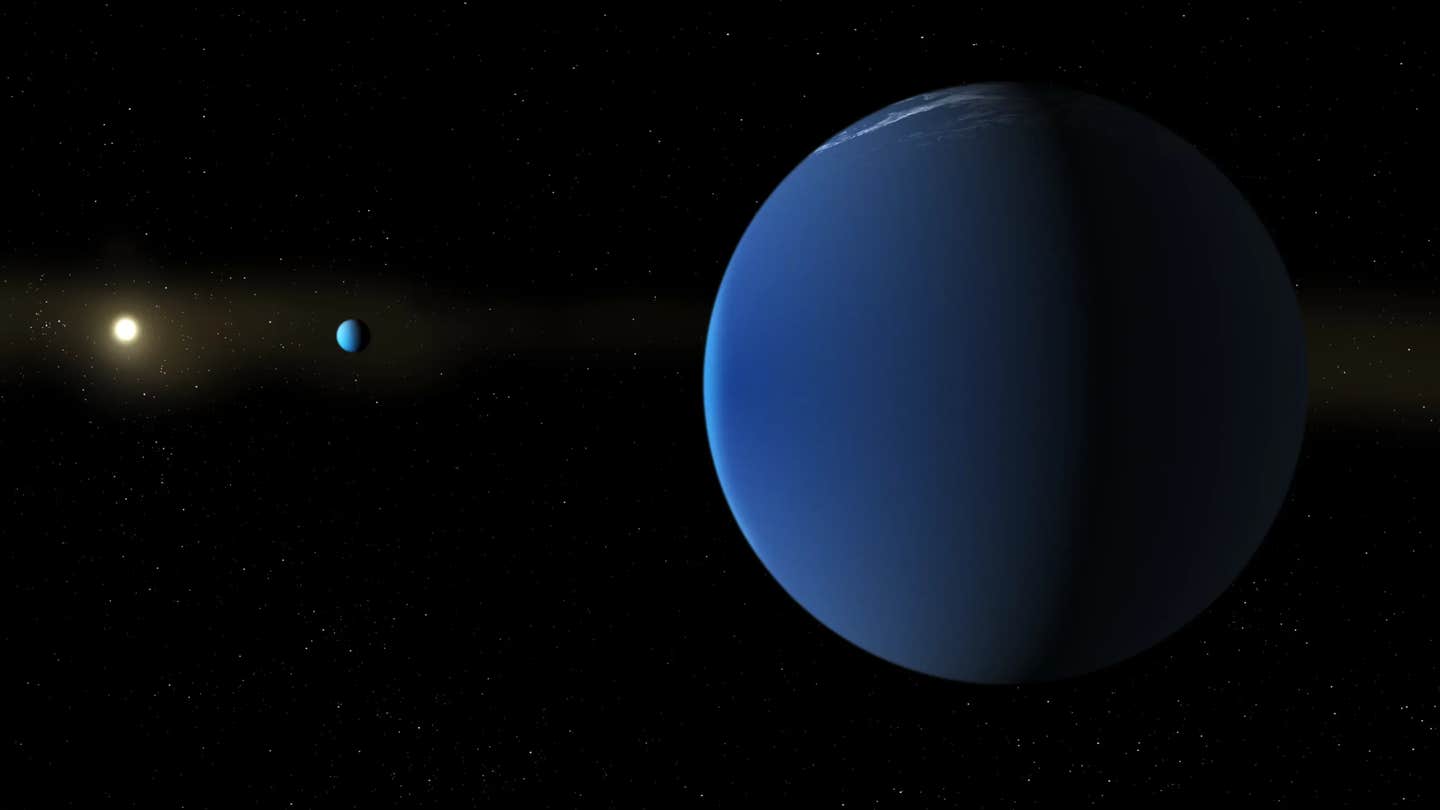
This illustration depicts the Sun-like star TOI-791 and two giant planets that NASA’s TESS space telescope discovered in its orbit. These planets, designated TOI-791 b and TOI-791 c, are roughly the size of Jupiter. (CREDIT: NASA / Daniel Rutter)
A pair of giant planets circling a star more than 1,100 light-years from Earth looks almost too bloated to be real. Each world is about the size of Jupiter. Yet both are far lighter than expected, with densities so low they fall into the rare class known as “super-puffs.”
That alone would make the system unusual.
What makes TOI-791 stranger is that it appears to host two of these swollen worlds at once. Both are on long orbits and both cross in front of their star. Additionally, both tug on each other strongly enough for astronomers to weigh them through subtle shifts in timing.
TOI-791 b and TOI-791 c
“The main reason these planets are interesting to study is that we didn’t expect to see them at all,” said Jon Jenkins, the science lead for the Science Processing Operations Center at NASA’s Ames Research Center in California’s Silicon Valley, which provided the science-ready data from TESS analyzed in this study. “They represent a puzzle for us to solve about how giant planets like Jupiter and the super-puffs form.”
The two planets, TOI-791 b and TOI-791 c, orbit an F7-type star called TOI-791. NASA’s Transiting Exoplanet Survey Satellite, or TESS, first spotted them by catching repeated dips in the star’s light. Those dips happen when a planet passes in front of its star from Earth’s point of view.
The star sits about 1,113 light-years away. TESS was able to watch it for an unusually long stretch because the system lies in the spacecraft’s southern Continuous Viewing Zone. Over seven years, the mission gathered 1,122 days of data on the star. This provided researchers an unusually rich record for a pair of slow-moving planets.
Giant worlds with almost no heft
TOI-791 b is nearly Jupiter’s size but has only 3.0 percent of Jupiter’s mass. TOI-791 c is even larger than Jupiter, yet has just 5.9 percent of Jupiter’s mass. The study reports densities of 0.061 and 0.106 grams per cubic centimeter. This makes them the largest planets yet found with densities below 0.1 grams per cubic centimeter.
Those numbers place them among the puffiest planets known.
“Only a handful of these super-puffy planets are known, and it is even rarer to find two in the same system,” said lead author George Dransfield of Oxford University’s Department of Physics in Oxford, England. “Their extremely low densities make them fascinating targets for understanding how planetary systems form and evolve.”
Their orbits are unusual too. TOI-791 b circles its star every 139 days, while TOI-791 c takes 232 days. Warm Jupiters that transit their stars are already uncommon, and pairs of transiting giant planets are rarer still. The team says TOI-791 is only the ninth known system with more than one transiting giant planet.
That scarcity is part of what makes the find valuable. Giant planets on wider orbits are harder to catch because they transit less often. They can also take many hours to cross their stars. In this case, TESS observations were combined with follow-up work from a long list of ground-based observatories. This included ASTEP in Antarctica, which is especially useful for long, infrequent transits.
A planetary tug-of-war
The two planets do not simply orbit in isolation. They are close to a 5:3 mean motion resonance, meaning their orbital periods nearly line up in a repeating pattern. That arrangement lets them pull on each other in a measurable way.
Instead of relying only on radial velocity data, the team used transit timing variations. These are small shifts in the moments when each planet crossed the star, used to pin down their masses. Planet b showed timing shifts of up to about 100 minutes across the observing baseline. Additionally, planet c also showed measurable variations.
Those timing signals matter because the star itself is not an easy one for radial velocity work. It rotates quickly, which broadens its spectral lines and makes it harder to detect the tiny stellar wobble caused by lightweight planets. Therefore, the timing method turned out to be the better route.
The result is a system where two huge planets seem to have very little material packed inside them. The authors say the evidence points to a circular orbital configuration for now. However, continued monitoring will be needed to refine the system’s full architecture and test whether small eccentricities are present.
Why these planets may exist at all
Super-puffs remain one of exoplanet science’s stranger categories. One idea is that they contain massive hydrogen-helium atmospheres, possibly making up a large share of their total mass. If so, they may have formed far from their star, where gas was abundant and conditions favored rapid atmospheric growth. Later, they may have moved inward.
Another proposal is that some super-puffs may not be unusually low-density worlds after all. Instead, they could be normal planets whose apparent size is inflated by optically thick rings seen nearly face-on.
TOI-791 does not settle that debate. But it adds a new and especially revealing case because both planets in the system occupy roughly the same strange territory. That makes it harder to dismiss the result as a fluke tied to one odd object.
The team also found strong hints that the planets may truly be locked in resonance. Their stability analysis suggests the system is tightly packed. Moreover, most of the modeled solutions from the timing analysis point to resonant behavior. That may help explain how two giant planets can survive in such a compact arrangement without destabilizing each other.
“Large planet formation is believed to drive the evolution of a planetary system, so further study of these Jupiter-size, but far less than Jupiter-mass, planets is of high value,” said Steve Howell, a NASA Ames research scientist who was involved in this study.
A rare laboratory for future observations
The system may prove unusually useful for follow-up work. Because both planets are large and pass in front of their star, astronomers could study their atmospheres with transmission spectroscopy. The paper notes that warm giant planets in this temperature range are promising targets because carbon-, nitrogen-, and oxygen-bearing species may all be detectable.
The planets could also help scientists probe how giant planets migrate, whether they formed farther out in the system, and how their present orbits were shaped. Other future tests could look at the tilt of the star relative to the planets’ orbits. Further, these could test even whether the planets’ spins make them measurably oblate.
For now, the discovery leaves astronomers with an unusually vivid mystery: not one cotton candy giant, but two, moving together in a gravitational dance that should help reveal how giant worlds are assembled.
Practical implications of the research
This system gives astronomers a rare chance to test competing ideas about how giant planets form, migrate, and hold onto thick atmospheres.
Because both planets transit and interact, future observations could improve their mass estimates, probe their atmospheric chemistry, and reveal whether super-puffs are truly bloated gas worlds or something more complicated.
The system also offers a way to study how closely packed giant planets stay stable over time, a question that matters far beyond this single star.
Research findings are available online in the journal Monthly Notices of the Royal Astronomical Society.
The original story "NASA discovers the 'puffiest' two planets in our universe" is published in The Brighter Side of News.
Related Stories
- The haziest planet we've ever seen won't give up its secrets
- JWST spots a lemon-shaped exoplanet orbiting a pulsar — rewriting the rules of planet formation
- Astronomers discover ultra-dense 'super-Earth' with the density of lead
Like these kind of feel good stories? Get The Brighter Side of News' newsletter.
Joseph Shavit
Writer, Editor-At-Large and Publisher
Joseph Shavit, based in Los Angeles, is a seasoned science journalist, editor and co-founder of The Brighter Side of News, where he transforms complex discoveries into clear, engaging stories for general readers. With vast experience at major media companies like The Los Angeles Times, Times Mirror and Tribune Publishing, he writes with both authority and curiosity. His writing focuses on space science, planetary science, quantum mechanics, geology. Known for linking breakthroughs to real-world markets, he highlights how research transitions into products and industries that shape daily life.