New, battery-like, device sucks carbon dioxide directly out of the air
Scientists develop a battery-like system that removes CO2 from air using electricity, offering a new path to fight climate change.

 Edited By: Joseph Shavit

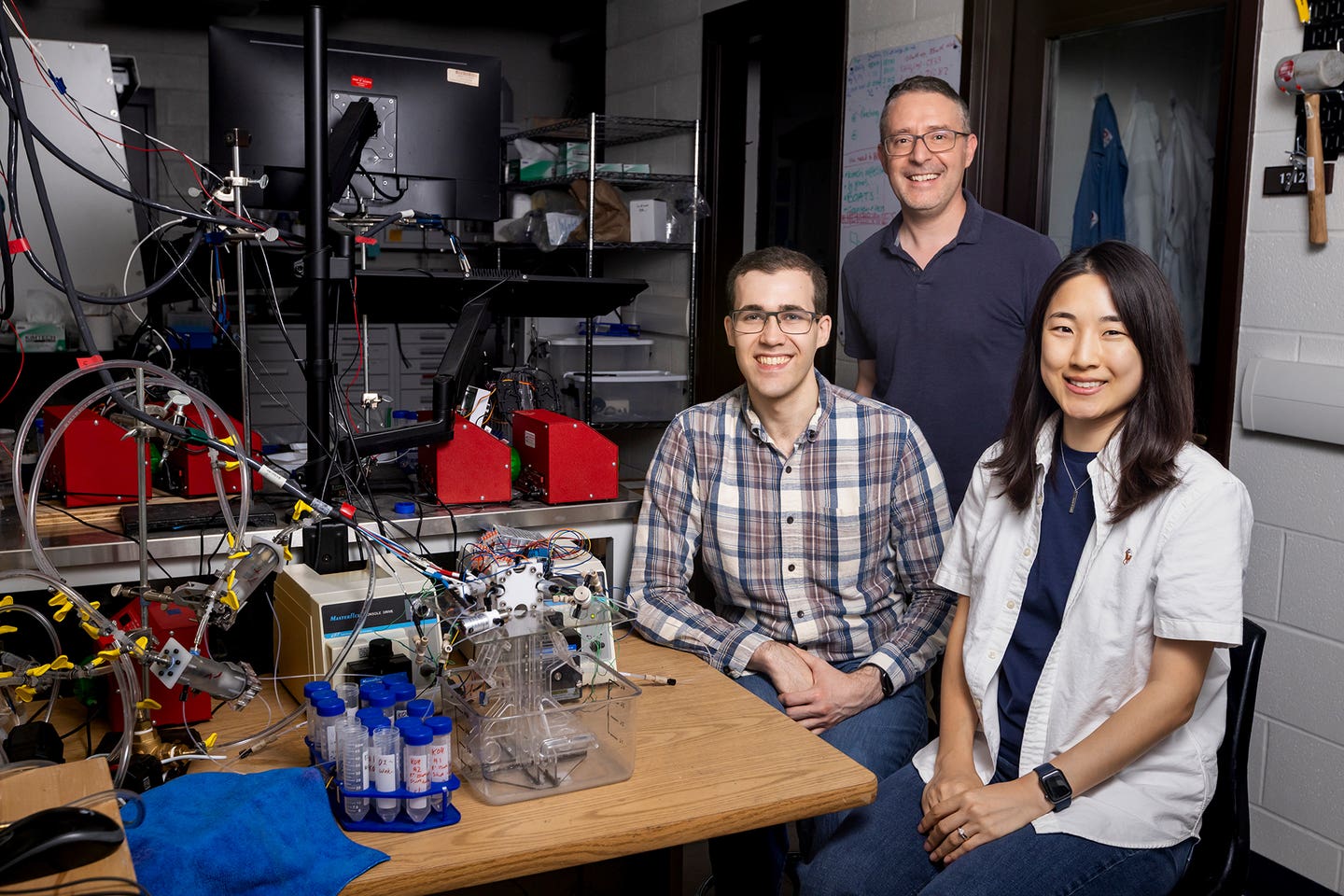
Mechanical Science and Engineering (MechSE) Associate Professor, Kyle Smith (middle) and PhD students, Paul Rozzi (left) and Jenna Lee (right), have developed a new battery-type device that can capture CO2 from the air. (CREDIT: Michelle Hassel)
- Researchers developed a battery-like electrochemical device that captures carbon dioxide directly from the air using electricity rather than heat.
- The system changes the acidity of a liquid to absorb and release CO₂, using potassium-stabilized manganese dioxide electrodes.
- Controlled fluid mixing reduced energy use from about 2.77 to 1.76 gigajoules per ton of CO₂ while slightly improving productivity.
- The technology worked in oxygen-rich air and produced concentrated CO₂, but it still needs higher productivity and better control of fluid mixing and gas leakage before large-scale use.
The fight against climate change is entering a new phase. Cutting emissions alone may not be enough to stabilize global temperatures. Scientists increasingly agree that removing carbon dioxide already in the air will also be necessary. A new study suggests that this goal may be closer than expected, using a device that works much like a rechargeable battery.
Researchers from the University of Illinois Urbana-Champaign and the Toyota Research Institute of North America have developed an electrochemical system that captures carbon dioxide directly from the air. Their work, published in Environmental Science and Technology, introduces a new approach that relies on electricity instead of heat.
A Growing Need For Carbon Removal
Carbon dioxide has built up in the atmosphere over decades. Even if emissions drop sharply, much of that gas will remain. This lingering carbon continues to trap heat and drive climate change.
Many current carbon capture methods focus on industrial sources, such as power plants. These systems work where carbon dioxide is concentrated. They cannot address the vast amount already spread across the atmosphere.
“Point source methods are important, but they don’t deal with the vast amount of CO2 already mixed into the air at much lower concentrations,” said Kyle Smith. “Our work is aimed at that legacy problem.”
Capturing carbon from open air is far more difficult. The gas exists at only about 400 parts per million. That low concentration makes removal both energy-intensive and expensive.
A Battery-Like Solution
The new system approaches the problem in a different way. Instead of heating chemicals to absorb and release carbon dioxide, it uses electricity to drive chemical changes in water.
The device functions in cycles, similar to charging and discharging a battery. During one phase, it prepares a liquid to capture carbon dioxide. In the next phase, it releases that gas in a concentrated form.
At the center of the process are special electrodes made from potassium-stabilized manganese dioxide. These materials allow the system to move charged particles, which in turn changes the acidity of the liquid.
When the liquid becomes more alkaline, it absorbs carbon dioxide from the air. When it becomes less alkaline, the gas is released. This repeating cycle allows continuous capture and release.
“What’s innovative about our work is that we use proton-intercalation electrodes in what we call a cation-compensated cell,” Smith said. “That design lets us operate in an alkaline range where CO2 is much more soluble, which is crucial for making direct air capture practical.”
Designing For Efficiency
To improve performance, the team treated the process like a thermodynamic cycle. Engineers often use such cycles to design power plants or engines.
Instead of focusing on pressure and temperature, the researchers mapped how carbon and ions move through the system. This approach helped them identify where energy was being lost.
“By framing our process as a thermodynamic cycle in this particular space, we could see where energy was being wasted and how to redesign the cycle,” said JeongA Lee.
This careful design allowed the system to reach competitive energy levels. Early tests showed energy use of about 2.77 gigajoules per ton of carbon dioxide. This is similar to other emerging technologies in the field.
Challenges With Fluid Mixing
Despite promising results, the system faces practical challenges. One of the biggest issues involves the movement of liquids inside the device.
The process relies on two separate streams of liquid. One captures carbon dioxide, while the other releases it. Ideally, these streams remain completely separate.
In practice, some mixing occurs when the flows switch. This blending reduces efficiency by weakening the difference between the two streams.
“Inter-stream mixing is one of the biggest issues we’re dealing with now,” said Paul Rozzi. “If we can limit that mixing or design around it, we can significantly improve both energy consumption and productivity.”
To address this, the team explored an unexpected strategy. Instead of trying to prevent mixing, they tested controlled premixing. This approach reduced the energy needed for each cycle.
The results showed a drop in energy use to about 1.76 gigajoules per ton. That represents a reduction of more than one-third. Productivity also increased slightly, showing a balance between efficiency and output.
Performance Under Real Conditions
The researchers also tested the system under realistic conditions. They used air that included oxygen, which makes up about one-fifth of the atmosphere.
The presence of oxygen did not significantly affect performance. This suggests the system could operate in real-world environments without major adjustments.
In another test, the team increased the concentration of carbon dioxide released from the device. Instead of releasing gas at low levels, they produced a more concentrated stream.
This higher concentration reduces the cost of later steps, such as compression and storage. It also makes the captured carbon more useful for industrial applications.
However, these conditions introduced new challenges. Higher pressures caused some gas to escape, reducing overall efficiency. The results highlight the trade-offs involved in scaling up the technology.
A Step Toward Scalable Solutions
The system remains in an early stage of development. Current productivity levels are still too low for large-scale use. Engineers must improve materials, increase reaction rates, and refine the design.
Even so, the research offers a clear direction. By combining electrochemistry with smart system design, it may be possible to create more efficient carbon capture devices.
“This type of early-stage research supports Toyota’s broader effort to explore innovative pathways toward long-term decarbonization,” said Chip Roberts.
Rethinking How Carbon Is Removed
This work reflects a broader shift in climate science. Instead of relying only on emission cuts, researchers are developing tools to actively remove carbon from the air.
Direct air capture technologies are still evolving. Each new approach adds to a growing set of options. Some use heat, others use chemical filters, and now some use electricity.
The battery-like system stands out because it operates at room temperature and uses widely available materials. It may also integrate more easily with renewable energy sources, such as solar or wind power.
Practical Implications Of The Research
This research could play an important role in future climate strategies. If scaled successfully, electrochemical capture systems could help remove large amounts of carbon dioxide from the atmosphere.
The technology may also reduce the cost of carbon removal. Lower energy use means lower operating expenses. This makes it more practical for widespread adoption.
In addition, the system preserves flexibility. Captured carbon dioxide can be stored underground or reused in products such as fuels or building materials.
The study also advances the broader field of electrochemistry. Insights from this work could apply to other areas, including energy storage and water treatment.
For society, the implications are significant. Removing carbon already in the atmosphere could help limit global warming and reduce the severity of climate impacts.
While challenges remain, the research shows that new solutions are emerging. With continued development, technologies like this could become a key part of the global response to climate change.
Research findings are available online in the journal Environmental Science & Technology.
The original story "New, battery-like, device sucks carbon dioxide directly out of the air" is published in The Brighter Side of News.
Related Stories
- Solar catalyst converts CO2 and organic waste into essential materials
- Researchers turn sunlight and CO2 into living biomass
- Rising CO2 levels threaten to disrupt global space communication
Like these kind of feel good stories? Get The Brighter Side of News' newsletter.
Shy Cohen
Writer