Astronomers may have finally detected a moon located outside our solar system
A Jupiter-mass object may orbit a brown dwarf in a strange three-tier system that blurs the line between moons and planets.

 Edited By: Joseph Shavit

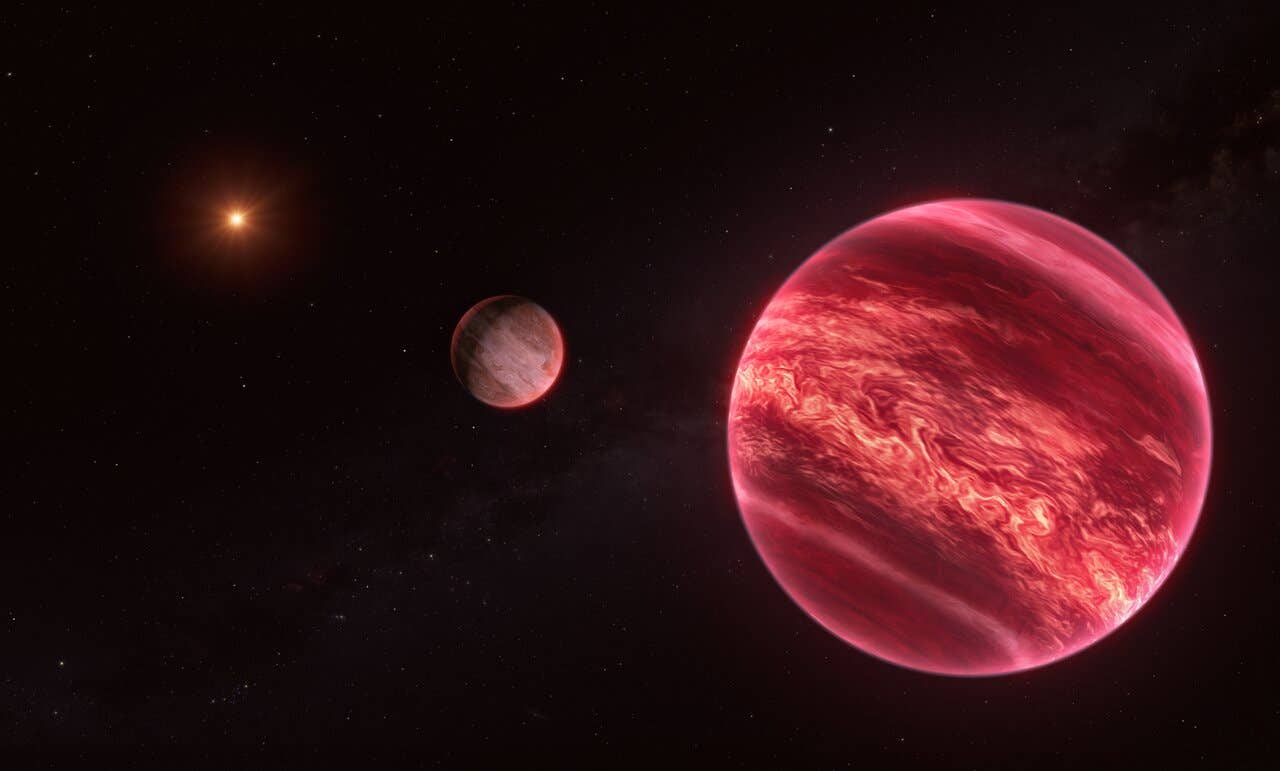
This illustration shows the system around the star CD-35 2722, with the newly found moon-like object at the centre. The star –– the point source to the left –– has about half the mass of our Sun, and it is orbited by a brown dwarf, the reddish-brown object seen here in the foreground (right). (CREDIT: ESO/M. Kornmesser)
- Astronomers detected a strong 170-day signal suggesting a Jupiter-mass object orbits the brown dwarf CD-35 2722 B.
- The candidate could be the first convincing exomoon found beyond our Solar System, though more observations are needed.
- Computer simulations favor one eccentric satellite over a less stable two-satellite system.
- The discovery blurs the definitions of moons, planets and brown-dwarf companions, and may require new astronomical labels.
A strange object may be circling a brown dwarf 65 light-years from Earth, creating a three-level system unlike anything confirmed beyond the Solar System. It could also force astronomers to rethink what counts as a moon.
The system, called CD-35 2722, contains a star with about 40 percent to half the Sun’s mass. That star is orbited by CD-35 2722 B, a brown dwarf roughly 37 times as massive as Jupiter.
Observations with the European Southern Observatory’s Very Large Telescope now suggest that another object orbits the brown dwarf. Its minimum mass is close to Jupiter’s, making it massive enough to resemble a planet.
Yet it does not orbit a star.
“Being the third wheel in this system makes us want to call it a moon, even if it is nothing like the small, rocky moons we have in our system,” said lead author Kevin Hoy, an ESO student in Chile. The findings were published in Nature.
A system that resists familiar labels
Brown dwarfs occupy the mass range between planets and stars. They are too massive to fit comfortably beside ordinary planets, but they cannot sustain the hydrogen fusion that powers stars.
CD-35 2722 B orbits its star at a projected separation of about 2.8 arcseconds. Its path appears highly elongated, with an eccentricity near 0.9 and an estimated orbital period of roughly 5,000 years.
The newly detected object appears to orbit that brown dwarf every 170 days. Its minimum mass is about 0.9 times Jupiter’s mass, although the true mass remains uncertain because the orbital inclination is unknown.
“This system is somewhat hard to define using Solar-System-based words like ‘planet’ and ‘moon’,” Hoy said. He is also affiliated with Universidad Diego Portales and the Millennium Nucleus of Young Exoplanets and their Moons in Chile.
The team uses the broader term “exosatellite.” That label describes a natural satellite outside the Solar System without settling whether the body should be called a moon or planet.
“The satellite we report is a giant gaseous body orbiting a highly massive companion, itself several times the mass of Jupiter,” said Alice Zurlo, director of the Chile-based research group and a collaborator on the study.
A 170-day wobble in the brown dwarf
Astronomers have searched for moons outside the Solar System for years, but no candidate has gained firm confirmation. More than 6,000 exoplanets have been identified, while possible exomoons remain rare and disputed.
The CD-35 2722 team used the CRIRES+ instrument on the Very Large Telescope between October 2023 and February 2026. They collected 26 observing epochs and retained 23 high-quality nights for analysis.
Because the brown dwarf sits far enough from its star, the instrument could record its spectrum without significant contamination from the brighter primary.
The team applied the radial velocity method, which searches for small shifts in an object’s motion. Those shifts can reveal the gravitational pull of an unseen companion.
A strong signal appeared near a 170-day period. It crossed the 0.1 percent false-alarm threshold in the team’s period analysis, indicating that the periodicity was unlikely to result from random noise.
The researchers then fitted orbital models to the data. One involved a single object on an eccentric orbit. The other included two satellites moving on nearly circular paths.
One satellite fits more naturally
The single-satellite model produced a period of about 170 days, a minimum mass near 0.9 Jupiter masses and an eccentricity of roughly 0.27.
The two-satellite model included one object with a similar period and mass, plus an inner companion orbiting in about 86 days. That arrangement placed the pair close to a 2-to-1 orbital resonance.
Radial velocity measurements alone could not clearly separate the two possibilities. A pair of circular orbits in resonance can imitate the signal created by one eccentric orbit.
Computer simulations, however, favored the simpler explanation.
The one-satellite system remained stable over long timescales. Most versions of the two-satellite model became chaotic, often ejecting one object within 500 years.
Only unusual configurations remained stable. The two satellites had to orbit within 20 degrees of the same plane while moving in opposite directions.
Because that arrangement appears harder to produce, the researchers consider the single eccentric satellite more likely. Additional observations are still needed to confirm the signal and refine its orbit.
Rotation is unlikely to explain the signal
Atmospheric activity on the brown dwarf could potentially create false velocity changes. Brown dwarfs may have clouds or large-scale circulation patterns that alter their brightness and spectra.
CD-35 2722 B, however, should rotate much faster than the observed 170-day signal. Earlier measurements place its maximum rotation period near 0.65 days.
The team found no strong velocity changes at that shorter timescale. Their period searches and noise models also failed to uncover a signal consistent with rotation.
Longer atmospheric or magnetic cycles cannot be completely excluded. Still, the required velocity effect would be far stronger than comparable activity signals observed in other objects.
“At a minimum, the apparent RVs of CD-35 B show strong periodicity,” the authors wrote. The pattern is well described by an eccentric Keplerian orbit, although follow-up data will determine whether that interpretation holds.
A moon, a planet or something new
The candidate’s classification presents a problem. The object orbits a brown dwarf, not a star, and has a minimum mass ratio of about 2.5 percent compared with its host.
That position at the bottom of a three-tier system supports a moon-like label. Its large mass, however, places it far outside the range of familiar moons.
Current definitions can classify planetary-mass objects orbiting brown dwarfs as planets. That approach does not account for the wider hierarchy of a system or the different environments created by stars and brown dwarfs.
The distinction may matter physically. As the system ages, the brown dwarf should become about 100 times less luminous, while the central star will continue radiating at roughly its present level.
Astronomers therefore may need a new category for large satellites around substellar objects. Future discoveries could reveal whether CD-35 2722 is unusual or part of a broader population.
Practical implications of the research
Confirming the signal would give astronomers their first strong example of a satellite orbiting a brown dwarf that itself orbits a star. It would also provide a new test for theories of moon, planet and binary formation.
The system’s eccentric architecture could help researchers examine how distant stellar gravity shapes satellite orbits. Continued radial velocity monitoring should distinguish the one-satellite model from the less stable two-object alternative.
ESO’s planned Extremely Large Telescope, with its 39-meter mirror, should detect smaller satellites and expand the available sample. More discoveries would allow astronomers to compare formation pathways, orbital stability and mass ratios across systems unlike the Solar System.
They may also force scientific language to catch up with the objects being found.
Research findings are available online in the journal Nature.
The original story "Astronomers may have finally detected a moon located outside our solar system" is published in The Brighter Side of News.
Related Stories
- Hydrogen atmospheres could keep exomoons habitable for billions of years
- Astronomers map the climate of Earth-like exoplanets for the first time
- Astronomers find thick water-ice clouds on Jupiter-like exoplanet Epsilon Indi Ab
Like these kind of feel good stories? Get The Brighter Side of News' newsletter.
Joshua Shavit
Writer and Editor
Joshua Shavit is a NorCal-based science and technology writer with a passion for exploring the breakthroughs shaping the future. As a co-founder of The Brighter Side of News, he focuses on positive and transformative advancements in technology, physics, engineering, robotics, and astronomy. Having published articles on AOL.com, MSN, Yahoo News, and Ground News, Joshua's work highlights the innovators behind the ideas, bringing readers closer to the people driving progress.