
New, cold-resistant, metal alloys tolerate extreme temperatures up to −253°C
Crystal twins and structural changes helped two experimental alloys resist cracking at 20 kelvin, suggesting a new design strategy.
 University of Oxford Writer: Caroline Wood

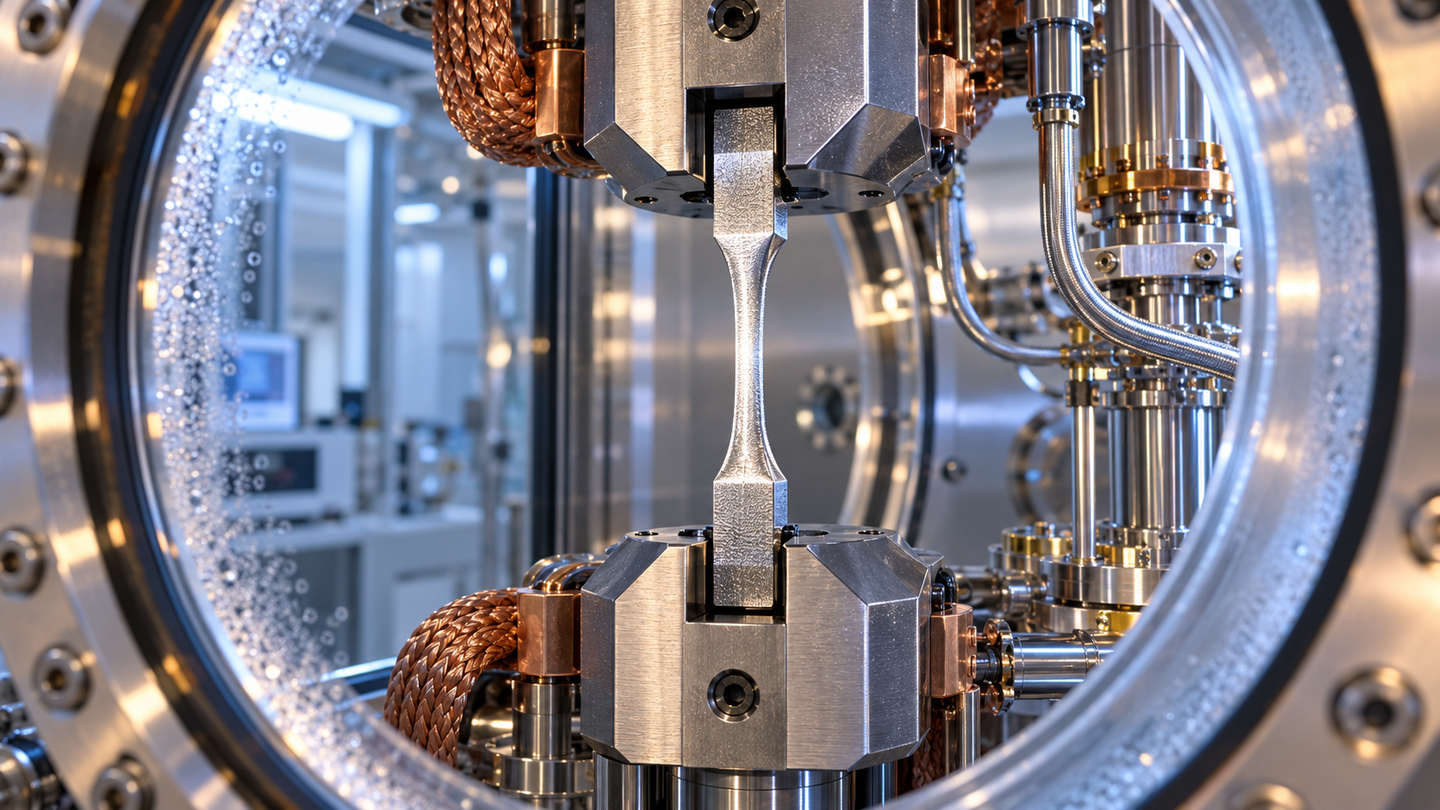
Two niobium-titanium alloys stayed tough at −253°C by generating new routes for deformation inside their crystal structures. (CREDIT: The Brighter Side of News)
- Two niobium-titanium-based alloys resisted cracking at 20 kelvin, with no measurable transition to brittle behavior down to that temperature.
- Nanoscale crystal twins and a local structural transformation helped generate new defects that allowed the metals to deform.
- The findings suggest a materials-design strategy for extreme cold, although the alloys still fractured and require further engineering evaluation.
A metal’s ability to bend can disappear in extreme cold, allowing a small crack to become a sudden fracture. Two experimental alloys have demonstrated a different response at just 20 kelvin, approximately −253°C. Their internal structures help create fresh routes for deformation when ordinary routes become difficult to use.
The findings, published in Nature, concern two niobium-titanium-based alloys. An international team led by the University of California, Berkeley, Lawrence Berkeley National Laboratory and the University of Oxford investigated their behavior. Neither alloy showed a measurable transition to brittle behavior down to the lowest temperature tested.
That does not mean cooling left their properties unchanged or made them impossible to break. Instead, the experiments revealed an unusual microscopic sequence that preserved substantial resistance to cracking. The result offers a possible design strategy for structural metals used in exceptionally cold environments.
Why strong metals can become brittle
Strength and toughness describe different qualities. Strength measures resistance to deformation, while fracture toughness describes resistance to crack initiation or growth. A metal can become stronger as temperatures fall while becoming less able to tolerate damage.
The problem affects many metals with a body-centered cubic crystal structure, including iron, tungsten and chromium. Their atoms occupy the corners of an imaginary cube, with another atom at its center. That arrangement influences how defects move when the material experiences a load.
These line-like defects, called dislocations, allow parts of a crystal to shift without breaking the entire structure. A particular type, known as a screw dislocation, depends strongly on thermal activation to move. Cooling can slow that movement, limiting deformation around a crack and making brittle failure more likely.
Traditional alloy-design strategies therefore often aim to make dislocations move more easily. The new work suggests another important consideration: whether a material can generate new dislocations where stress accumulates. That ability may help determine whether a cold metal deforms or fractures prematurely.
Testing two recipes in the deep freeze
One alloy contained niobium, tantalum, titanium and hafnium in atomic proportions of 45%, 25%, 15% and 15%. The second contained 70% niobium and 30% titanium. Comparing the two allowed the team to examine a chemically complex alloy alongside a simpler counterpart.
The researchers melted, forged, rolled and heat-treated the materials before testing them. They used the Engin-X instrument at the ISIS Neutron and Muon Source in Oxfordshire, cooling samples with gaseous helium. Neutron measurements accompanied mechanical loading, while separate fracture tests measured resistance as cracks extended.
At 20 kelvin, the four-element alloy began permanent deformation at about 939 megapascals, nearly matching its value at 77 kelvin. Its maximum tensile stress reached about 1,150 megapascals. However, its elongation before fracture fell by roughly half compared with the 77-kelvin result, showing that cold still affected performance.
Its crack-initiation toughness reached approximately 96.5 megapascals times the square root of a meter. Resistance rose as a crack extended, reaching a crack-growth toughness of about 118 in the same units. The simpler alloy had a crack-initiation toughness of approximately 170, compared with 188 at 77 kelvin and 219 near room temperature.
Crystal twins open another route
Electron microscopy revealed nanoscale regions called twins, where the crystal adopts a mirror-image orientation. These formed alongside a local transformation into a different atomic arrangement known as the omega phase. Together, the changes helped initiate deformation before conventional dislocation movement dominated the overall response.
The sequence matters because twinning does not always protect a metal. In other body-centered cubic materials, twins can concentrate stress where they meet grain boundaries, the interfaces between neighboring crystals. Those concentrations can initiate cracks rather than relieve the load.
In these alloys, the team observed something more useful at those intersections. Stress concentrations generated new dislocations, which allowed further deformation and delayed fracture. Subsequent movement of those defects helped the metal accommodate the applied force.
The process resembles opening alternative roads when familiar routes become blocked. Here, twins and structural changes help establish the sites where new deformation routes emerge. However, microscopy could not establish whether twinning or the omega transformation came first; the processes appear closely coupled.
Toughness comes with qualifications
The way the researchers loaded a sample changed how it eventually broke. Samples pulled in simple tension showed ductile fracture through the merging of microscopic voids. Precracked specimens experienced more constrained stresses near their crack tips and developed a mixture of ductile and brittle-looking features.
That distinction prevents an overly broad interpretation of the results. The alloys retained substantial damage tolerance, but the experiments did not eliminate cracking or every sign of brittle fracture. Nor does testing down to 20 kelvin establish behavior at still lower temperatures.
The main four-element alloy measurements also involved limited specimen numbers. The reported tensile comparisons used three tests, while fracture-toughness values represented means across two tests. Those results provide a benchmark, but broader testing would be needed to establish variability for engineering use.
The mechanism also should not be confused with self-healing. The observed structural changes help material around a crack accommodate stress; they do not restore broken metal. Preserving deformation capacity can delay failure even when a specimen eventually fractures under increasing load.
Atomic-scale chemistry introduced another complication. Atom-probe analysis found titanium and hafnium enrichment within roughly three nanometers of a measured grain boundary. Such local chemistry may help generate dislocations, but it can also encourage the omega phase, whose brittleness can contribute to damage.
A different starting point for alloy design
David Cook, the lead author, conducted the research at Berkeley and is now at Cambridge. “Traditionally, the focus was on how readily existing dislocations can move through a metal,” he said. The results suggest that creating new dislocations at interfaces deserves attention alongside their subsequent movement.
Oxford corresponding author Dong Liu described the work as a pathway toward structural metals for extreme cryogenic environments. Potential uses span energy, transport and aerospace, where components may encounter demanding temperatures. The present experiments establish a mechanism and laboratory performance rather than qualification for a particular component.
Finding the same broad response in both alloys also suggests that chemical complexity alone does not explain their resilience. Their ability to combine twinning, structural transformation and dislocation generation appears more important. Designing how these processes interact could help engineers preserve toughness when ordinary deformation mechanisms become difficult to activate.
Dig deeper into metals that withstand extreme cold
These studies examine cryogenic toughness, refractory alloys and the microscopic processes that control deformation.
Kink bands promote exceptional fracture resistance in a NbTaTiHf refractory medium-entropy alloy: Earlier work on the four-element alloy connects its fracture resistance across a broad temperature range with several deformation mechanisms. (Science, 2024)
Exceptional fracture toughness of CrCoNi-based medium- and high-entropy alloys at 20 kelvin: Examines exceptional cryogenic toughness in alloys with a different crystal structure, providing a useful comparison. (Science, 2022)
Electronic descriptors for dislocation deformation behavior and intrinsic ductility in bcc high-entropy alloys: Investigates how electronic structure relates to deformation and ductility in body-centered cubic alloys. (Science Advances, 2024)
Intrinsic factors responsible for brittle versus ductile nature of refractory high-entropy alloys: Combines experiments and modeling to investigate why some refractory alloys deform while others break. (Nature Communications, 2024)
Exceptional damage-tolerance of a medium-entropy alloy CrCoNi at cryogenic temperatures: Documents the combination of strength, ductility and fracture resistance in a three-element alloy at low temperatures. (Nature Communications, 2016)
Research findings are available online in the journal Nature.
The original story "New, cold-resistant, metal alloys tolerate extreme temperatures up to −253°C" is published in The Brighter Side of News.
Related Stories
- Scientists discover why rain drops can damage metal protective coatings
- Laser-heated electrons can reshape metals in a billionth of a second
- Scientists propose simple new way to spot alien life in the universe
Like these kind of feel good stories? Get The Brighter Side of News' newsletter.
Joshua Shavit
Writer and Editor
Joshua Shavit is a NorCal-based science and technology writer with a passion for exploring the breakthroughs shaping the future. As a co-founder of The Brighter Side of News, he focuses on positive and transformative advancements in technology, physics, engineering, robotics, and astronomy. Having published articles on AOL.com, MSN, Yahoo News, and Ground News, Joshua's work highlights the innovators behind the ideas, bringing readers closer to the people driving progress.