UCF researchers discover an unusual magnetic state that could reshape future electronics
Opposite electron spins separate without creating a net magnetic field in a newly confirmed layered altermagnetic material.
 UCF Writer: Margot Winick

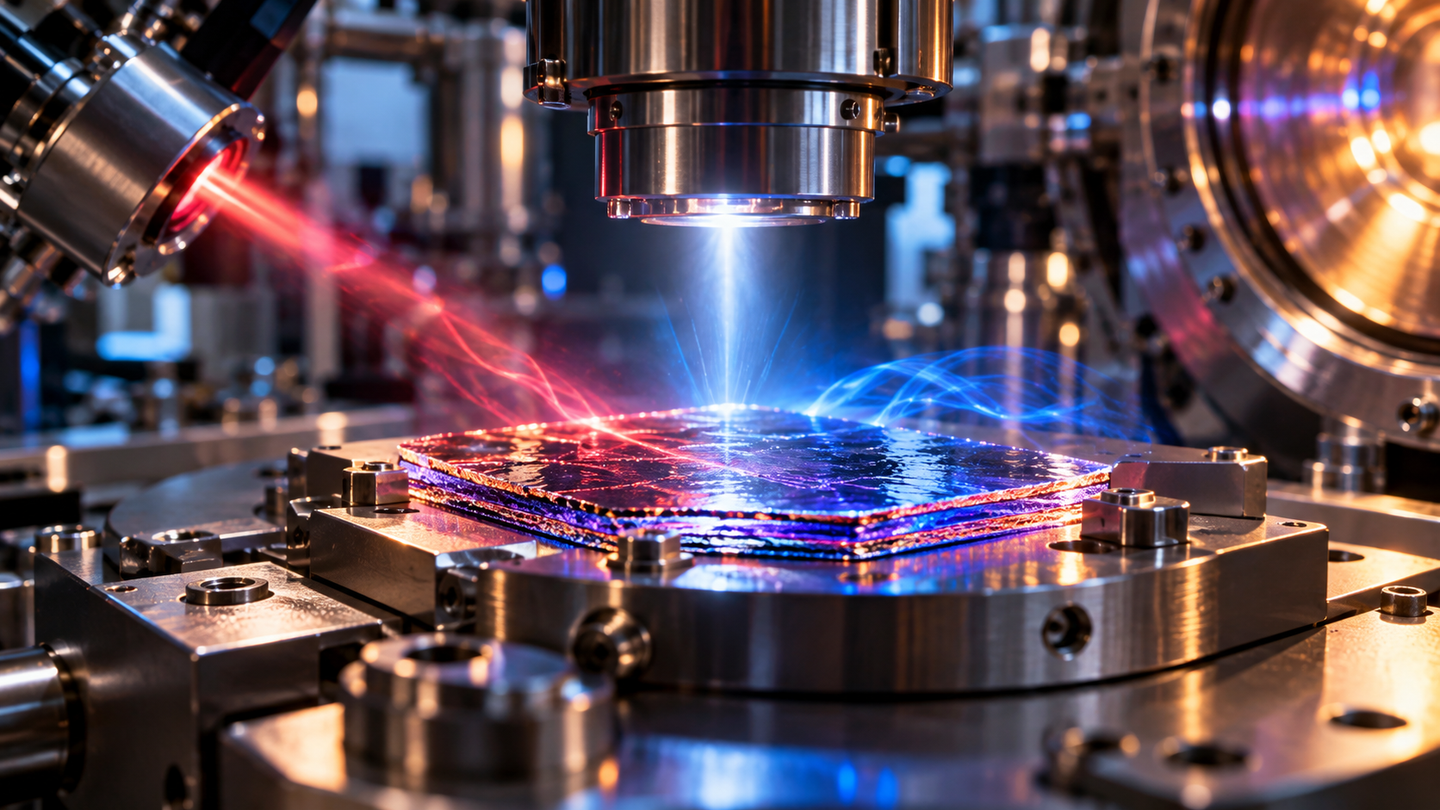
Scientists directly observed altermagnetic spin splitting in a layered material that could become a platform for future spintronics. (CREDIT: Shutterstock)
- Scientists have directly observed momentum-dependent spin splitting in Co₁/₄TaSe₂, providing experimental evidence that the layered material hosts an unusual magnetic state known as altermagnetism.
- Spin-resolved measurements showed that electrons with opposite spins separate and reverse polarization across momentum space even though the material has no overall magnetization.
- Because Co₁/₄TaSe₂ belongs to a family of layered materials that can be thinned and combined into heterostructures, it could become a useful platform for studying future spin-based electronics, although practical devices remain a longer-term goal.
The computers of the future may move information using more than the electrical charge of electrons. A rapidly developing field called spintronics aims to exploit another fundamental property, electron spin, to create devices that could operate with less energy while processing information at extremely high speeds.
A newly studied material may give researchers an unusually flexible way to explore that possibility. Scientists led by the University of Central Florida have found strong experimental evidence for altermagnetism in Co₁/₄TaSe₂, a layered compound made from cobalt, tantalum and selenium.
Altermagnetism combines characteristics normally divided between ferromagnets and antiferromagnets. The result is a material with no large overall magnetic field but with strongly spin-dependent electronic states that could potentially be used to move and manipulate information.
The findings, published in Nature Communications, establish Co₁/₄TaSe₂ as a new experimental platform for investigating a form of magnetism that has moved rapidly from theoretical prediction to laboratory observation.
A third route through magnetism
Ferromagnets are the materials behind familiar permanent magnets. Their microscopic magnetic moments tend to align in the same direction, creating an overall magnetization. That property is valuable for storing and reading information, but the magnetic fields extending outside the material can interfere with nearby components.
Traditional antiferromagnets solve part of that problem. Their neighboring magnetic moments point in opposing directions, largely canceling the overall field. This makes them attractive for densely packed electronics, although their lack of net magnetization can also make their internal state difficult to control and detect.
Altermagnets occupy an unusual middle ground. Their magnetic moments also compensate, producing essentially no net magnetization, but the symmetry of their crystal allows electrons with opposite spins to occupy different energy states depending on their momentum.
That spin splitting resembles an important property of ferromagnets without requiring a permanent macroscopic magnetic field.
“These materials are distinguished from more conventional antiferromagnets by their ability to generate and detect spin currents without the negative effect of producing stray fields,” UCF physicist Madhab Neupane said.
Researchers mapped the electrons directly
To test Co₁/₄TaSe₂, the researchers used angle-resolved photoemission spectroscopy, commonly called ARPES. The technique shines photons onto a material and measures electrons emitted from its surface, allowing scientists to reconstruct the relationship between their energy and momentum.
Measurements were conducted well below the material’s magnetic transition temperature of 178 kelvins. At low temperature, the cobalt moments form an ordered magnetic arrangement in which spins align within individual layers but point oppositely between neighboring layers.
Initial ARPES measurements revealed a characteristic splitting of the electronic bands. The size of that separation depended on the direction in momentum space and closely matched calculations based on density functional theory.
The researchers then used spin-resolved ARPES to determine whether the apparently separated bands genuinely carried different spin states.
They did. Across one prominent electronic feature, the measured spin polarization changed from approximately negative 13% to positive 13%. The dominant spin therefore flipped as researchers moved through momentum space, matching the alternating pattern predicted for an altermagnet.
“Our approach was to use higher-resolution methods that were insensitive to the electron’s spin to measure the splitting in the energy levels,” Neupane said. “Then, we complemented this measurement with spin-resolved ARPES to conclusively tell if this looks like altermagnetism.”
A six-fold spin pattern emerged
The electronic structure displayed what physicists call g-wave altermagnetic splitting. Rather than separating into simple regions of spin-up and spin-down electrons, the spin character alternates six times as momentum changes around the material’s electronic structure.
Certain symmetry directions remained spin-degenerate, meaning electrons of opposite spin retained the same energy there. Move away from those directions, however, and the splitting increased.
Temperature experiments provided another test. The researchers compared the material at 7 kelvins, deep within its magnetically ordered phase, with measurements at 200 kelvins, above its 178-kelvin transition temperature.
The distinctive low-temperature electronic features weakened or disappeared above the transition. Cooling the sample again restored them, connecting the observed band reconstruction to the magnetic ordering rather than to an unrelated feature of the crystal.
“The significance became clear once the experimental measurements consistently matched our theoretical predictions,” Neupane said. “Seeing those independent pieces of evidence converge gave us confidence that we had identified a genuine layered altermagnet.”
Layers make this material particularly useful
Co₁/₄TaSe₂ belongs to the transition-metal dichalcogenide family, a group of materials whose atomic layers are held together by comparatively weak van der Waals forces.
That structure is attractive because researchers can potentially separate thin layers or stack them with other materials. Similar approaches have produced artificial structures with electronic, magnetic, superconducting and topological properties unavailable in conventional bulk materials.
In Co₁/₄TaSe₂, cobalt atoms occupy spaces between tantalum-selenide layers. Those cobalt atoms supply magnetism while also interacting with the electrons responsible for conduction.
The researchers found evidence that the magnetism is neither completely localized on individual cobalt atoms nor completely spread through the material. Instead, the system appears to sit between those extremes, with cobalt electrons contributing substantially to the electronic states near the Fermi level.
That combination could make the compound useful for studying how altermagnetism interacts with superconductivity, topological electronic states and deliberately engineered interfaces.
Device applications remain a future goal
Spintronics aims to encode or transmit information using electron spin rather than relying entirely on moving electrical charge. In principle, altermagnets could provide fast spin dynamics, strong spin-polarized currents and minimal stray-field interference.
Those characteristics have led researchers to discuss possible applications ranging from high-density memory to terahertz electronics. Co₁/₄TaSe₂, however, is not yet a working electronic component, and its magnetic ordering temperature of 178 kelvins remains well below room temperature.
Scientists still need to determine how reliably its magnetic state can be switched, read and controlled in thin devices. They also need to understand how the material behaves when reduced to only a few layers or combined with other quantum materials.
For now, its importance lies in offering a highly tunable laboratory for answering those questions. Altermagnetism is still a young field, but layered compounds such as Co₁/₄TaSe₂ could help bridge the gap between discovering the phenomenon and learning whether it can eventually become useful technology.
Dig deeper into altermagnetism and spintronics
These recent studies and reviews provide broader context on the rapid experimental development of altermagnetic materials and their potential use in spin-based electronics.
Altermagnetic spintronics: This recent review examines how altermagnets could generate spin-polarized currents without net magnetization and discusses their prospects for scalable memory, superconducting interfaces and ultrafast spintronics. (Nature Physics, 2026)
Symmetry, microscopy and spectroscopy signatures of altermagnetism: This comprehensive review explains the symmetry principles behind d-wave, g-wave and other altermagnetic states while surveying the experimental techniques used to identify them. (Nature, 2026)
Altermagnetism, kagome flat band, and Weyl fermion states in magnetically intercalated transition metal dichalcogenides: Researchers explore how magnetically intercalated layered materials can combine altermagnetism with flat electronic bands and topological Weyl states. (npj Quantum Materials, 2026)
Three-dimensional mapping of the altermagnetic spin splitting in CrSb: Spin-resolved ARPES revealed large momentum-dependent splitting in CrSb, providing a powerful experimental comparison for identifying altermagnetic electronic structures. (Nature Communications, 2025)
Nanoscale imaging and control of altermagnetism in MnTe: Researchers directly imaged altermagnetic domains, vortices and domain walls and demonstrated ways to control their organization at nanoscale dimensions. (Nature, 2024)
Research findings are available online in the journal Nature Communications.
The original story "UCF researchers discover an unusual magnetic state that could reshape future electronics" is published in The Brighter Side of News.
Related Stories
- Scientists reveal how quantum electron spin can create magnetism
- Superconductivity and magnetism can co-exist in some materials, MIT study finds
- Scientists confirm long-theorized idea - discover metallic material displaying 1D magnetism
Like these kind of feel good stories? Get The Brighter Side of News' newsletter.
Shy Cohen
Writer