Scientists discover why rain drops can damage metal protective coatings
Water droplets can build electrical charge as they move, creating tiny discharges that puncture coatings and expose metal to corrosion.
 MPIP Writer: Christian Schneider

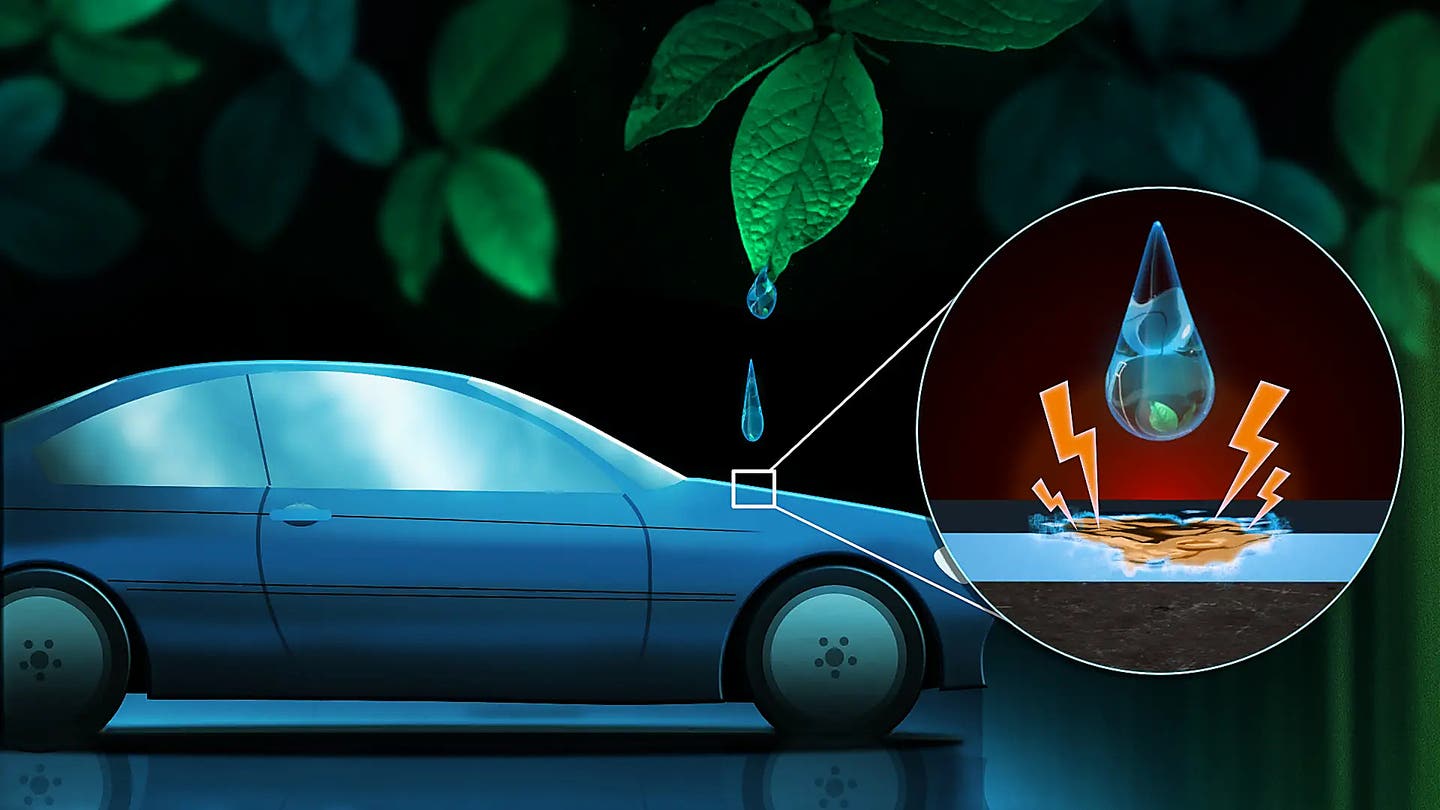
Drops can become electrically charged as they slide across surfaces. If they then fall onto a coating—such as on a car—the coating can be corroded by the drop’s electrical discharge and permanently damaged. (CREDIT: Katharina Maisenbacher / MPI-P)
- Water droplets can become electrically charged as they slide across surfaces, sometimes reaching electrical potentials of thousands of volts.
- Experiments found that charged droplets damaged protective coatings after 3,000 impacts, while otherwise identical neutral droplets left the coating unchanged.
- The electrical discharge can puncture insulating coatings, expose the metal underneath and begin a corrosion process that worsens with repeated contact.
A garden fence that needs another coat of paint usually looks like a familiar case of weather taking its toll. Rain, moisture and years of exposure gradually weaken the barrier protecting the material underneath. The same basic problem affects much larger structures, where maintaining protective coatings can become an expensive and time-consuming job.
Water may be doing more than simply wearing those coatings down or attacking them chemically. Droplets can pick up an electrical charge as they move across a surface, then release that charge when they reach coated metal. The resulting electrical breakdown can punch microscopic holes through the protective layer and expose the metal beneath to corrosion.
Researchers led by Hans-Jürgen Butt at the Max Planck Institute for Polymer Research identified the process in experiments published in Nature. The work involved collaborators from the University of Bonn, South China University of Technology, MIT and Johannes Gutenberg University Mainz.
Water droplets can charge themselves
Scientists have generally focused on two ways that water damages protective coatings. Moving droplets can cause physical abrasion, while salts, acids and other substances dissolved in water can chemically degrade a surface. The new findings add a third mechanism: electricity generated by the droplets themselves.
Water can spontaneously become charged when it moves across an insulating surface. Known as slide or contact electrification, the process leaves an opposite charge behind on the material. Depending on the surface and other conditions, the electrical potential carried by the droplet can reach several thousand volts.
“A few years ago, we investigated the physics behind how water droplets become charged as they slide across surfaces. This is a kind of ‘friction electricity’ in droplets and is physically much more complex than previously assumed,” said Rüdiger Berger, group leader in the Max Planck institute’s Physics at Interfaces department.
The researchers wanted to know whether that accumulated charge could damage the coatings used to protect metals from corrosion.
3,000 droplets reveal the difference
The team began with electrically neutral water droplets falling directly onto copper covered by a 60-nanometer-thick Teflon film. They released 35-microliter droplets containing sodium chloride every 12 seconds. After 3,000 impacts, microscopy showed no notable change. The coated surface remained flat and smooth.
They then changed one part of the experiment. Before hitting the Teflon-coated copper, droplets slid four centimeters down one of four inclined surfaces: a Tradescantia spathacea plant leaf, PVC foam board, polystyrene glass or fluorinated quartz.
That short trip was enough to electrically charge the water. Depending on the surface, droplets carried between about 0.2 and 2 nanocoulombs before striking the coating.
After 3,000 charged droplets hit the copper, microscopy revealed damage in every case. Atomic force microscopy found hole-like defects that penetrated the Teflon coating and extended into the copper underneath.
“The charge a droplet acquires as it slides depends heavily on the specific surface—we measured differences of up to a factor of ten,” said first author Zhongyuan Ni. “Regardless of this, we were able to detect changes in the coating in all experiments.”
A microscopic electrical breakdown
High-speed video provided another clue to what was happening. Electrically neutral droplets kept a smooth, curved shape as they approached the coated surface. Charged droplets behaved differently. Their lower surface stretched into a cone shortly before contact.
The researchers linked that deformation to the strong electric field forming between the charged water and the metal. The effect resembles the cone formation seen when electrical forces become strong enough to overcome the surface tension of a liquid.
Measurements also showed where the charge went. A droplet that had moved across fluorinated quartz carried about 2 nanocoulombs before impact. When it struck the Teflon-coated copper, about 1.8 nanocoulombs transferred into the copper. After the droplet left, only about 0.016 nanocoulombs remained.
The team concluded that the discharge can cause dielectric breakdown, the failure of an insulating material under a strong electrical field. In this case, the charged droplet and metal beneath the coating behave like two electrodes. As the gap between them shrinks, the electric field grows stronger until the protective layer can fail.
Calculations indicated that droplets carrying nanocoulomb-scale charges could break down many insulating coatings several micrometers thick. Each event can produce extremely small damage, but repeated discharges allow those defects to accumulate.
Damage spreads beyond a tiny hole
Teflon was not the only material affected. The researchers tested polystyrene coatings of several thicknesses on copper, polystyrene on gold and a silicon dioxide coating on gold. Charged droplets produced similar damage, suggesting the process is not limited to one particular coating or metal.
Longer experiments showed how the problem could grow. After 10,000 charged-droplet impacts, measurements indicated that the protective barrier of Teflon-coated commercial copper foil had deteriorated. After roughly 50,000 impacts, corrosion areas larger than one millimeter appeared.
Chemical analyses identified cuprous oxide and basic copper chloride among the corrosion products. Once electrical breakdown opened the coating, water gained direct access to the metal. Additional droplets enlarged the damaged regions and encouraged further electrochemical corrosion.
The researchers also found that droplets did not have to fall onto a surface to cause damage. In another experiment, water slid across quartz and copper hidden beneath a continuous Teflon coating. After 3,000 droplets, a trench-like defect developed along the buried boundary between the two materials. Sliding alone had produced a localized electrical discharge.
Rethinking how coatings face the weather
Charged droplets can form in natural settings that include clouds, thunderstorms, ocean waves, fountains and waterfalls, or when water moves across hydrophobic materials. Similar droplets also occur during industrial processes such as electrostatic spraying, inkjet printing and chemical or pharmaceutical production.
The findings do not replace the established roles of physical abrasion and chemical attack. Instead, they identify another route by which repeated water exposure can weaken a protective surface. A coating that withstands friction and corrosive chemicals could still face damage if charged water creates an electrical field strong enough to puncture it.
The researchers hope the work will help guide the development of coatings that better resist this kind of electrical damage. Such materials could have implications for structures, vehicles, industrial equipment and cultural heritage exposed to water over long periods.
A falling or sliding droplet may look harmless. At the microscopic level, however, its electrical charge can make its encounter with a coated metal surface resemble a tiny flash of lightning.
Dig deeper into charged water dropletsand protective coatings
These resources explore how moving water becomes electrically charged, what controls that charge and how rain and repeated droplet impacts affect protective materials.
Liquid slide electrification: advances and open questions: This review examines the physics of charge separation when water droplets move across insulating surfaces, including how droplet potentials can reach kilovolt levels and how electrification affects wetting and droplet motion. (Soft Matter, 2025)
Spontaneous Charging from Sliding Water Drops Determines the Interfacial Deposition of Charged Solutes: This study found that the electric fields created during slide electrification can change how dissolved charged substances deposit on a surface, showing that droplet charging can influence more than just motion and wetting. (Advanced Materials, 2025)
How Surface and Substrate Chemistry Affect Slide Electrification: Researchers examined how both surface coatings and the materials underneath them affect the electrical charge acquired by moving water droplets, helping explain why different surfaces produce very different levels of electrification. (Journal of the American Chemical Society, 2024)
Control of spontaneous charging of sliding water drops by plasma-surface treatment: The research shows that plasma treatment can either reduce or increase the charge acquired by sliding water droplets depending on how the surface is treated, pointing toward possible ways to control slide electrification through material design. (Scientific Reports, 2024)
Recent Progress in the Development and Evaluation of Rain and Solid Particle Erosion Resistant Coatings for Leading Edge Protection of Wind Turbine Blades: This review examines how rain and particle impacts damage polymer protective coatings and surveys materials, testing methods and coating strategies developed to improve erosion resistance. (Polymer Reviews, 2024)
Research findings are available online in the journal Nature.
The original story "Scientists discover why rain drops can damage metal protective coatings" is published in The Brighter Side of News.
Related Stories
- Old World War wrecks are still leaking TNT into the North Sea
- Scientists discover atomic shield that keeps gold from tarnishing
- Breakthrough technology harnesses clean energy from falling rainwater
Like these kind of feel good stories? Get The Brighter Side of News' newsletter.
Joshua Shavit
Writer and Editor
Joshua Shavit is a NorCal-based science and technology writer with a passion for exploring the breakthroughs shaping the future. As a co-founder of The Brighter Side of News, he focuses on positive and transformative advancements in technology, physics, engineering, robotics, and astronomy. Having published articles on AOL.com, MSN, Yahoo News, and Ground News, Joshua's work highlights the innovators behind the ideas, bringing readers closer to the people driving progress.