New fuel-cell catalyst could power next-generation data centers
Radial carbon channels kept platinum-cobalt particles small, ordered and active through punishing fuel-cell durability tests.
 Washington University in St. Louis Writer: Talia Ogliore

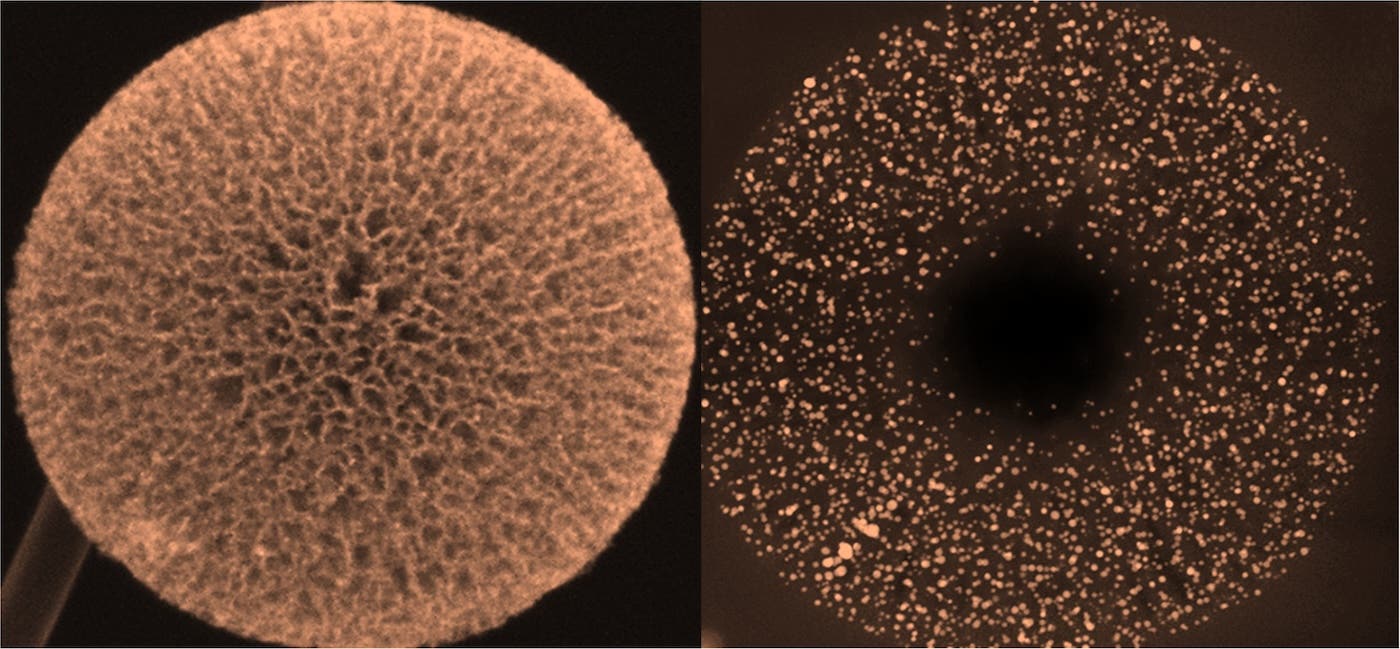
A fuel cell catalyst for data centers retained 82.5% performance after 150,000 cycles while using stable platinum-cobalt particles. (CREDIT: Wu lab)
- A new fuel-cell catalyst kept 82.5% of its performance after 150,000 voltage cycles, while preventing tiny platinum-cobalt particles from clumping together.
- Hollow carbon spheres with narrow, outward-facing channels allowed the catalyst to withstand extreme heat and form a more stable atomic structure.
- The design could support longer-lasting fuel cells for heavy vehicles, aviation and data centers, although more development and industry testing remain necessary.
Data centers are becoming hungry neighbors on the U.S. power grid. By 2030, they could consume up to 9% of the nation’s annual electricity generation, more than double their 2023 share.
That rising demand has intensified the search for power sources that can operate efficiently without adding more strain to the grid. A new fuel-cell catalyst developed by a multi-institutional research team could help address that problem.
The work, led by Gang Wu at Washington University in St. Louis, appears in Nature Nanotechnology. The group included researchers from Brookhaven National Laboratory, Lawrence Berkeley National Laboratory, Northeastern University and the University of Pittsburgh.
“If a data center is able to supply its electricity itself by using a fuel cell, it would directly convert hydrogen and other fuels into the electricity, reducing the burden on the energy grid,” Wu said.
A costly catalyst with a durability problem
Proton-exchange membrane fuel cells combine hydrogen and oxygen to produce electricity, water and heat. They can deliver high efficiency, high power density and zero-emission operation, making them attractive for heavy-duty vehicles, aviation and data centers.
Their performance depends heavily on the catalyst at the cathode, where oxygen is reduced. Platinum works especially well, but it is expensive. Engineers therefore try to use very small amounts while preserving activity and durability.
Turning platinum into nanoparticles exposes more surface area, allowing catalyst loadings below one-quarter of a milligram per square centimeter. Yet those particles can dissolve, migrate and merge as the fuel cell operates. Their growth reduces the active surface and gradually weakens performance.
Platinum-cobalt intermetallic catalysts offer one possible solution. Their atoms form an ordered structure that can improve oxygen-reduction activity and resist cobalt dissolution. Producing that order, however, usually requires high heat.
Temperatures below 700 degrees Celsius often leave the atomic structure only partly ordered. Higher temperatures improve ordering but also cause nanoparticles to clump together, especially when the catalyst contains the high platinum concentrations preferred by industry.
Hollow carbon spheres hold particles in place
Wu’s team designed a carbon support made from partially hollow spheres crossed by open channels that radiate outward. The channels are about 11 nanometers wide and provide a large internal surface area.
That structure allowed the researchers to heat platinum-cobalt nanoparticles to 1,000 degrees Celsius. The high temperature produced a strongly ordered intermetallic structure while the channels kept the particles smaller than 5 nanometers and evenly distributed.
“Our strategy is using this new carbon nanostructure to synthesize platinum cobalt intermetallic nanoparticles that can reduce precious metal content and enhance activity and stability,” Wu said. “Traditionally, there would be a tradeoff between size and stability, but with the ordered carbon nanochannel host, platinum cobalt nanoparticles can be confined and remain stable at very small particle size even at high temperatures.”
More than 97% of the nanoparticles sat inside the radial channels rather than in the hollow center or on the sphere’s outer surface. Their average diameter measured 4.4 nanometers, even with platinum making up 40% of the catalyst by weight.
High-temperature microscopy showed why the support mattered. As heating rose from 400 to 1,000 degrees Celsius, particles inside the radial channels grew from 1.3 to 4.0 nanometers. On two comparison supports, they expanded to 7.1 and 9.5 nanometers.
The carbon also helped distribute the ion-containing material used in the electrode. Its open passages gave protons, oxygen and water clearer routes through the catalyst layer.
“The open channel structure also helps the ion-containing material, such as an ionomer, spread evenly and makes it easier for protons, oxygen and water to move through the electrode,” Wu said.
Performance survives an extreme stress test
In membrane electrode assemblies tested under heavy-duty vehicle conditions, the catalyst generated 2.12 amperes per square centimeter at 0.70 volts. A commercial platinum-cobalt catalyst reached 1.56 amperes per square centimeter under the same conditions.
Durability proved equally important. After 150,000 voltage cycles, the new catalyst still produced 1.75 amperes per square centimeter at 0.70 volts and retained 82.5% of its performance. The researchers described that cycling level as likely equivalent to about 25,000 hours of operation.
The particles also remained nearly unchanged in size. They measured 4.5 nanometers after extended testing, compared with 4.4 nanometers before it. The ordered atomic structure largely persisted, although its ordering declined from 78.3% to 71.2%.
Computational work supported the experiments. Models indicated that the rough, defective carbon surface held platinum more strongly than smooth graphene. The grooved channels also hindered particle movement and physically separated neighboring particles.
The ordered platinum-cobalt structure contributed another layer of stability. Calculations predicted that it raised the energy barrier for cobalt movement and reduced the force driving cobalt toward the surface, where it could dissolve.
Practical implications of the research
The design addresses two linked barriers in fuel-cell development: limited catalyst life and heavy reliance on platinum. By keeping small particles stable at high temperatures, the carbon support allows a more complete atomic ordering process without sacrificing active surface area.
That combination could help fuel cells meet demanding performance targets for heavy-duty transportation and other high-power uses. It may also improve their prospects as on-site power sources for data centers, where electricity demand is rising quickly.
The manufacturing route used impregnation, freeze-drying and annealing, and the team produced a single batch of up to 10 grams. Wu has filed a patent through the Washington University Office of Technology Management.
Further development and industry collaboration will still be needed. The work does not remove every catalyst challenge, but it gives engineers a tested way to preserve activity, durability and high platinum loading in the same system.
“As a result, the platinum cobalt nanoparticles built into this support showed best-in-class performance and long-lasting durability,” Wu said. “Eventually, through further development and collaboration with industry partners, we’ll be able to solve the remaining catalyst problems and significantly advance fuel cell technologies for powering our future more efficiently and sustainably.”
Research findings are available online in the journal Nature Nanotechnology.
The original story "New fuel-cell catalyst could power next-generation data centers" is published in The Brighter Side of News.
Related Stories
- Hydrogen fuel cell innovation could replace batteries as the future of clean, long-haul transportation
- Toyota eliminates EV range anxiety through swappable hydrogen fuel cell batteries
- New chip design could boost efficiency of power management in data centers
Like these kind of feel good stories? Get The Brighter Side of News' newsletter.
Joseph Shavit
Writer, Editor-At-Large and Publisher
Joseph Shavit, based in Los Angeles, is a seasoned science journalist, editor and co-founder of The Brighter Side of News, where he transforms complex discoveries into clear, engaging stories for general readers. With vast experience at major media companies like The Los Angeles Times, Times Mirror and Tribune Publishing, he writes with both authority and curiosity. His writing focuses on space science, planetary science, quantum mechanics, geology. Known for linking breakthroughs to real-world markets, he highlights how research transitions into products and industries that shape daily life.